
Chinese Cancer Drugs Are Gaining Global Influence
Key Takeaways
- China is evolving from a major market for cancer drug production and consumption into an increasingly important source of innovative medicines.
- Regulatory reform, stronger clinical research capabilities, and the development of the pharmaceutical industry have collectively driven innovation in Chinese cancer drugs.
- Chinese cancer drug development now spans multiple modalities, including targeted therapies, antibody-drug conjugates (ADCs), bispecific antibodies, and cell therapies.
- The international competitiveness of Chinese innovative drugs increasingly depends not only on R&D capabilities but also on clinical evidence, overseas regulatory approvals, and market access.
From a pharmaceutical industry once focused largely on generic medicines and imported drugs to one producing an expanding pipeline of domestically developed cancer therapies, China’s pharmaceutical sector is undergoing a profound transformation.
Hong Kong DengYue Medicine examines the data and industry developments behind this transformation to explain why Chinese cancer drugs are gaining global influence, how the innovation landscape is evolving, and what these changes mean for international pharmaceutical markets.
1. The Global Cancer Drug Landscape Is Changing: China’s Innovation Takes the Spotlight

For decades, Western pharmaceutical companies have led oncology drug development. Today, more Chinese-developed medicines are gaining visibility in global clinical research, regulatory approvals, and industry partnerships.
This shift is supported by more than industry observations.
A review published in JCO Global Oncology in April 2026 systematically examined developments in China’s cancer drug research, regulatory framework, reimbursement, and market access.[1]
According to the review, between 2015 and 2024, 393 cancer drugs received approvals globally, including 158 approved by China’s National Medical Products Administration (NMPA), of which 72 were new drugs from Chinese brands.
Since 2021, approvals of domestically branded innovative cancer drugs in China have broadly caught up with approvals of imported drugs. In the most recent two years covered by the review, the number of approvals for domestic brands exceeded that for imported medicines.
These figures highlight a shift in China’s role in cancer drug development. Chinese cancer drugs are gaining global influence as domestic companies expand their pipelines of innovative medicines for international markets.
2. From 580 Days to Approximately 280 Days: How Regulatory Reform Has Supported Cancer Drug Development

If one year stands out as a turning point in China’s innovative drug development, it is 2015.
That year, China launched a major reform of its drug review and approval system. Since then, regulatory procedures, technical guidelines, and support mechanisms for innovative medicines have continued to evolve, reshaping the environment for pharmaceutical research and development.
A study published in Cancer Communications [2]provides a useful illustration of this change:
- 2010–2015: China’s Center for Drug Evaluation (CDE) approved 45 oncology drug applications, with an average review time of approximately 580 days.
- 2016–2024: The number of approved applications increased to 329, while the average review time fell to approximately 280.2 days.
In other words, the average review time for the applications covered by these figures decreased by more than half.
Why does this matter?
Innovative drug development involves substantial investment, long development cycles, and considerable scientific and commercial uncertainty.
Clearer review procedures and technical requirements can help pharmaceutical companies plan their R&D and regulatory strategies more effectively while aligning development programs more closely with international practices.
Since 2012, China has issued 61 technical guidance documents related to oncology drug development. Regulatory mechanisms have also evolved, including priority review, conditional approval, and breakthrough therapy designation.
In 2017, China joined the International Council for Harmonisation of Technical Requirements for Pharmaceuticals for Human Use (ICH) and subsequently implemented relevant guidelines, helping align its drug development and registration practices with international technical standards.
📊 These reforms have supported innovation, strengthened the drug development environment, and explain why Chinese cancer drugs are gaining global influence through advances in research and regulatory progress.
3. Beyond Domestic Approvals: Chinese Cancer Drugs Are Entering Overseas Markets
Approval in China marks an important step in translating research into an available medicine. Approval by an overseas regulatory authority, however, requires a drug to meet another set of clinical evidence requirements, registration procedures, and market access conditions.
In recent years, several Chinese-developed cancer drugs have crossed this threshold.
Notable examples include: 🔽
- Zanubrutinib (Brukinsa): Developed by China’s BeiGene, zanubrutinib is a Bruton tyrosine kinase (BTK) inhibitor. It received its first accelerated approval from the US Food and Drug Administration (FDA) in 2019.
- Tislelizumab (Tevimbra): Developed by BeiGene, tislelizumab is a programmed cell death protein 1 (PD-1) inhibitor. It received European Union marketing authorization in 2024.
- Toripalimab (Loqtorzi): Developed by China’s Junshi Biosciences, toripalimab is a PD-1 inhibitor that received FDA approval in 2023 for specific indications involving recurrent or metastatic nasopharyngeal carcinoma.
- Fruquintinib (Fruzaqla): Developed by China’s HUTCHMED, fruquintinib is a small-molecule anticancer drug that received FDA approval in 2023 for certain patients with previously treated metastatic colorectal cancer.
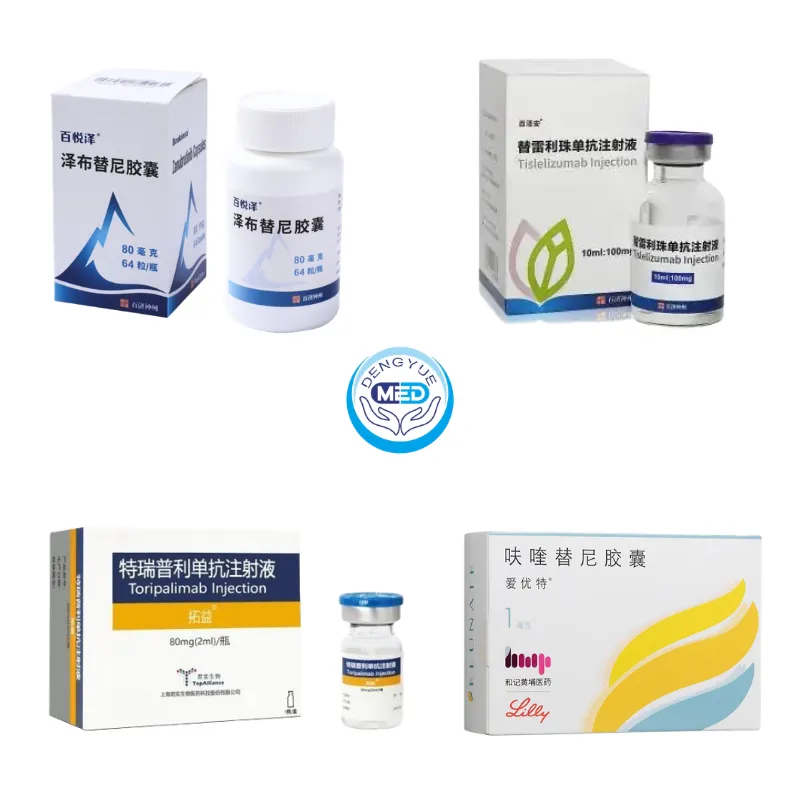
These cases show why Chinese cancer drugs are gaining global influence, with several medicines advancing from domestic approval to international markets.
4. From Bispecific Antibodies to CAR-T: Chinese Cancer Drugs Are Expanding Across Multiple Modalities
Another important development in China is the increasing diversity of cancer drug types and mechanisms of action. Research now spans several major areas, including molecularly targeted therapies, antibody-drug conjugates (ADCs), bispecific antibodies, and cell therapies.
The following Chinese-developed medicines illustrate different directions in this expanding innovation landscape:
- Ivonescimab (Yidafang): A bispecific antibody designed to target PD-1 and VEGF-related pathways, representing an approach that combines immune checkpoint inhibition with targeting of a pathway associated with tumor angiogenesis.
- Sacituzumab tirumotecan (Jiatailai): A TROP2-targeting antibody-drug conjugate (ADC) that has been described as the first TROP2 ADC approved for a lung cancer indication globally.
- Sunvozertinib (Zegfrovy): A targeted therapy for non-small cell lung cancer (NSCLC) associated with EGFR exon 20 insertion mutations. It exemplifies precision oncology approaches designed around specific genetic alterations.
- Satricabtagene autoleucel (Kailimei): Described as the world’s first approved CAR-T cell therapy for a solid tumor, it represents China’s exploration of cell therapy for cancers beyond hematological malignancies.
- Izalontamab brengitecan (Yizekang): Described as the world’s first approved bispecific ADC, it focuses on a specific clinical setting involving recurrent or metastatic nasopharyngeal carcinoma.

These examples highlight the breadth of Chinese cancer drug innovation, while international oncology conferences offer a valuable platform for showcasing and evaluating these advances.
For example, ASCO 2026 presented overall survival results from the Phase III HARMONi-6 study, which compared ivonescimab plus chemotherapy with tislelizumab plus chemotherapy in previously untreated patients with advanced squamous NSCLC.[3]
✨ The study was featured among the meeting’s late-breaking abstracts, showing how Chinese cancer drugs are gaining global influence through international scientific exchange and clinical evaluation.
5. After Approval: How Can Chinese Cancer Drugs Reach Overseas Patients?
Approval in China is only the first step toward global expansion. Broader access to Chinese innovative drugs depends on regulatory approval, reliable pharmaceutical supply chains, and integration into local healthcare systems.
1. Medicines Must Enter Their Target Markets
Different countries and regions have their own drug registration and approval requirements. Understanding local regulatory policies and preparing the necessary registration documentation are essential steps for Chinese innovative drugs seeking to expand internationally.
2. Medicines Need Reliable Cross-Border Supply Chains
From supplier qualification and pharmaceutical documentation to import customs clearance, storage, transportation, and logistics tracking, every stage can affect whether a medicine reaches its intended market reliably.
As a China pharmaceutical exporter with experience in pharmaceutical import and export, DengYueMed supports supply-chain connections between Chinese medicines and international markets, helping address the operational requirements involved in cross-border pharmaceutical supply.
Reliable supply-chain services are an important part of international pharmaceutical distribution, alongside regulatory compliance, product documentation, and coordination with qualified partners in destination markets.
3. Medicines Must Be Integrated into Local Healthcare Systems
Even after a medicine receives marketing authorization, several factors influence whether patients can access it. These include pricing, reimbursement arrangements, hospital capabilities, and the availability of the medicine through local distribution channels.
Effective access therefore requires more than regulatory approval. Pharmaceutical supply must also connect with local healthcare systems and their practical requirements.
Conclusion: Chinese Cancer Drugs Are Entering a New Phase of Global Expansion
Chinese cancer drugs are gaining global influence through advances in drug development, clinical research, and overseas market access—not just rising research output and domestic approvals.
Since China’s 2015 regulatory reforms, stronger R&D capabilities, overseas approvals, and growing presence at international scientific meetings have made China an increasingly important player in global oncology innovation.
The global influence of Chinese cancer drugs will depend not only on overseas expansion, but also on strong clinical evidence, international market access, and the ability to bring innovative treatments to more patients.

Connecting Chinese Medicine with Patients Worldwide
FAQ about Chinese Cancer Drugs Are Gaining Global Influence
What are Chinese cancer drugs?
Chinese cancer drugs are cancer treatments developed or manufactured by pharmaceutical companies in China, including targeted therapies, immunotherapies, antibody-drug conjugates (ADCs), and cell therapies.
Are Chinese cancer drugs approved in other countries?
Yes, several Chinese-developed cancer drugs have received regulatory approval in markets such as the United States and the European Union, including toripalimab, zanubrutinib, and fruquintinib.
What types of cancer drugs are developed in China?
China’s oncology pipeline includes targeted therapies, PD-1 inhibitors, bispecific antibodies, antibody-drug conjugates (ADCs), and CAR-T cell therapies.
How has China improved cancer drug development?
Since 2015, China’s drug regulatory reforms, evolving technical guidelines, and improved review procedures have supported the development and evaluation of innovative cancer medicines.
How can Chinese cancer drugs reach international markets?
Chinese cancer drugs require local regulatory approval, while DengYueMed supports cross-border pharmaceutical supply chains connecting Chinese medicines with global markets.
References
[1] Xu Z, et al. China’s Growing Importance in Global Cancer Medicines. JCO Global Oncology, 2026. https://ascopubs.org/doi/10.1200/GO-25-00524
[2] Tang L, et al. Anti-tumor drug supervision in China from 2010 to 2024: the evolution and prospect of drug review standards. Cancer Communications. 2024;45(1):63–67. https://doi.org/10.1002/cac2.12630
[3] American Society of Clinical Oncology. HARMONi-6: Overall survival results of the Phase III trial. https://www.asco.org/abstracts-presentations/267303