
What Are Degrader-Antibody Conjugates (DACs)? Next-Generation ADC Technology and the Global Pipeline Landscape
The excitement surrounding antibody-drug conjugates (ADCs) has not yet faded, but a new frontier is already capturing the attention of global pharmaceutical giants. 🔥
Recently, Johnson & Johnson announced a $1 billion acquisition of Firefly Bio-related assets, once again bringing Degrader-Antibody Conjugates (DACs) into the spotlight. Even before J&J’s move, DACs had already emerged as one of the most closely watched areas in oncology drug development.
So, what are Degrader-Antibody Conjugates (DACs), and why are they generating so much excitement across the biopharmaceutical industry?
🐱🏍 Although DACs remain at a very early stage of development, with only a handful of programs reaching clinical trials, the sector has already attracted more than $10 billion in partnerships, licensing deals, and acquisitions.
In this article, HongKong DengYue Medicine explores some of the most important questions in this emerging field: 🔽
- What Are Degrader-Antibody Conjugates (DACs)?
- Why are they considered the next generation of ADC technology?
- How is the global DAC pipeline landscape evolving?
What Are Degrader-Antibody Conjugates (DACs)?
DACs (Degrader-Antibody Conjugates) are a novel class of therapeutics that combine antibody-drug conjugate technology with targeted protein degradation (TPD).
Structurally, DACs closely resemble traditional ADCs and consist of three major components:
- Antibody
- Linker
- Payload
The key difference lies in the payload.
Traditional ADCs typically utilize cytotoxic payloads such as:
- Microtubule inhibitors
- DNA-damaging agents
- Topoisomerase inhibitors
In contrast, DAC payloads are protein degraders, including:
- PROTAC-based degraders
- Molecular glue degraders
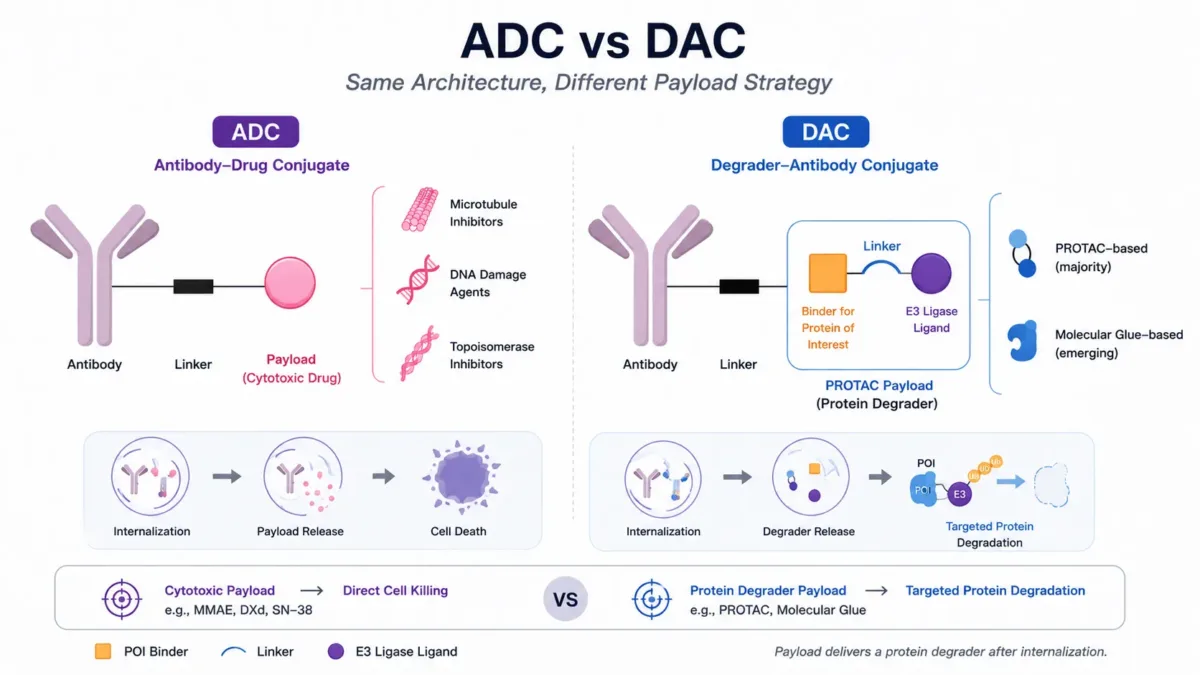
As a result, DAC drugs do not primarily function by directly killing tumor cells through cytotoxicity. Instead, they precisely deliver protein degraders into targeted cells, where disease-driving proteins can be selectively eliminated.
In simple terms: ADCs aim to kill cancer cells, while DACs aim to eliminate the proteins that drive disease progression.
This fundamental difference is one of the reasons DACs are considered a potentially transformative therapeutic platform.
Why Are DACs Considered the Next Generation of ADC Technology?
Over the past decade, ADCs have demonstrated the commercial and clinical value of precision drug delivery. At the same time, targeted protein degradation (TPD) has emerged as one of the most promising areas in drug discovery.
The emergence of DACs represents the convergence of these two breakthrough technologies. From this perspective, understanding this unique combination is another way to answer the question: What Are Degrader-Antibody Conjugates (DACs)?
The mechanism of action typically involves the following steps: 👇
- The antibody recognizes a tumor-associated cell surface antigen.
- The DAC is internalized into the target cell.
- The linker releases the degrader payload.
- The degrader induces selective protein degradation.
- Tumor growth is suppressed or cancer cells are eliminated.
✅ Compared with conventional therapies, DACs may offer several theoretical advantages:
- Improved delivery of protein degraders to diseased tissues
- Reduced systemic exposure and off-target toxicity
- Potential to overcome drug resistance mechanisms
- Expanded access to previously undruggable targets
- A shift from protein inhibition to protein elimination
For these reasons, many researchers view DACs as one of the most promising next-generation ADC technologies currently under development.
Why Are Global Pharmaceutical Companies Investing in DACs?
Despite being in the early stages of development, DACs have already attracted significant industry attention.
According to publicly available information, more than ten DAC-related transactions have been completed globally, with total deal values exceeding $10 billion.
Major transactions include:
- Johnson & Johnson’s acquisition of Firefly Bio-related DAC assets
- Roche’s DAC collaboration with C4 Therapeutics
- BMS’s licensing agreement with Orum Therapeutics for ORM-6151
- Multiple investments in platforms combining ADC and TPD technologies
These deals reflect growing industry confidence in next-generation cancer treatment platforms.
For large pharmaceutical companies, ADC development is becoming increasingly competitive. DACs, meanwhile, represent a potential new technological frontier.
The companies that successfully validate the clinical value of DAC drugs may secure a significant competitive advantage over the next decade.
Global DAC Pipeline Landscape: Still in the Early Stages
Beyond the question of What Are Degrader-Antibody Conjugates (DACs), industry attention is increasingly shifting toward the pace of clinical development and the evolution of the global DAC pipeline landscape.
Although investor enthusiasm continues to grow, the overall DAC pipeline landscape remains relatively immature.
Current estimates suggest that more than 70 active DAC programs are under development worldwide. However, the vast majority remain in preclinical stages, with only a small number advancing into human clinical trials.
The most actively pursued targets include:
- GSPT1
- HER2
- CD33
- CD123
- PSMA
- B7-H3
- CD38
🎯 Among these, GSPT1 has emerged as one of the most important targets in protein degradation therapeutics.
Many DAC developers utilize molecular glue degraders as payloads, and GSPT1 remains one of the most validated molecular glue degradation targets available today.
From an indication perspective, current DAC development efforts are largely focused on:
- Acute Myeloid Leukemia (AML)
- Myelodysplastic Syndromes (MDS)
- Multiple Myeloma (MM)
- Breast Cancer
- Gastric Cancer
- Prostate Cancer
- Small Cell Lung Cancer (SCLC)
At present, oncology remains the dominant area of application for DAC drugs.
Leading DAC Companies and Key Pipeline Programs
When discussing What Are Degrader-Antibody Conjugates (DACs) and their commercial potential, Orum Therapeutics is often cited as one of the most influential innovators in the field.
Its lead program, ORM-6151, is among the most closely watched DAC candidates globally.
The therapy combines:
- A CD33-targeting antibody
- A GSPT1 degrader payload
The program is being developed primarily for AML and MDS.
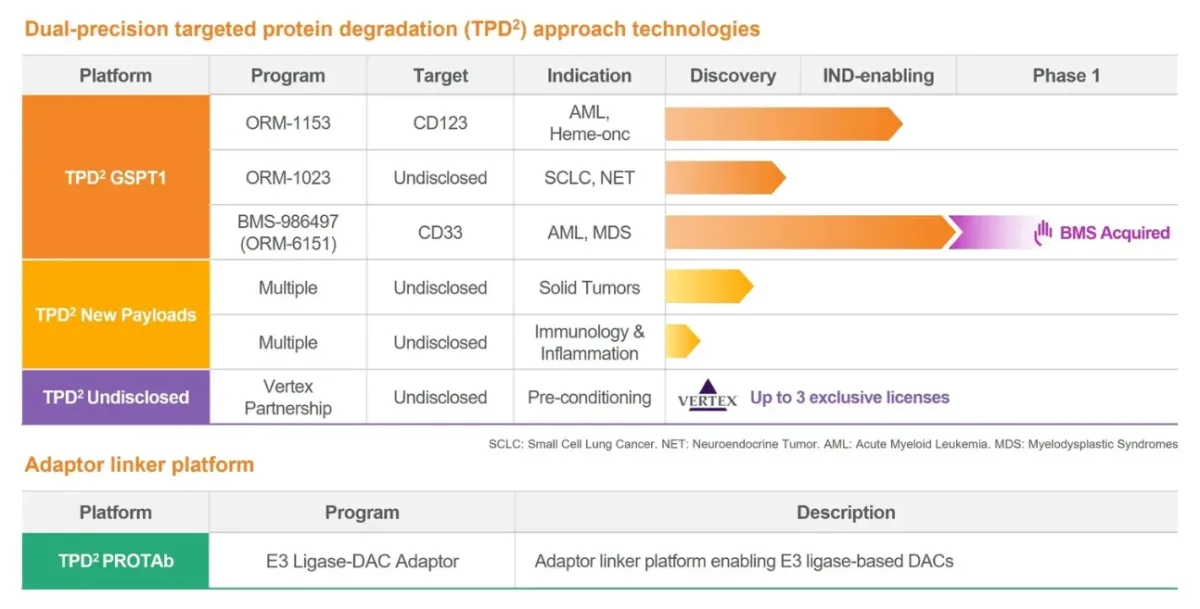
In 2024, BMS secured rights to ORM-6151 through a strategic partnership, further increasing industry interest in DAC technology.
Meanwhile, Roche continues to expand its DAC efforts through collaborations with C4 Therapeutics, focusing on targets such as HER2 and B7-H4. These programs are primarily intended for solid tumors including breast cancer and gastric cancer.
Other companies active in the field include:
- Prelude Therapeutics
- Vertex Pharmaceuticals
- Astellas Pharma
How Is China’s DAC Drug Industry Developing?
China is rapidly becoming an important contributor to the global DAC ecosystem.
Today, more than 30 DAC programs are being developed by Chinese companies, representing a significant portion of the global pipeline.
👉 Key players include:
- BeOne Medicines
- Jiangsu Hengrui Pharmaceuticals
- Medilink Therapeutics
- Kangpu Biopharmaceuticals
- Shanghai Helioson Pharmaceutical
- CSPC Pharmaceutical
- HealZen Therapeutics
👉 The primary targets pursued by Chinese DAC developers include:
- CD123
- CD33
- CD38
- HER2
- GPC3
- B7-H3
One of the most notable programs is HDZ-C123A from HealZen Therapeutics. It is currently being developed for AML.
The product combines:
- A CD123-targeting antibody
- A GSPT1 degrader payload
Importantly, the program has already enabled one of China’s earliest international DAC licensing collaborations, highlighting the growing competitiveness of Chinese biotechnology companies in next-generation ADC technology.
Meanwhile, ADC-2419 from CSPC Biologics and DAC-002 from Shanghai Helioson Pharmaceutical continue to advance through preclinical development.
What Challenges Do DACs Face?
Although DACs offer significant promise, substantial challenges remain before commercial success can be achieved.
1️⃣ Drug Delivery Challenges
Whether degrader payloads can be efficiently released and remain active after cellular internalization remains a critical question.
2️⃣ Safety Challenges
Because protein degraders operate through unique biological mechanisms, minimizing off-target degradation and systemic toxicity remains a major concern.
3️⃣ Linker Technology Challenges
Linker stability and payload release efficiency directly affect both efficacy and safety.
4️⃣ Clinical Validation Challenges
The field still lacks robust human clinical data.
The first wave of clinical results will likely determine whether DAC drugs can fulfill their considerable promise.
Conclusion: Will DACs Become the Next ADC Success Story?
After understanding what are degrader-antibody conjugates (DACs) and examining the current DAC pipeline landscape, it becomes clear that the field is at a stage similar to where ADCs stood a decade ago.
On one hand, DACs combine the precision delivery capabilities of ADCs with the unique therapeutic potential of targeted protein degradation. On the other hand, the technology remains largely unproven in clinical settings.
Over the next three to five years, key clinical readouts will determine whether DACs can truly fulfill expectations as the next generation of ADC technology.
Global pharmaceutical distributor DengYueMed will continue to monitor developments in DACs, ADCs, PROTACs, bispecific antibodies, and other cutting-edge oncology therapies, delivering timely industry insights to healthcare professionals and patients worldwide.
FAQ about What Are Degrader-Antibody Conjugates (DACs)
What Are Degrader-Antibody Conjugates (DACs)?
Degrader-Antibody Conjugates (DACs) are a new class of therapeutics that combine antibody-drug conjugates (ADCs) with targeted protein degradation technology. They are designed to selectively deliver protein degraders to diseased cells and eliminate disease-driving proteins.
How Do DAC Drugs Work?
DAC drugs use antibodies to target specific cells and deliver degrader payloads inside them. Once released, these degraders trigger the destruction of target proteins through the cell’s natural protein degradation machinery.
What Is the Difference Between DACs and ADCs?
The main difference is the payload. Traditional antibody-drug conjugates (ADCs) carry cytotoxic drugs to kill cancer cells, while Degrader-Antibody Conjugates (DACs) carry protein degraders that eliminate disease-causing proteins.
Why Are Pharmaceutical Companies Investing in DAC Technology?
Many researchers view DACs as a potential next-generation ADC platform because they combine precision targeting with targeted protein degradation. This approach may improve efficacy, reduce toxicity, and expand access to previously difficult-to-drug targets.