

Ciprocopan Approved in China as the World’s First Once-Daily Oral CFB Inhibitor for PNH
Ciprocopan approved in China as the world’s first once-daily oral Complement Factor B (CFB) inhibitor, bringing a new oral treatment option for patients with paroxysmal nocturnal hemoglobinuria (PNH).
On July 23, 2026, China’s National Medical Products Administration (NMPA) approved Haisco’s Ciprocopan Succinate Tablets for adult patients with paroxysmal nocturnal hemoglobinuria (PNH) who have not previously received complement inhibitor therapy.
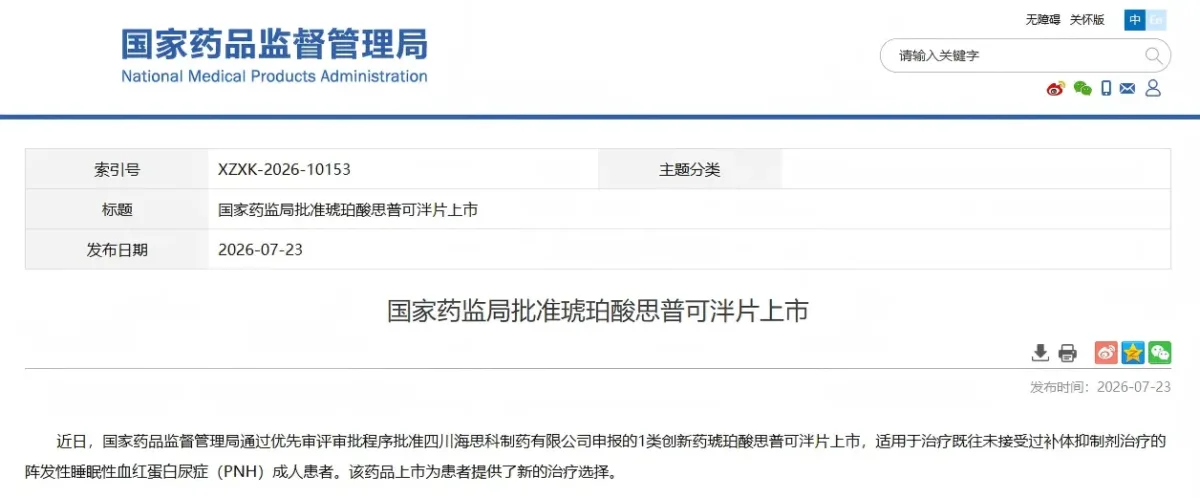
Approved through the priority review pathway, Ciprocopan approved in China represents not only the world’s first once-daily oral CFB inhibitor but also the second domestically developed CFB inhibitor approved in China, marking another significant milestone in China’s complement-targeted innovation.
In this article, China pharmaceutical wholesaler DengYueMed explores Ciprocopan’s mechanism of action, Phase III clinical results, and clinical value for PNH treatment.
What Is Ciprocopan?
Ciprocopan (development code: HSK39297) is an orally administered small-molecule Complement Factor B (CFB) inhibitor developed by Haisco Pharmaceutical Group.
By inhibiting Complement Factor B (FB), Ciprocopan blocks the alternative complement pathway and reduces abnormal complement activation. Its ability to control C3-mediated extravascular hemolysis makes it a promising innovation for the treatment of paroxysmal nocturnal hemoglobinuria (PNH).
Ciprocopan at a Glance
| Item | Information |
|---|---|
| Generic Name | Ciprocopan Succinate Tablets |
| Chinese Name | 琥珀酸思普可泮片 |
| Development Code | HSK39297 |
| Developer | Haisco Pharmaceutical Group |
| Drug Class | Class 1 innovative oral small-molecule drug |
| Target | Complement Factor B (CFB) |
| Mechanism of Action | Inhibits the alternative complement pathway and blocks complement amplification |
| Administration | Once-daily oral dosing |
| Approval Date | July 23, 2026 |
| Approved By | National Medical Products Administration (NMPA), China |
| Approved Indication | Adult PNH patients who have not previously received complement inhibitor therapy |
| Key Advantage | World’s first once-daily oral CFB inhibitor capable of controlling both intravascular and extravascular hemolysis while improving anemia and reducing transfusion requirements |
Why Does PNH Need New Treatment Options?
Paroxysmal nocturnal hemoglobinuria (PNH) is a rare, chronic, life-threatening acquired hematopoietic stem cell disorder.
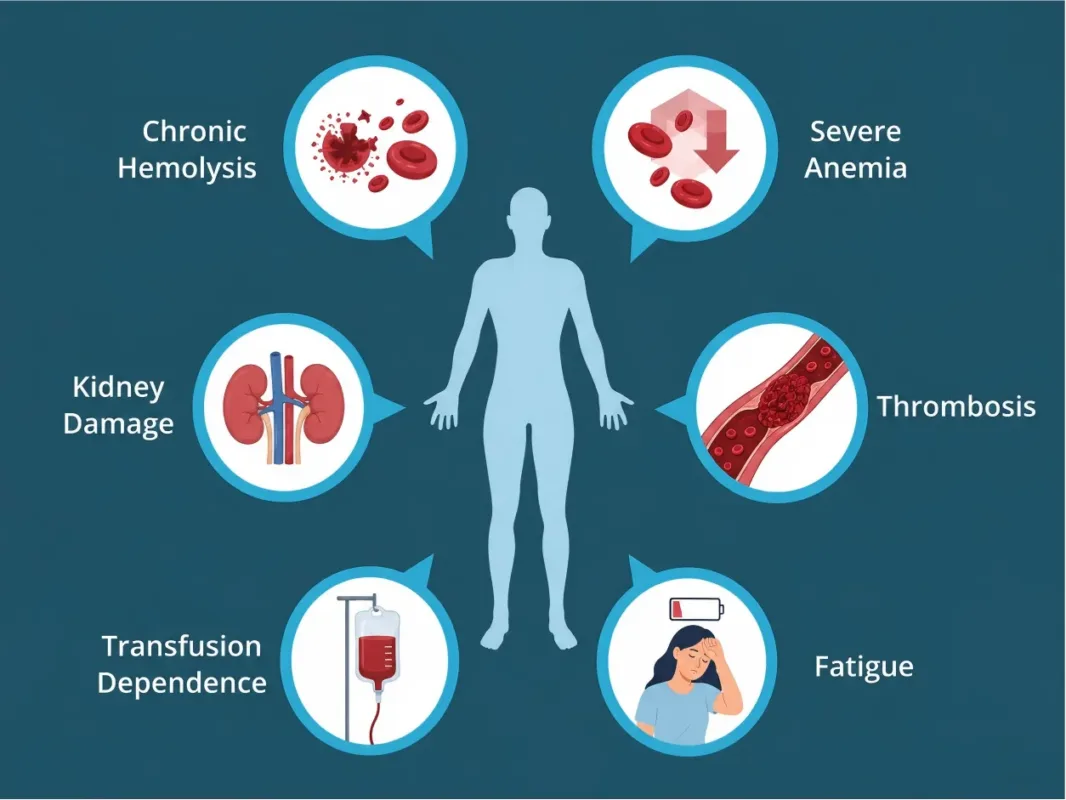
Persistent complement activation may lead to:
- Chronic hemolysis
- Severe anemia
- Thrombosis
- Fatigue
- Transfusion dependence
- Kidney impairment
Although C5 inhibitors such as eculizumab have significantly improved PNH management, many patients continue to experience:
- Persistent anemia
- C3-mediated extravascular hemolysis
- Long-term intravenous infusions
- Frequent dosing schedules
As a result, novel therapies targeting the alternative complement pathway with convenient oral administration have become a major focus of global drug development.
Phase III Clinical Studies: Ciprocopan Demonstrates Superior Efficacy to Eculizumab
For PNH, Ciprocopan completed two Phase III clinical studies covering:
- Treatment-naïve PNH patients
- Previously treated patients with persistent anemia despite stable C5 inhibitor therapy
Both studies were selected for presentation at the 2026 European Hematology Association (EHA) Congress.
Study in Treatment-Naïve Patients
Among patients who had not previously received complement inhibitor therapy, Ciprocopan approved in China was supported by strong Phase III clinical evidence demonstrating superiority over eculizumab.
Key findings included:
- Hemoglobin response rate significantly higher than eculizumab (59.5% vs. 8.3%)
- Significantly more patients achieved Hb ≥120 g/L during Weeks 18-24
- The vast majority became transfusion independent
- Reticulocyte counts decreased substantially
- Fatigue scores improved significantly
- No risk of C3 deposition-related extravascular hemolysis was observed
Study in Previously Treated Patients
Among patients who remained anemic despite stable C5 inhibitor treatment, switching to Ciprocopan resulted in:
- Sustained increases in hemoglobin
- Most patients achieving transfusion independence
- Hb ≥120 g/L exceeding the predefined threshold during Weeks 18-24
- Reduction of red blood cell C3 deposition from 9.31% to 0.19%
- Effective elimination of residual C3 deposition following C5 inhibitor therapy
- Significant improvement in fatigue symptoms
These findings suggest that Ciprocopan can effectively control both intravascular and extravascular hemolysis.
Favorable Safety Profile
Across both Phase III studies:
- Most adverse events were mild to moderate.
- No adverse events led to dose reduction.
- No patients discontinued treatment because of drug-related adverse events.
- Overall tolerability was favorable.
Clinical benefits were consistently observed across different age groups, sexes, disease durations, and baseline hemoglobin levels.
Once-Daily Oral Dosing Improves Long-Term Treatment Convenience
Currently approved CFB inhibitors include:
| Drug | Dosing | Developer | Approved Markets |
|---|---|---|---|
| Iptacopan | Twice daily (oral) | Novartis | United States, China, and others |
| Lanoracopan | Twice daily (oral) | Createrna | China |
| Ciprocopan | Once daily (oral) | Haisco | China |
Compared with existing twice-daily oral therapies, Ciprocopan approved in China offers the convenience of once-daily dosing, which may improve long-term treatment adherence while reducing medication burden.
What Other Indications Are Being Developed for Ciprocopan?
Beyond PNH, Haisco is also evaluating Ciprocopan for several complement-mediated diseases, including:
- Lupus nephritis (Phase II)
- Primary IgA nephropathy (Phase III)
Among them, the IgA nephropathy indication has been granted Breakthrough Therapy Designation by China’s Center for Drug Evaluation (CDE).
As complement-targeted therapies continue to evolve, Ciprocopan approved in China may pave the way for broader applications across multiple complement-mediated diseases.
A New Milestone for China’s Complement Therapeutics
The approval of Ciprocopan represents several important milestones:
- World’s first once-daily oral CFB inhibitor
- China’s second domestically developed approved CFB inhibitor
- A new oral treatment option for treatment-naïve PNH patients
- Potential to improve anemia, reduce transfusion dependence, and minimize extravascular hemolysis
- Demonstrates China’s growing capabilities in complement-targeted drug innovation
As more complement-targeted therapies advance through clinical development and commercialization, patients with PNH, IgA nephropathy, lupus nephritis, and other complement-mediated diseases are expected to benefit from increasingly precise treatment options.
Ciprocopan approved in China also highlights the rapid progress of China’s innovative pharmaceutical industry in rare disease therapeutics.
Conclusion
The fact that Ciprocopan approved in China represents more than the launch of a new therapy. It provides adult patients with PNH who have not previously received complement inhibitor therapy with a convenient oral treatment option while marking another important milestone in China’s innovation in complement-targeted medicines.
As complement-based therapies continue to evolve, the treatment landscape for PNH, IgA nephropathy, lupus nephritis, and other complement-mediated diseases is expected to expand further.
China pharmaceutical wholesaler DengYueMed continues to track innovative drug development and regulatory approvals, providing the latest pharmaceutical insights and supporting global partners with cross-border pharmaceutical distribution and supply chain services.
👉 Contact us to learn more about innovative medicines from China and our global pharmaceutical sourcing and distribution solutions.
FAQ about Ciprocopan Approved in China
What is Ciprocopan?
Ciprocopan is an oral complement factor B (CFB) inhibitor developed for the treatment of paroxysmal nocturnal hemoglobinuria (PNH). It helps reduce abnormal complement activation and improve disease control.
What is Ciprocopan approved for in China?
In China, Ciprocopan is approved for the treatment of adult patients with paroxysmal nocturnal hemoglobinuria (PNH) who have not previously received complement inhibitor therapy.
How does Ciprocopan work?
Ciprocopan selectively inhibits complement factor B in the alternative complement pathway, reducing complement-mediated red blood cell destruction and hemolysis.
What are the potential benefits of Ciprocopan for PNH patients?
Clinical studies suggest Ciprocopan may reduce hemolysis, improve hemoglobin levels, decrease transfusion needs, and help manage PNH symptoms.
Why is Ciprocopan’s approval important?
Its approval provides a new oral treatment option for PNH and represents continued progress in complement-targeted therapies for rare blood disorders.