
Tinengotinib Approved for Cholangiocarcinoma in China, Addressing FGFR Inhibitor Resistance
Tinengotinib approved for cholangiocarcinoma marks an important advance for patients with FGFR2 fusion or rearrangement-positive disease who have progressed after FGFR inhibitor therapy. As a China-developed multi-target kinase inhibitor, it is the first globally approved treatment specifically for this patient population.
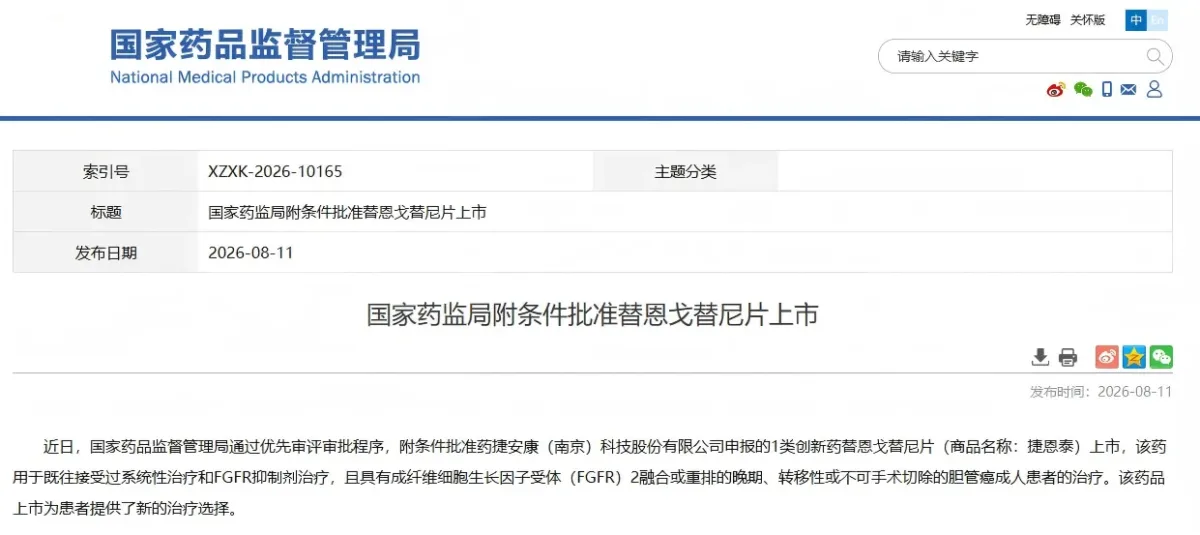
On August 4, Tinengotinib tablets were approved by the NMPA for adult patients with advanced, metastatic, or unresectable cholangiocarcinoma with FGFR2 fusions or rearrangements who have previously received systemic therapy and an FGFR inhibitor.
In this article, DengYueMed introduces the approved indication, mechanism of action, and clinical research data for Tinengotinib, and discusses its potential value in treating cholangiocarcinoma after FGFR inhibitor resistance.
What Is Tinengotinib?
Tinengotinib is the first proprietary innovative drug developed by TransThera Sciences to receive marketing approval. It is also the first globally approved treatment specifically for patients with cholangiocarcinoma who have progressed after FGFR inhibitor therapy.
For patients with FGFR2 fusion or rearrangement-positive cholangiocarcinoma, the current approval mainly targets patients whose disease has progressed after treatment with an FGFR inhibitor, providing another treatment option at this stage of the disease.
Tinengotinib: Key Information at a Glance
| Item | Details |
|---|---|
| Generic name | Tinengotinib |
| Brand name | Yochanra®/捷恩泰® |
| Dosage form | Tablet |
| Drug type | Multi-target small-molecule kinase inhibitor |
| Developer | TransThera Sciences |
| Regulatory authority | National Medical Products Administration (NMPA), China |
| Approval date | August 4, 2026 |
| Approved indication | Adult patients with advanced, metastatic, or unresectable cholangiocarcinoma with FGFR2 fusions or rearrangements who have previously received systemic therapy and an FGFR inhibitor |
| Main pathways | FGFR/VEGFR, JAK, Aurora, and others |
| Main therapeutic area | Oncology, cholangiocarcinoma |
| FDA designations | Previously granted Fast Track and Orphan Drug designations by the U.S. FDA |
| EMA designation | Previously granted Orphan Medicinal Product designation for biliary tract cancer by the EMA |
Why Does FGFR Inhibitor Treatment Lead to Resistance?
FGFR is an important member of the fibroblast growth factor receptor family. In some patients with cholangiocarcinoma, FGFR2 fusions or rearrangements can lead to abnormal FGFR signaling and promote tumor growth, making FGFR an important target for precision therapy.
FGFR inhibitors can provide targeted treatment for patients with FGFR2-altered cholangiocarcinoma, but some patients may develop acquired resistance after treatment.
Resistance may be associated with: 🔽
- Secondary FGFR2 mutations: Changes at key sites such as N550 and V565 may affect drug binding to the target.
- Multiple resistance mutations: Some patients may develop multiple FGFR2 resistance mutations, making the mechanisms of resistance more complex.
Therefore, developing treatment strategies that can address different resistance mechanisms remains an important research direction in FGFR-targeted therapy.
How Can Tinengotinib Address FGFR Inhibitor Resistance?
One of the development strategies for Tinengotinib is to investigate its antitumor activity in patients previously treated with FGFR inhibitors.
🎯 Unlike treatment strategies that focus on a single target, Tinengotinib can act on multiple relevant pathways, including FGFR/VEGFR, JAK, and Aurora.
FGFR inhibitor resistance may involve different FGFR2 mutations as well as other changes in tumor biology. Therefore, drug development for complex resistance states needs to consider multiple molecular mechanisms.
Tinengotinib approved for cholangiocarcinoma provides a new treatment option for patients whose disease has progressed after FGFR inhibitor treatment, reflecting the potential therapeutic value of its multi-target mechanism of action.
It is important to note that the drug’s activity against different resistance mutations and potential patient benefit should be assessed based on clinical data and molecular characteristics, as responses may vary among patients.
Clinical Data Supporting Tinengotinib Approved for Cholangiocarcinoma
The Chinese approval of Tinengotinib approved for cholangiocarcinoma was primarily supported by a Chinese multicenter, open-label, single-arm, pivotal Phase II clinical study.
As of December 27, 2025, the median follow-up was 12 months. The study enrolled 50 patients with advanced cholangiocarcinoma, all of whom had previously received at least one line of chemotherapy and an FGFR inhibitor.
According to blinded independent central review (BICR), the results of Tinengotinib treatment were as follows:
| Clinical Endpoint | Study Result |
|---|---|
| Objective response rate (ORR) | 28.0% |
| Confirmed partial response (PR) | 14 patients |
| Disease control rate (DCR) | 82.0% |
| Median duration of response (DoR) | 8.5 months |
| Median progression-free survival (PFS) | 6.0 months |
| Median overall survival (OS) | 20.7 months |
The study results indicate that Tinengotinib demonstrated antitumor activity in patients with advanced cholangiocarcinoma who had previously received an FGFR inhibitor.
An objective response rate of 28.0% means that some patients experienced tumor shrinkage meeting predefined response criteria, while the disease control rate of 82.0% indicates that some patients achieved either tumor response or stable disease.
However, this single-arm Phase II study cannot be directly compared with trials of other drugs. Treatment outcomes may also vary based on prior treatment, disease burden, molecular characteristics, and overall health.
What Does Tinengotinib Approved for Cholangiocarcinoma Mean for Treatment?
For patients with FGFR2 fusion or rearrangement-positive cholangiocarcinoma, FGFR inhibitors have changed the treatment landscape and provided an important targeted treatment option for some patients.
However, as the use of FGFR-targeted therapy increases, resistance has become an important challenge in the further development of precision treatment.
Tinengotinib approved for cholangiocarcinoma represents an important step in extending treatment options to patients whose disease has progressed after prior FGFR inhibitor therapy.
In other words, precision treatment for cholangiocarcinoma is evolving from identifying actionable targets, to targeting those alterations, and now toward addressing resistance after targeted therapy.
For patients, this means that treatment options for FGFR2-altered cholangiocarcinoma are becoming increasingly differentiated. For drug development, it reflects a broader shift in precision oncology from simply identifying new targets toward addressing resistance to existing targeted therapies.
What Other Clinical Research Directions Are Being Explored for Tinengotinib?
The approval of Tinengotinib for cholangiocarcinoma is not the endpoint of its clinical development.
Publicly available information indicates that further studies of Tinengotinib in cholangiocarcinoma are ongoing, including global multicenter Phase III studies and related confirmatory studies in China.
At the same time, researchers are exploring the potential therapeutic value of Tinengotinib in other solid tumors, including prostate cancer, breast cancer, and liver cancer.
These studies are at different stages of clinical development, and potential indications under investigation should not be considered approved uses.
As more clinical data become available, the value of Tinengotinib across different tumor types and treatment settings will require further validation.
Conclusion
Tinengotinib approved for cholangiocarcinoma in China provides a new treatment option for adults with specific FGFR2 fusion- or rearrangement-positive advanced, metastatic, or unresectable cholangiocarcinoma who have previously received systemic therapy and an FGFR inhibitor.
As FGFR inhibitor resistance remains a key challenge in precision treatment, Tinengotinib represents a further step toward addressing treatment needs after targeted therapy resistance. With advances in molecular testing and targeted therapies, treatment strategies for FGFR-altered cholangiocarcinoma may continue to evolve.
DengYueMed, a Chinese pharmaceutical wholesaler, will continue to monitor developments in Chinese innovative drugs and oncology treatments, providing global healthcare and pharmaceutical professionals with information on China pharmaceuticals.