
Felzartamab Approved for Multiple Myeloma: Another CD38 Monoclonal Antibody Enters the Chinese Market
Felzartamab is a CD38-targeting human monoclonal antibody, with Felzartamab approved for multiple myeloma in China and under clinical development for IgA nephropathy, primary membranous nephropathy, and kidney transplant antibody-mediated rejection.
Recently, information published on the official website of the NMPA showed that Felzartamab was approved in China for the treatment of adult patients with multiple myeloma who have received at least one prior line of therapy, in combination with lenalidomide and dexamethasone.
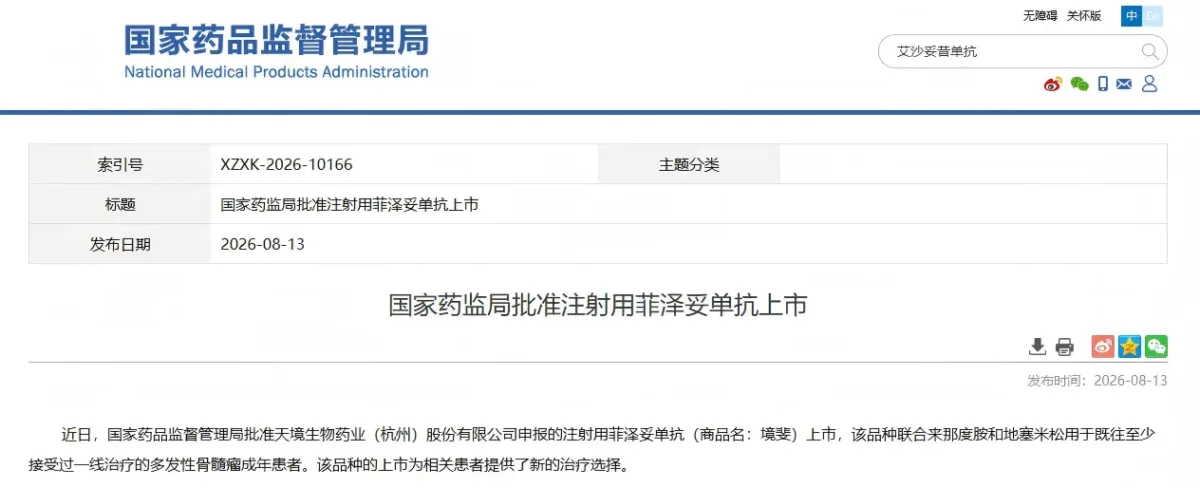
Felzartamab is the third CD38 monoclonal antibody, following daratumumab and isatuximab, to receive approval for multiple myeloma treatment, while its clinical development also extends into multiple immune-mediated diseases.
DengYueMed will provide an overview of the Felzartamab China approval, mechanism of action, clinical development, and ongoing indications, providing information for readers interested in multiple myeloma treatment and innovative drug development.
What Is Felzartamab?
Felzartamab is a CD38-targeted human monoclonal antibody that works by recognizing CD38-positive cells and depleting plasma cells.
CD38 is a protein expressed on the surface of plasma cells, plasmablasts, and other cell types. In multiple myeloma, abnormal plasma cells typically express high levels of CD38, making CD38 an important therapeutic target in multiple myeloma treatment.
Because some immune-mediated diseases are associated with abnormal plasma cells and pathogenic antibodies, this mechanism also provides a scientific basis for the clinical development of Felzartamab in other disease areas.
Felzartamab Quick Facts
| Item | Information |
|---|---|
| Generic Name | Felzartamab |
| Brand Name | Jing Fei (境斐®) |
| Development Codes | TJ202 / MOR202 |
| Drug Type | Human monoclonal antibody |
| Target | CD38 |
| Dosage Form | Injection |
| Primary Mechanism | Targets CD38-positive plasma cells |
| Approved Indication | Multiple myeloma |
| Approval Authority | National Medical Products Administration (NMPA), China |
| Approval Date | August 11, 2026 |
| First Published by NMPA | August 12, 2026 |
| Other Development Areas | IgA nephropathy, primary membranous nephropathy, antibody-mediated rejection following kidney transplantation, and other immune-mediated diseases |
| Original Developer | MorphoSys |
| Greater China Development and Commercialization Rights | TJ Biopharma |
| Current Global Rights Holder | Biogen |
Another CD38 Monoclonal Antibody Enters the Chinese Market
Before Felzartamab approved for multiple myeloma, two major CD38 monoclonal antibodies had already been approved globally for multiple myeloma treatment: 🔽
- Daratumumab: first approved in 2015; approved in China in 2019
- Isatuximab: first approved in 2020; approved in China in 2025
The introduction of these two therapies helped establish CD38-targeted therapy for multiple myeloma as an important treatment strategy.
With the approval of Felzartamab, the number of approved CD38 monoclonal antibodies for multiple myeloma globally increases to three.
For newer CD38 antibodies entering the market, clinical and commercial attention extends beyond efficacy to factors such as infusion time, infusion-related reactions, treatment convenience, and combination potential with other anti-myeloma therapies.
Felzartamab Clinical Development in Multiple Myeloma
Felzartamab has been evaluated in multiple clinical studies in multiple myeloma, including an international multicenter Phase III study and an earlier Phase I/IIa study.
These Felzartamab clinical trials have primarily evaluated its safety, tolerability, efficacy in combination regimens, and infusion characteristics.
Felzartamab Clinical Trial Overview
| Study Phase | Study Population / Regimen | Main Objective | Key Findings |
|---|---|---|---|
| Phase I/IIa | 91 patients with multiple myeloma; single-agent and combination treatment | Evaluate safety, tolerability, and dosing | Infusion could be completed in approximately 30 minutes; the combination-treatment group showed a lower rate of infusion-related reactions |
| Phase III | Patients with relapsed or refractory multiple myeloma who had received at least one prior line of therapy | Felzartamab + lenalidomide + dexamethasone vs. lenalidomide + dexamethasone | Primary endpoint was progression-free survival (PFS); study completed |
Early-Stage Studies: Infusion Time and Safety
In the Phase I/IIa study, 91 patients received Felzartamab either as monotherapy or in combination with other treatments. The study showed that Felzartamab could be administered by intravenous infusion in approximately 30 minutes.
Infusion-related reactions occurred in 14 of 35 patients in the monotherapy group and 4 of 56 patients in the combination-treatment group, corresponding to 40% and 7%, respectively.
The most common Grade 3 or higher treatment-emergent adverse events included lymphopenia, neutropenia, and leukopenia. The maximum tolerated dose of Felzartamab was not reached during the study.
Phase III Study: Registrational Development
In the Phase III registrational study, Felzartamab was evaluated in combination with lenalidomide and dexamethasone, compared with lenalidomide plus dexamethasone, in patients with relapsed or refractory multiple myeloma who had received at least one prior line of therapy.
The primary endpoint was progression-free survival (PFS), with efficacy and safety also evaluated.
The completion of this study provided an important clinical basis for the subsequent registration and development of Felzartamab for multiple myeloma.
Specific efficacy and safety conclusions should be based on formally published clinical data and regulatory information.
Overall, Felzartamab approved for multiple myeloma follows development from early-stage clinical studies through a key Phase III registrational program. Its relatively short infusion time is also an important feature of its clinical development.
Significance of the Felzartamab Approval
The Felzartamab China approval adds another CD38-targeted treatment option to the multiple myeloma treatment landscape in China.
For multiple myeloma, a hematologic malignancy characterized by abnormal plasma-cell proliferation, CD38 has become a clinically validated therapeutic target.
Felzartamab approved for multiple myeloma also means that competition within the CD38 monoclonal antibody segment is expanding in the Chinese market.
At the same time, Felzartamab development is not limited to multiple myeloma. Its ongoing clinical development in several immune-mediated diseases provides opportunities for further indication expansion.
With the approval of the multiple myeloma indication in China and the consolidation of global rights, the future clinical and commercial development of this CD38-targeted antibody will continue to be closely followed.
Felzartamab Pipeline and Additional Indications
With Felzartamab approved for multiple myeloma in China, the drug is also being clinically developed for several immune-mediated diseases.
Publicly available information indicates development programs in: 🔽
- IgA nephropathy (IgAN)
- Primary membranous nephropathy (PMN)
- Antibody-mediated rejection (AMR) following kidney transplantation
- Systemic lupus erythematosus (SLE)
Several indications, including IgA nephropathy, primary membranous nephropathy, and antibody-mediated rejection, have advanced into later-stage clinical development.
This development strategy gives Felzartamab a clear multi-indication development profile. Its core mechanism—targeting CD38-positive plasma cells—provides a potential common therapeutic approach across multiple diseases involving pathogenic antibodies.
Conclusion
Felzartamab approved for multiple myeloma marks the entry of another CD38 monoclonal antibody into the Chinese market and makes Felzartamab the third CD38 monoclonal antibody approved globally for multiple myeloma treatment.
As a CD38-targeted human monoclonal antibody, Felzartamab has completed important clinical development in multiple myeloma and continues to be investigated in several immune-mediated diseases.
DengYueMed is a China-based pharmaceutical wholesaler focused on innovative medicines and the global pharmaceutical industry, providing supply and distribution services across oncology, hematology, and autoimmune diseases.