
Zeruini (Zorifertinib) – NSCLC | HongKong DengYue Medicine
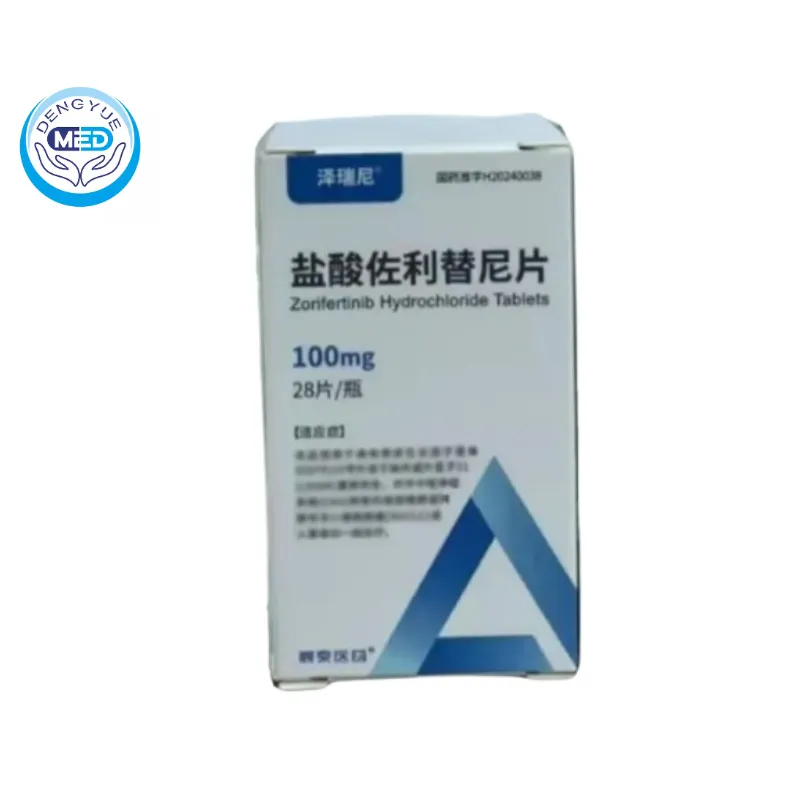
- Generic Name/Brand Name: Zorifertinib/Zeruini
- Indications: NSCLC
- Dosage Form: Tablets
- Specification: 100 mg × 28
Zorifertinib Application Scope
Zorifertinib is indicated for the first-line treatment of adult patients with locally advanced or metastatic non-small cell lung cancer (NSCLC) harboring epidermal growth factor receptor (EGFR) exon 19 deletion (Exon 19Del) or exon 21 (L858R) substitution mutations, and with central nervous system (CNS) metastases.
Zorifertinib Characteristics
-
Ingredients: Active ingredient: Zorifertinib (chemical name: (2R)-2,4-dimethylpiperazine-1-carboxylic acid [4-(3-chloro-2-fluoroanilino)-7-methoxyquinazolin-6-yl] ester). Inactive ingredients are not publicly detailed in available sources but typically include standard tablet excipients such as fillers, binders, and coatings.
-
Properties: Zorifertinib is a potent, orally active, reversible, small-molecule epidermal growth factor receptor (EGFR) tyrosine kinase inhibitor (TKI) with central nervous system (CNS) penetration. It selectively inhibits EGFR activating mutations (Exon 19Del and L858R) with IC50 values of 0.2 nM for both, and EGFR wild-type (WT) with an IC50 of 0.3 nM. It exhibits 100% blood-brain barrier penetration, enabling effective control of intracranial lesions.
-
Packaging Specification: Film-coated tablets, 100 mg per tablet. Packaged in blister packs of 28 tablets per box
-
Storage: Store in a sealed container at room temperature (below 25°C), away from light and moisture. Keep out of reach of children.
-
Expiry Date: 36 months from the date of manufacture.
-
Executive Standard: Chinese Pharmacopoeia (ChP) 2020 Edition; complies with National Medical Products Administration (NMPA) standards for chemical drugs.
-
Approval Number: National Drug Approval H20240038 (issued by NMPA, China).
-
Date of Revision: November 2024.
-
Manufacturer: Jiangsu Alpha Biopharmaceutical Co., Ltd., in collaboration with Hansoh Pharma and AstraZeneca (China) Investment Co., Ltd.
Guidelines for the Use of Zorifertinib
-
Dosage and Administration:
-
Recommended Dose: 200 mg twice daily (total 400 mg per day). Tablets should be swallowed whole with water.
-
Administration: May be taken with or without food. If a dose is missed, take it as soon as remembered unless it is within 6 hours of the next dose; do not double the dose. For patients unable to swallow tablets, disperse in water (non-carbonated) and administer via nasogastric tube if needed.
-
Missed Dose: Skip the missed dose and resume the regular schedule. Do not take extra medication to make up for the missed dose. Consult a physician if multiple doses are missed.
-
-
Adverse Reactions:
-
Common Adverse Reactions: Skin rash (any grade: ~70%; Grade ≥3: ~10%), diarrhea (any grade: ~50%; Grade ≥3: ~5%), elevated liver enzymes (ALT/AST: any grade: ~40%; Grade ≥3: ~5%), pruritus, dry skin, stomatitis, and fatigue.
-
Serious Adverse Reactions: Interstitial lung disease (ILD)/pneumonitis (rare, <1%; may be fatal—discontinue if suspected), severe cutaneous reactions (e.g., Stevens-Johnson syndrome, <1%), severe hepatotoxicity (Grade ≥3 transaminase elevation), and QT prolongation (monitor ECG in at-risk patients).
-
-
Contraindications: Hypersensitivity to zorifertinib or any excipients. Severe interstitial lung disease or history of drug-induced ILD. Concurrent use with strong CYP3A4 inducers (e.g., rifampin) that cannot be discontinued.
-
Precautions:
-
Perform EGFR mutation testing prior to initiation.
-
Monitor for ILD symptoms (e.g., dyspnea, cough); withhold and evaluate promptly.
-
Assess liver function (ALT/AST) every 2 weeks for the first 2 months, then monthly.
-
Use caution in patients with cardiac risk factors (e.g., QT prolongation); obtain baseline ECG.
-
Avoid pregnancy (use effective contraception); may cause fetal harm. Lactation discontinuation recommended.
-
Dose reduction or interruption for Grade ≥3 toxicities; permanent discontinuation for recurrent severe events.
-
Not recommended for patients without CNS metastases or EGFR mutations.
-
Zorifertinib Interactions
- Zorifertinib is metabolized primarily by CYP3A4.
-
Strong CYP3A4 Inhibitors (e.g., ketoconazole, ritonavir): May increase zorifertinib exposure; monitor for toxicity and consider dose reduction.
-
Strong CYP3A4 Inducers (e.g., rifampin, phenytoin): May decrease exposure; avoid concurrent use or increase zorifertinib dose to 300 mg twice daily if unavoidable.
-
Moderate CYP3A4 Inhibitors/Inducers: Monitor closely; adjust dose as needed.
-
Substrates of CYP3A4, CYP2C9, or P-gp: Potential interactions; monitor levels (e.g., warfarin for CYP2C9).
-
QT-Prolonging Drugs (e.g., amiodarone): Avoid if possible; monitor ECG.
-
No significant food interactions, but avoid grapefruit juice (CYP3A4 inhibitor). Consult a physician for all concurrent medications.
-
Note:
- If there is a new packaging for the drug, the new packaging shall prevail. The above information is sourced from DengYue Medicine.
- This content is for reference only. Prescription drugs must be used under a doctor’s guidance and purchased from authorized sources.
Related products
-

Adagrasib Tablets | Lung Cancer | HK DengYueMed
-
Opdivo (Nivolumab) – NSCLC | HongKong DengYue Medicine
-
Capmatinib|Non-Small Cell Lung Cancer (NSCLC)
-
Zykadia (Ceritinib) – NSCLC | HongKong DengYue Medicine
-
Zepzalca (Lurbinectedin) – NSCLC|HongKong DengYue Medicine
-
Methotrexate 2.5mg Tablets | Cancer Chemotherapy
-
Selpercatinib|Thyroid Cancer|HongKong DengYue Medicine
-
Lorbrena (Lorlatinib) – Lymphoma Kinase | HongKong DengYue Medicine
Reviews
There are no reviews yet.