
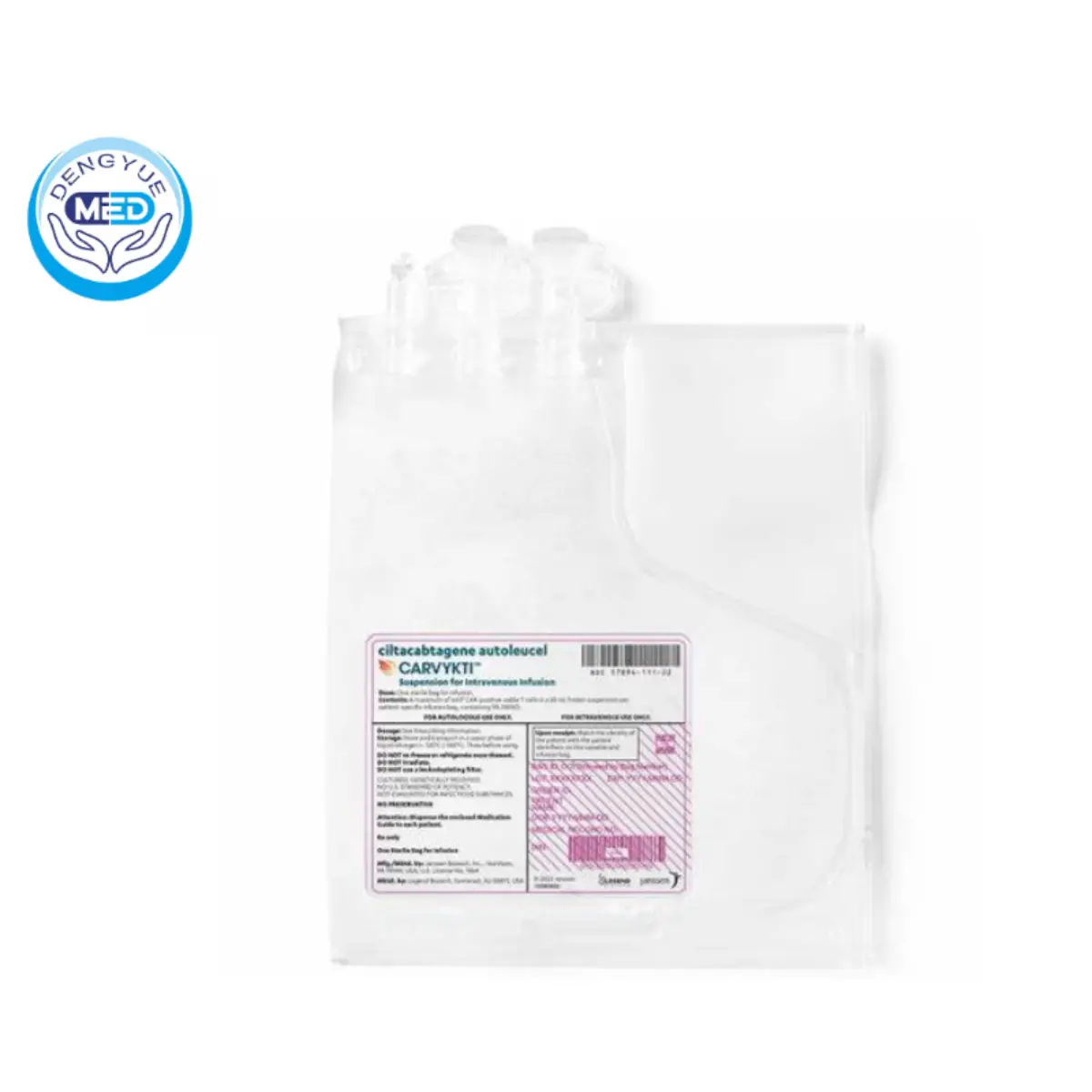
Ciltacabtagene Autoleucel|Multiple Myeloma
- Generic Name/Brand Name: Ciltacabtagene Autoleucel/Carvykti
- Indications: Multiple Myeloma
- Dosage Form: solutions
- Specification: Each product is customized for the patient and packaged in individual vials for infusion
Ciltacabtagene Autoleucel Application Scope
Ciltacabtagene Autoleucel (cilta-cel) is a chimeric antigen receptor (CAR) T-cell therapy used for the treatment of relapsed or refractory multiple myeloma (RRMM) in adult patients who have received at least 3 prior lines of therapy, including a proteasome inhibitor, an immunomodulatory agent, and an anti-CD38 monoclonal antibody. Ciltacabtagene Autoleucel is a B-cell maturation antigen (BCMA)-directed CAR T-cell therapy, designed to target and kill myeloma cells expressing BCMA.
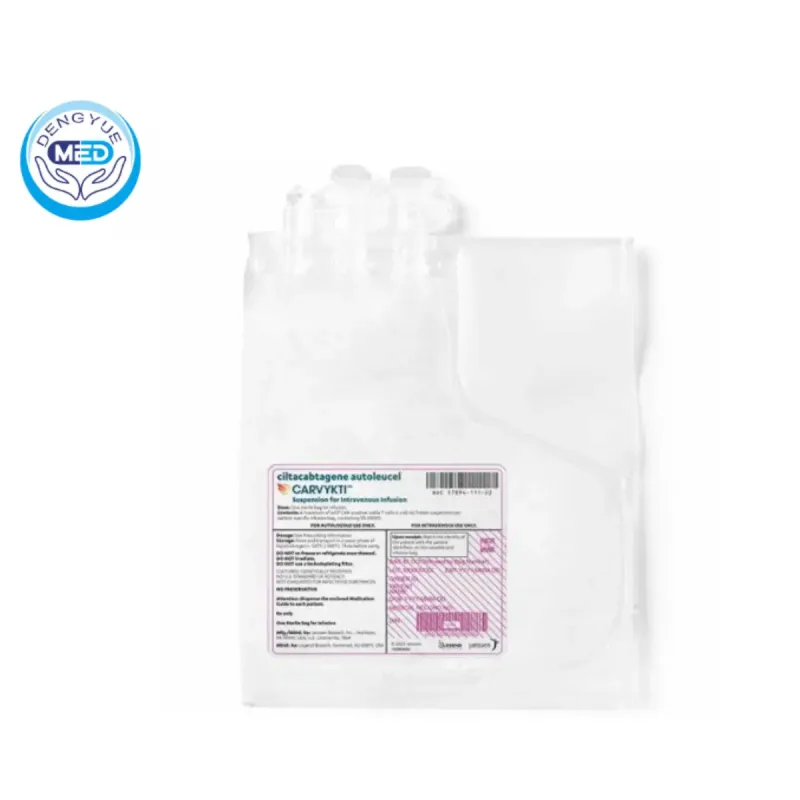
Ciltacabtagene Autoleucel /Carvykti Package Insert
Ingredients:
- Active Ingredient: Autologous T cells transduced with a lentiviral vector encoding a BCMA-specific chimeric antigen receptor (CAR).
- Excipients: None specified (autologous cell product, no additional excipients).
Properties:
- Mechanism of Action: Ciltacabtagene Autoleucel is designed to recognize and bind to BCMA, a protein highly expressed on the surface of myeloma cells, leading to T-cell activation, cytokine release, and killing of the myeloma cells.
- Formulation: This is a cell-based product that requires patient-specific collection and modification of T cells (via leukapheresis), followed by genetic modification and expansion of the T-cells in the laboratory before infusion back into the patient.
Specification:
- Strength: The final product is a suspension of modified T cells containing a specific number of CAR T-cells, as determined by the manufacturing process.
Packaging Specification:
- Packaging: Each product is customized for the patient and packaged in individual vials for infusion.
- Transport: Must be transported and stored at temperatures appropriate to preserve cell viability (usually cryopreserved at ≤-150°C).
Storage:
- Before infusion: Stored frozen in a cryopreserved state at ≤-150°C.
- After thawing: Must be administered immediately, with a short shelf life once thawed (usually within 3 hours).
Expiry Date:
- Typically within 6 months from the time of leukapheresis (the patient’s T cells collection).
Executive Standard:
- Manufactured in compliance with Good Manufacturing Practices (GMP), Good Clinical Practices (GCP), and Good Laboratory Practices (GLP).
Approval Number:
- Approved by regulatory agencies such as FDA (U.S.), EMA (Europe), or NMPA (China). Specific approval numbers will vary by country.
Date of Revision:
- The most recent revision date of the prescribing information should be checked in the product’s official documentation.
Manufacturer:
- Janssen Biotech, a subsidiary of Johnson & Johnson (the company responsible for the development and commercialization of ciltacabtagene autoleucel).
Guidelines for the Use of Ciltacabtagene Autoleucel
Dosage and Administration:
- Indication: For adult patients with relapsed or refractory multiple myeloma after at least 3 prior lines of therapy.
- Dosage: The dose is based on the number of CAR-positive T cells infused, typically a single infusion of ciltacabtagene autoleucel, following the completion of the lymphodepleting chemotherapy regimen.
- Lymphodepletion chemotherapy: Prior to infusion, patients typically receive a lymphodepleting regimen (such as fludarabine and cyclophosphamide) to optimize the efficacy of the CAR T-cell therapy.
- Administration Route: Infused intravenously. It is a one-time infusion of modified autologous T cells.
Adverse Reactions:
- Ciltacabtagene autoleucel side effects:
- Cytokine release syndrome (CRS): A potentially life-threatening reaction, with symptoms ranging from mild fever to severe hypotension and organ failure.
- Neurologic toxicities: Including encephalopathy, delirium, and confusion.
- Infections: Due to immune system alterations.
- Serious adverse events:
- Severe CRS: Requires immediate medical intervention, including the use of tocilizumab (an IL-6 receptor antagonist).
- Neurological toxicities: May require supportive care or corticosteroid treatment.
- Infections: Patients may be at an increased risk due to immunosuppression.
Contraindications:
- Known hypersensitivity to ciltacabtagene autoleucel or any of the components in the formulation.
- Not recommended for patients with uncontrolled infections or who have active central nervous system disease.
Precautions:
- Cytokine release syndrome (CRS) and neurotoxicity require careful monitoring. These side effects are more common in the first few days after infusion.
- Ensure that Tocilizumab (Actemra) and steroid therapies are available for the management of CRS and neurological side effects.
- Infection prophylaxis: Patients should receive prophylactic antimicrobials to prevent infections, especially in the early period following therapy.
- Patients should be monitored in a facility capable of managing severe reactions for at least 7 days post-infusion.
Ciltacabtagene Autoleucel Interactions
Drug Interactions:
- Cytokine release syndrome (CRS) treatments:
- Tocilizumab (Actemra) is commonly used to manage CRS and should be used with caution as it may affect other immune responses.
- Corticosteroids may also be used for neurotoxicity and CRS management.
- Chemotherapy drugs: Prior lymphodepletion chemotherapy (e.g., fludarabine, cyclophosphamide) may affect the efficacy and safety of ciltacabtagene autoleucel.
Note:
- If there is a new packaging for the drug, the new packaging shall prevail. The above information is sourced from HongKong DengYue Medicine. It is only for internal discussion among medical staff and does not serve as a basis for medication. For specific medication guidelines, please consult the attending physician.
Contact Us
Related products
-

Zolinza (Vorinostat) – CTCL | HongKong DengYue Medicine
-
Azathioprine Tablets
-

Lunsumio(Mosunetuzumab)- NHL|HongKong DengYue Medicine
-
Recombinant|Acute Lymphoblastic Leukaemia|HongKong DengYue Medicine
-
Folotyn (Pralatrexate) – T-cell lymphoma|HongKong DengYue Medicine
-
Mabthera (Rituximab) – NHL/CLL | HongKong DengYue Medicine
-
Polivy (Polatuzumab Vedotin) – DLBCL | HongKong DengYue Medicine
-
Ripertamab – DLBCL | HongKong DengYue Medicine



.webp "Mabthera (Rituximab) – NHL/CLL | HongKong DengYue Medicine")

Reviews
There are no reviews yet.