
Octahydroaminoacridine Succinate Approved in China for Alzheimer’s Disease, Marking Progress in Innovative Drug Development
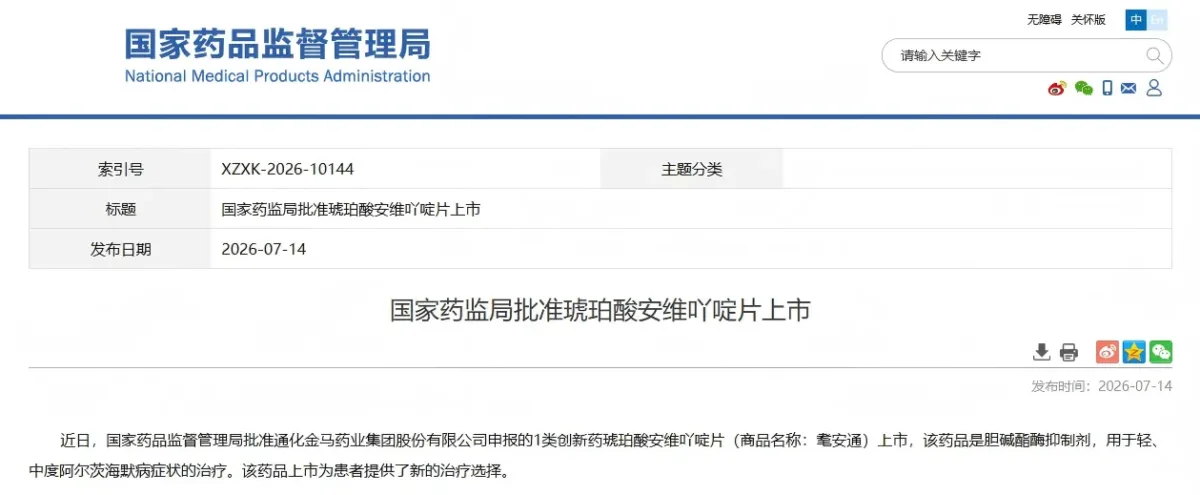
On June 25, 2026, the National Medical Products Administration (NMPA) announced Octahydroaminoacridine Succinate approved in China for mild to moderate Alzheimer’s disease, marking another milestone in China’s neurological drug innovation.
Alzheimer’s disease (AD) is the world’s most common neurodegenerative disorder and the leading cause of dementia.
As a domestically developed innovative medicine with independent intellectual property rights, Octahydroaminoacridine Succinate represents more than two decades of research and development and has become one of the most significant breakthroughs in China’s neuroscience drug pipeline.
This article provides a comprehensive overview of its mechanism of action, clinical trial results, development history, key characteristics, and significance in Alzheimer’s disease treatment.
What Is Octahydroaminoacridine Succinate?
Octahydroaminoacridine Succinate Tablets are a Class 1 innovative chemical drug independently developed by Tonghua Golden-Horse Pharmaceutical Group. The drug belongs to the cholinesterase inhibitor class and is indicated for the treatment of mild to moderate Alzheimer’s disease.
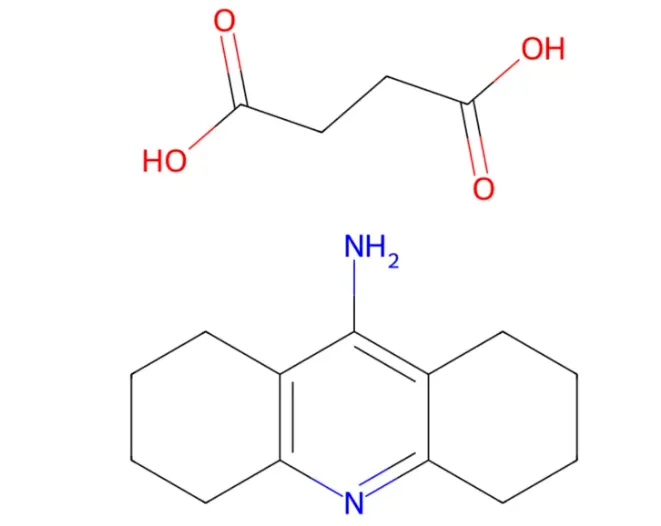
Drug Overview
| Item | Information |
|---|---|
| Drug Name | Octahydroaminoacridine Succinate Tablets |
| Chinese Name | 琥珀酸安维吖啶片 |
| Developer | Tonghua Golden-Horse Pharmaceutical Group |
| Drug Class | Class 1 Innovative Chemical Drug |
| Indication | Mild to Moderate Alzheimer’s Disease |
| Route of Administration | Oral |
| Approval Date | June 25, 2026 |
| Regulatory Authority | National Medical Products Administration (NMPA) |
| Mechanism of Action | Dual Cholinesterase Inhibitor |
As a major national pharmaceutical innovation project, Octahydroaminoacridine Succinate has completely independent intellectual property rights. Its approval demonstrates China’s continued progress in developing innovative therapies for neurodegenerative diseases.
The octahydroaminoacridine succinate approved in china milestone reflects the growing strength of China’s innovative pharmaceutical industry and expands treatment options for Alzheimer’s disease patients worldwide.
How Does Octahydroaminoacridine Succinate Treat Alzheimer’s Disease?
In Alzheimer’s disease, progressive neuronal degeneration, synaptic loss, and declining neurotransmitter levels gradually impair memory and cognitive function. Reduced acetylcholine (ACh) is considered one of the major contributors to these symptoms.
Increasing acetylcholine levels in the brain has therefore remained one of the primary therapeutic strategies for Alzheimer’s disease.
Dual Cholinesterase Inhibition
One of the distinguishing features of Octahydroaminoacridine Succinate is its dual cholinesterase inhibition mechanism.
The drug simultaneously inhibits: 🔽
- Acetylcholinesterase (AChE)
- Butyrylcholinesterase (BuChE)
Both enzymes are responsible for breaking down acetylcholine.
According to in vitro studies released by the developer, Octahydroaminoacridine Succinate demonstrates potent inhibitory activity against both enzymes, with stronger inhibition than some conventional cholinesterase inhibitors.
This innovative mechanism is one of the reasons why octahydroaminoacridine succinate approved in china has attracted considerable attention among neurology researchers and healthcare professionals.
Phase III Clinical Trial Results Supporting Octahydroaminoacridine Succinate Approved in China
The NMPA approval was primarily based on a Phase III clinical trial involving patients with mild to moderate Alzheimer’s disease.
Phase III Study Design
The study included the following features:
- Multicenter
- Randomized
- Double-blind
- Double-dummy
- Placebo-controlled
- Positive-control parallel comparison
- 26-week treatment period
- Extended follow-up to 54 weeks
The study evaluated both the efficacy and safety of Octahydroaminoacridine Succinate in patients with mild to moderate Alzheimer’s disease.
Primary Efficacy Endpoint
The primary endpoint was assessed using ADAS-Cog12 (Alzheimer’s Disease Assessment Scale–Cognitive Subscale), one of the most widely used cognitive assessment tools in Alzheimer’s disease clinical trials.
The study demonstrated:
- Significantly greater improvement in ADAS-Cog12 scores compared with placebo.
- An adjusted mean difference of 3.35 points versus placebo (P < 0.001).
- The positive-control group also showed cognitive improvement, although the overall magnitude was slightly lower than that observed in the investigational group.
The trial successfully met its predefined primary endpoint, indicating that Octahydroaminoacridine Succinate significantly improved cognitive function in patients with mild to moderate Alzheimer’s disease.
Secondary Endpoints
The study also evaluated several secondary efficacy outcomes.
Results showed:
- Significant improvement in CIBIC-Plus (Clinician’s Interview-Based Impression of Change Plus Caregiver Input).
- Statistically significant improvement in ADCS-ADL (Alzheimer’s Disease Cooperative Study–Activities of Daily Living).
- Improvement in NPI (Neuropsychiatric Inventory) did not reach statistical significance.
Overall, the drug demonstrated positive effects not only on cognition but also on patients’ overall clinical condition and certain aspects of daily functioning.
Safety Profile
Safety analyses showed:
- The incidence of adverse events was comparable to both the placebo group and the active-control group.
- Long-term follow-up supported favorable safety and tolerability throughout the 54-week observation period.
Overall, the Phase III study supports the efficacy and safety of Octahydroaminoacridine Succinate for treating mild to moderate Alzheimer’s disease.
The successful clinical data further strengthened the significance of octahydroaminoacridine succinate approved in china as an important development in Alzheimer’s disease treatment.
Development Timeline of Octahydroaminoacridine Succinate
As an innovative drug developed over more than 20 years, Octahydroaminoacridine Succinate has passed several important milestones.
| Year | Development Progress |
|---|---|
| 2005 | Clinical application initiated |
| 2016 | Tonghua Golden-Horse obtained development rights |
| 2021 | Phase III patient enrollment completed |
| 2023 | Phase III trial achieved primary endpoint |
| 2024 | New Drug Application submitted |
| June 2026 | Approved by the NMPA |
Future Development Directions
According to publicly available information from the company, additional indications may be explored beyond mild to moderate Alzheimer’s disease, including:
- Moderate to severe Alzheimer’s disease
- Vascular dementia
At present, these studies remain in the planning stage, and further clinical evidence will be required to confirm their efficacy and safety.
The approval of octahydroaminoacridine succinate approved in china may also encourage additional research into innovative cholinesterase inhibitors and other therapies targeting neurodegenerative diseases.
Conclusion
The approval of Octahydroaminoacridine Succinate marks another important milestone in China’s Alzheimer’s disease drug development.
As Alzheimer’s disease continues to pose a growing global health challenge, innovative therapies such as Octahydroaminoacridine Succinate may contribute to expanding future treatment options.
The achievement of octahydroaminoacridine succinate approved in china also highlights China’s growing role in global pharmaceutical innovation.
As a China pharmaceutical wholesaler, DengYueMed continues to follow the latest developments in innovative Chinese medicines and provides global partners with professional pharmaceutical insights and reliable drug supply services.
FAQ about Octahydroaminoacridine Succinate Approved in China
What is Octahydroaminoacridine Succinate?
Octahydroaminoacridine Succinate is a Class 1 innovative drug developed in China for the treatment of mild to moderate Alzheimer’s disease.
When was Octahydroaminoacridine Succinate approved in China?
Octahydroaminoacridine Succinate was approved in China on June 25, 2026, by the National Medical Products Administration (NMPA).
How does Octahydroaminoacridine Succinate work?
It works by inhibiting both acetylcholinesterase (AChE) and butyrylcholinesterase (BuChE) to increase acetylcholine levels and help improve cognitive function.
Who can receive Octahydroaminoacridine Succinate treatment?
The drug is approved for adults with mild to moderate Alzheimer’s disease according to its current NMPA indication.
What is the newest Alzheimer’s disease drug?
Octahydroaminoacridine Succinate is one of the newest Alzheimer’s disease drugs, approved in China in 2026 for the treatment of mild to moderate Alzheimer’s disease.