

Oveporexton Approved First in China: The First OX2R Agonist Targeting the Underlying Mechanism of Type 1 Narcolepsy
Oveporexton approved first in China, becoming the world’s first approved selective orexin receptor 2 (OX2R) agonist and the first therapy designed to target the underlying mechanism of Type 1 narcolepsy (NT1).
On July 21, 2026, the NMPA approved Oveporexton for the treatment of Type 1 narcolepsy in adolescents aged 16 years and older and adults, making China the first country in the world to approve this groundbreaking therapy.
The approval provides a new treatment option for patients while highlighting China’s growing role in global innovative drug development and first-in-world approvals.
In this article, Hong Kong-based DengYueMed reviews Oveporexton’s mechanism of action, clinical trial findings, and global development progress to help readers better understand the world’s first therapy approved to target the underlying cause of Type 1 narcolepsy (NT1).
What Is Oveporexton?
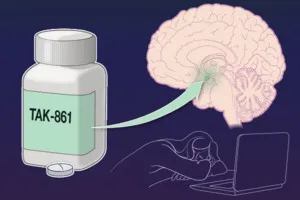
Oveporexton (TAK-861) is the world’s first approved selective orexin receptor 2 (OX2R) agonist, developed by Takeda, for the treatment of Type 1 narcolepsy (NT1).
Unlike conventional therapies that mainly manage symptoms, Oveporexton targets the underlying orexin deficiency by selectively activating orexin receptor 2 (OX2R), restoring orexin signaling to promote wakefulness.
✨ Because Oveporexton approved first in China represents the first clinical availability of an OX2R agonist, it introduces a new mechanism-based treatment approach for Type 1 narcolepsy.
Oveporexton at a Glance
| Item | Information |
|---|---|
| Generic Name | Oveporexton |
| Chinese Name | 奥普雷顿片 |
| Development Code | TAK-861 |
| Developer | Takeda |
| First Approval | July 21, 2026 |
| First Approved Country | China |
| Regulatory Authority | National Medical Products Administration (NMPA) |
| Indication | Type 1 Narcolepsy (NT1) in patients aged ≥16 years |
| Drug Class | Selective Orexin Receptor 2 (OX2R) Agonist |
| Mechanism of Action | Activates OX2R to restore orexin signaling |
| Key Feature | First therapy targeting the underlying cause of NT1 |
Oveporexton Approved First in China: A Global First-in-World Approval
Oveporexton is a first-in-class therapy developed under a globally synchronized development and regulatory submission strategy.
According to publicly available information, Takeda submitted marketing applications in multiple major markets within the same year:🔽
- January 2026: New Drug Application submitted to China’s NMPA
- February 2026: New Drug Application submitted to the U.S. Food and Drug Administration (FDA)
- June 2026: Marketing application submitted to Japan’s Pharmaceuticals and Medical Devices Agency (PMDA)
- July 21, 2026: Oveporexton approved first in China, making China the first country worldwide to grant marketing authorization
The approval came only about six months after the Chinese submission, highlighting the efficiency of China’s accelerated regulatory review system for innovative medicines.
Oveporexton has received multiple expedited regulatory designations worldwide, including:
- European Union: Orphan Drug Designation
- China: Breakthrough Therapy Designation and Priority Review
- United States: Breakthrough Therapy Designation and Priority Review
- Japan: Sakigake Designation and Orphan Drug Designation
What Is Type 1 Narcolepsy?
Narcolepsy is a rare, chronic neurological disorder characterized by the brain’s inability to properly regulate sleep and wakefulness.
Narcolepsy is classified into two subtypes:
- Type 1 Narcolepsy (NT1): Associated with cataplexy and caused primarily by severe loss of orexin-producing neurons.
- Type 2 Narcolepsy (NT2): Usually occurs without cataplexy, and its underlying mechanisms remain less well understood.
Patients with Type 1 narcolepsy commonly experience: 👇
- Excessive daytime sleepiness (EDS)
- Cataplexy
- Sleep paralysis
- Hypnagogic hallucinations
- Fragmented nighttime sleep
- Cognitive impairment
- Difficulty maintaining attention
- Reduced quality of life

In China, NT1 is recognized as a rare disease, with an estimated prevalence of 0.02%–0.05%. Because orexin deficiency is the underlying cause of the disease, restoring orexin signaling has long been a key therapeutic goal.
Oveporexton approved first in China marks the availability of the world’s first selective orexin receptor 2 (OX2R) agonist targeting orexin deficiency in Type 1 narcolepsy.
The First Therapy to Target the Underlying Mechanism of Type 1 Narcolepsy
For decades, treatment for Type 1 narcolepsy (NT1) has focused on managing symptoms such as excessive daytime sleepiness and cataplexy rather than addressing the underlying cause.
Unlike conventional therapies, Oveporexton selectively activates orexin receptor 2 (OX2R) to restore orexin signaling, targeting the underlying orexin deficiency in NT1.
Oveporexton approved first in China marks the availability of the world’s first approved OX2R agonist for Type 1 narcolepsy, introducing a new treatment approach that targets the disease’s underlying mechanism.
Clinical studies showed that Oveporexton not only improved wakefulness but also reduced cataplexy, enhanced cognitive function and attention, improved nighttime sleep, and enhanced patients’ overall quality of life.
Phase III Clinical Trials Demonstrated Significant Clinical Benefits
The approval of Oveporexton was primarily supported by two pivotal global Phase III clinical trials:
- FirstLight (TAK-861-3001)
- RadiantLight (TAK-861-3002)
These multinational, randomized, placebo-controlled studies enrolled more than 270 patients with Type 1 narcolepsy across 19 countries and regions, including participants from China.
Primary and Key Secondary Endpoints
After 12 weeks of treatment, Oveporexton demonstrated statistically significant improvements over placebo across all primary and key secondary endpoints (P < 0.001).
Key efficacy outcomes included:
- Significant improvement in the Maintenance of Wakefulness Test (MWT)
- Clinically meaningful reduction in Epworth Sleepiness Scale (ESS) scores
- Significant reduction in the weekly frequency of cataplexy attacks
- Improved sustained attention
- Better daily functioning
- Health-related quality of life approaching levels reported in healthy individuals
Subsequent analyses also showed additional clinical benefits, including:
- Approximately 70% of patients reported no significant cognitive difficulties.
- Nighttime sleep became more stable in most patients.
- The frequency of hypnagogic hallucinations and sleep paralysis decreased.
- REM sleep patterns showed a trend toward normalization.
The strong efficacy demonstrated in these pivotal studies was a key factor supporting Oveporexton approved first in China.
Safety Profile
Clinical studies showed that Oveporexton was generally well tolerated, with a safety profile consistent with previous clinical development.
Importantly, investigators reported:
- No new safety signals
- No treatment-related serious adverse events
The most commonly reported adverse reactions included:
- Insomnia
- Increased urinary frequency
- Urinary urgency
✅ Overall, the available evidence suggests that Oveporexton has a manageable safety profile suitable for long-term treatment of Type 1 narcolepsy.
The favorable benefit-risk balance further supported the decision behind Oveporexton approved first in China.
OX2R Agonists Remain One of the Most Promising Areas in Sleep Medicine
The approval of Oveporexton also highlights the rapid progress of orexin receptor 2 agonists, an emerging class of therapies aimed at restoring physiological wakefulness.
Although interest in orexin biology has grown substantially over the past decade, relatively few OX2R agonists have advanced into mid- or late-stage clinical development.
Major pipeline programs currently include:
| Candidate | Company | Development Stage | Indication |
|---|---|---|---|
| Oveporexton (TAK-861) | Takeda | Approved in China | Type 1 Narcolepsy |
| TAK-360 | Takeda | Phase II/III | Type 2 Narcolepsy |
| Alixorexton | Takeda | Phase III | Type 1 Narcolepsy |
| Cleminorexton | Originally Centessa, acquired by Eli Lilly | Clinical Development | Sleep Disorders |
| E2086 | Eisai | Phase II | Narcolepsy |
Compared with international companies developing OX2R agonists, many Chinese pharmaceutical companies have focused more heavily on orexin receptor antagonists (OXR antagonists) for insomnia treatment.
Following Oveporexton approved first in China, competition in this therapeutic area is expected to accelerate worldwide.
Conclusion
The approval of Oveporexton marks a historic milestone in Type 1 narcolepsy treatment. As the world’s first approved selective OX2R agonist, it introduces a new therapeutic approach by targeting orexin deficiency rather than only managing symptoms.
Developed through globally synchronized research and regulatory submissions, Oveporexton approved first in China highlights China’s growing role in global innovative drug development and regulatory advancement.
China pharmaceutical wholesaler DengYueMed will continue to share insights on innovative medicines, rare disease therapies, and emerging treatment technologies, supporting healthcare institutions, pharmacies, and industry partners worldwide.
FAQ about Oveporexton Approved First in China
What is Oveporexton?
Oveporexton is the world’s first approved selective OX2R agonist developed by Takeda for Type 1 narcolepsy (NT1). Approved in China, it targets orexin deficiency, a key disease mechanism.
When was Oveporexton approved in China?
Oveporexton was approved by China’s National Medical Products Administration (NMPA) on July 21, 2026, making China the first country to approve this innovative therapy for Type 1 narcolepsy.
How does Oveporexton work for Type 1 narcolepsy?
Oveporexton selectively activates orexin receptor 2 (OX2R) to restore orexin signaling and improve wakefulness in patients with Type 1 narcolepsy.
What is Type 1 narcolepsy (NT1)?
Type 1 narcolepsy is a rare neurological disorder mainly caused by the loss of orexin-producing neurons. Common symptoms include excessive daytime sleepiness, cataplexy, and disrupted nighttime sleep.
Why is Oveporexton approval in China significant?
Oveporexton approved first in China marks a major milestone as China became the first country to approve the world’s first selective OX2R agonist for Type 1 narcolepsy.