

Izalontamab Brengitecan Approved in China: World’s First EGFR×HER3 Bispecific ADC, a Breakthrough in Nasopharyngeal Cancer
On June 22, 2026, NMPA officially approved Biokin Pharmaceutical’s independently developed Class 1 innovative drug, izalontamab brengitecan (brand name: Yizekang), for marketing in China.
It is indicated for adult patients with recurrent or metastatic nasopharyngeal carcinoma (NPC) who have previously failed at least two lines of systemic chemotherapy and PD-1/PD-L1 inhibitor therapy.
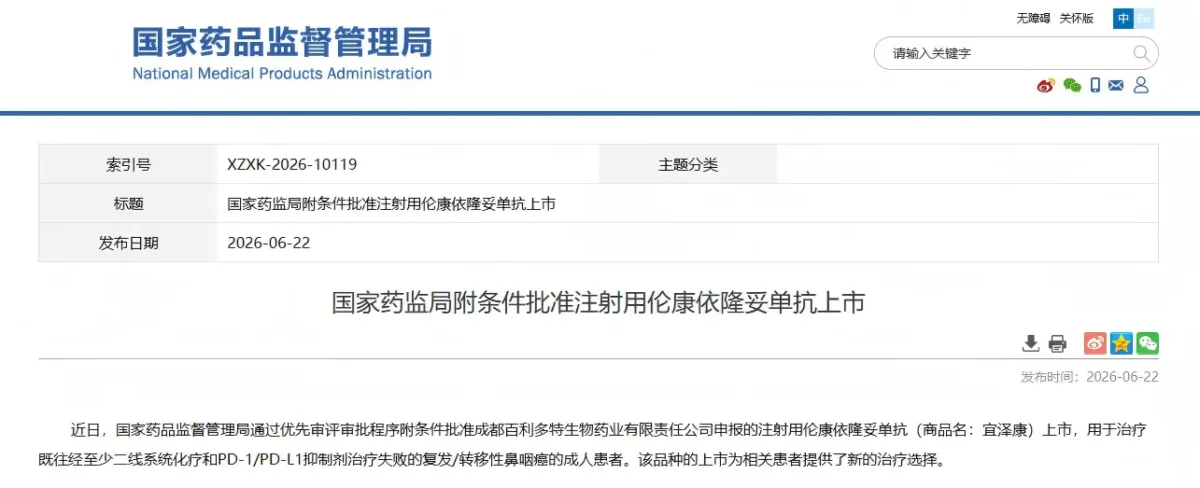
✨ With izalontamab brengitecan approved in China, a new treatment option is now available for late-line NPC patients, while the approval also represents a historic milestone in ADC development. It becomes the world’s first approved bispecific ADC and currently the only marketed bispecific ADC therapy.
In this article, Chinese pharmaceutical distributor DengYueMed examines the approval background, mechanism of action, key clinical findings, and future development potential of Izalontamab Brengitecan, offering a comprehensive analysis of this landmark innovative drug.
Izalontamab Brengitecan: The World’s First EGFR×HER3 Bispecific ADC
Izalontamab brengitecan is a bispecific antibody-drug conjugate independently developed by Biokin Pharmaceutical, designed to simultaneously target EGFR and HER3. 🎯
ADC drugs generally consist of three components: 🔽
- A monoclonal antibody (targeting tumor cells precisely)
- A linker (connecting antibody and payload)
- A cytotoxic payload (killing cancer cells)
Compared with traditional ADCs, izalontamab brengitecan approved in China introduces dual-target recognition, improving tumor selectivity and overcoming antigen heterogeneity.
EGFR and HER3 are widely expressed in epithelial tumors and are closely linked to tumor proliferation and resistance mechanisms.
Treatment Breakthrough for Recurrent or Metastatic Nasopharyngeal Carcinoma
The approved indication of izalontanab brengitecan approved in China is: 👇
Adult patients with recurrent or metastatic nasopharyngeal carcinoma who have failed at least two lines of systemic chemotherapy and prior PD-1/PD-L1 inhibitor therapy.
Nasopharyngeal carcinoma is a malignant tumor originating from the nasopharyngeal epithelium. Although relatively rare globally, it is highly prevalent in southern China, Southeast Asia, and parts of Africa.
For patients with advanced disease:
- First-line therapy usually involves platinum-based chemotherapy combined with immunotherapy
- Limited options exist after disease progression
- Outcomes of later-line therapy are generally poor
- Overall survival remains low
Therefore, there has long been an urgent clinical need for more effective and novel treatment options.

EGFR×HER3 Dual-Target Design Creates Differentiated Advantages
ADC therapies have become one of the fastest-growing areas in oncology drug development. However, most approved ADCs use single-target structures.
A key innovation of izalontamab brengitecan approved in China lies in its bispecific antibody design targeting EGFR and HER3 simultaneously.
Key advantages include:
✅ Enhanced tumor recognition
When tumor cells co-express EGFR and HER3, binding affinity is significantly increased.
✅ Overcoming tumor heterogeneity
Dual targeting reduces the risk of treatment escape caused by variable antigen expression.
✅ Reduced off-target toxicity
Structural optimization improves selectivity toward dual-positive tumor cells, potentially reducing skin toxicity associated with EGFR targeting.
Mechanism of Action: Tumor Killing Pathway of EGFR×HER3 Bispecific ADC
Izalontamab brengitecan is built on Biokin’s proprietary ADC platform, consisting of a bispecific antibody, a cleavable linker, and the topoisomerase I inhibitor Ed-04.
1. Dual targeting of EGFR×HER3
The antibody binds both EGFR and HER3, improving tumor targeting precision and reducing therapeutic escape.
2. Enzyme-cleavable linker for precise intracellular release
After internalization, the linker is cleaved by tumor-associated enzymes, releasing the cytotoxic payload directly inside cancer cells.
3. Ed-04 induces DNA damage
Ed-04 inhibits topoisomerase I, disrupting DNA replication and repair, ultimately triggering tumor cell apoptosis.
4. DAR = 8 enhances potency
A drug-to-antibody ratio (DAR) of 8 allows each antibody to carry multiple payload molecules, significantly increasing cytotoxic efficiency.
Phase III Trial BL-B01D1-303 Meets Primary Endpoints
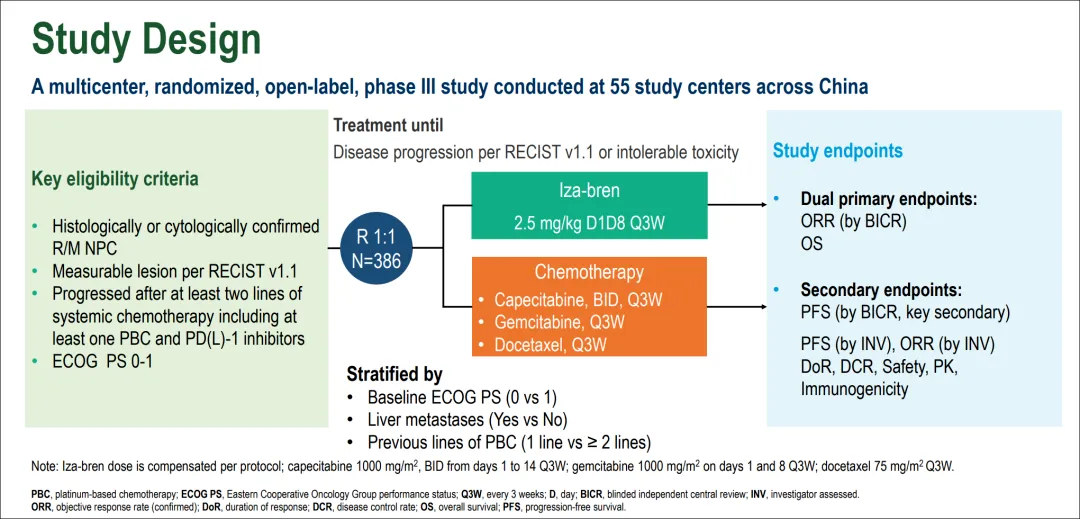
The approval of izalontamab brengitecan approved in China was primarily supported by the pivotal Phase III study BL-B01D1-303.
This study enrolled 386 patients with recurrent or metastatic nasopharyngeal carcinoma who had received at least two prior systemic therapies, including PD-1/PD-L1 inhibitors.
Patients were randomized 1:1 into:
- BL-B01D1 treatment group
- Physician’s choice chemotherapy group
Primary endpoints:
- Objective response rate (ORR)
- Overall survival (OS)
Secondary endpoints:
- Progression-free survival (PFS)
- Duration of response (DoR)
- Safety
Significant Clinical Superiority Over Standard Chemotherapy
Clinical outcomes showed clear superiority over standard chemotherapy:
| Endpoint | BL-B01D1 | Chemotherapy |
|---|---|---|
| ORR | 54.6% | 27.0% |
| DoR | 8.5 months | 4.8 months |
| PFS | 8.38 months | 4.34 months |
Key findings:
- ORR more than doubled
- Response duration significantly extended
- PFS nearly doubled
- Risk of progression or death reduced by 56%
Across predefined subgroups, consistent benefits were observed regardless of age, metastatic site, or prior treatment history.
These results positioned izalontamab brengitecan approved in China as one of the most promising therapies in NPC in recent years.
Manageable Safety Profile
Safety analysis demonstrated that izalontamab brengitecan approved in China has a controllable safety profile.
Key findings:
- Treatment discontinuation due to adverse events: 2.6%
- No new safety signals identified
- Most adverse events were clinically manageable
For a high-DAR ADC, this represents a favorable safety profile.
Global Value Validated by BMS $8.4 Billion Collaboration
In December 2023, Biokin Pharmaceutical entered a strategic collaboration with Bristol Myers Squibb (BMS).
Under the agreement:
- Mainland China rights retained by Biokin
- U.S. co-development between Biokin and BMS
- Other global markets licensed to BMS
Total deal value: $8.4 billion, including an $800 million upfront payment.
This partnership further validated the global potential of izalontamab brengitecan approved in China, highlighting China’s rising leadership in ADC innovation.

Multi-Indication Development Across Solid Tumors
Beyond NPC, izalontamab brengitecan approved in China is being evaluated across multiple solid tumor indications.
Currently, 14 Phase III trials are registered, including:
- Esophageal squamous cell carcinoma
- Triple-negative breast cancer
- Non-small cell lung cancer
- Small cell lung cancer
- Biliary tract cancer
- Urothelial carcinoma
- Ovarian cancer
Among them:
- NDA for esophageal cancer has been accepted
- NDA for triple-negative breast cancer has also been submitted
✨ With expanding clinical data, izalontamab brengitecan may become a multi-cancer ADC therapy.
Conclusion: The Dawn of Bispecific ADCs and a New Era of Global Oncology Innovation
The approval of izalontamab brengitecan approved in China marks not only a breakthrough for patients with recurrent or metastatic nasopharyngeal carcinoma but also the beginning of a new era in bispecific ADC therapy.
🐱🏍 As the world’s first approved bispecific ADC, izalontamab brengitecan demonstrates the growing global competitiveness of Chinese pharmaceutical innovation.
With ongoing clinical expansion and international development, izalontamab brengitecan is expected to become a key global player in the next generation of ADC therapeutics.
Chinese pharmaceutical distributor DengYueMed will continue to monitor developments in innovative Chinese medicines, oncology therapies, and global pharmaceutical trends, while providing drug information and supply chain support to international clients.
FAQ about Izalontamab Brengitecan Approved in China
What is izalontamab brengitecan?
Izalontamab brengitecan is a bispecific antibody-drug conjugate (ADC) that simultaneously targets EGFR and HER3. It is the world’s first approved bispecific ADC and was developed by Biokin Pharmaceutical for the treatment of multiple solid tumors.
What is the mechanism of action of iza bren?
Izalontamab Brengitecan is a bispecific ADC that targets both EGFR and HER3 on tumor cells. After binding and internalization, it releases a topoisomerase I inhibitor payload (Ed-04), causing DNA damage and ultimately leading to cancer cell death.
What is the new treatment for nasopharyngeal carcinoma?
Izalontamab brengitecan is a newly approved treatment in China for adults with recurrent or metastatic nasopharyngeal carcinoma (NPC) who have failed prior chemotherapy and PD-1/PD-L1 inhibitor therapy.
Has any bispecific ADC been approved?
Yes. Izalontamab brengitecan became the world’s first approved bispecific ADC when it was approved in China in 2026 for recurrent or metastatic nasopharyngeal carcinoma (NPC).