China National Essential Medicines List 2026: Key Updates on Innovative Drugs, GLP-1 and Cancer Therapies
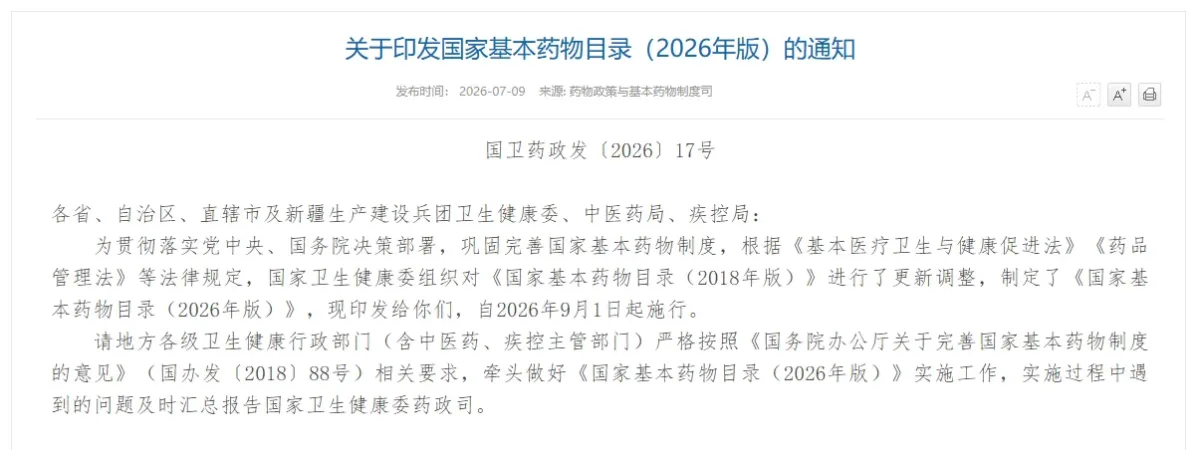
On July 9, 2026, China officially released the China National Essential Medicines List 2026, adding 116 medicines and bringing the total to 794. The updated list, the first revision since 2018, will take effect on September 1, 2026.
✨ This is the first revision of China’s National Essential Medicines List since 2018 and the fourth adjustment since the country’s healthcare reform was launched in 2009.
One of the most notable features of the China National Essential Medicines List 2026 is the significant expansion of innovative medicines, biologics, and therapies for chronic diseases, reflecting China’s growing emphasis on clinical value, evidence-based medicine, and improved patient access.
As a China pharmaceutical wholesaler, DengYueMed will continue to monitor national pharmaceutical policies and provide global partners with timely updates on China’s innovative medicines and pharmaceutical market.
What Are the Key Updates in the China National Essential Medicines List 2026?
The latest revision not only expands the overall size of the list but also optimizes its therapeutic structure. Most newly added medicines are concentrated in priority disease areas, including oncology, metabolic disorders, cardiovascular diseases, neurological disorders, and immune-mediated diseases.
| Key Update | 2026 Revision | Industry Significance |
|---|---|---|
| List Expansion | Total medicines increased to 794 (109 more than the 2018 edition) | Broader disease coverage |
| Innovative Medicines | Multiple targeted therapies and biologics added for the first time | Improved patient access to innovative treatments |
| Chronic Disease Management | First inclusion of GLP-1 receptor agonists and additional SGLT-2 inhibitors | Shift from glucose control to comprehensive metabolic management |
| Cancer Treatment | New EGFR inhibitors, PARP inhibitors, and anti-VEGF therapies | Further advancement of precision oncology |
| Biologics | More monoclonal antibodies and fusion proteins included | Biologics becoming part of standard clinical care |
| Dosage Forms | Addition of orally disintegrating tablets, sustained-release formulations, and inhalation products | Better support for diverse clinical needs |
Overall, the China National Essential Medicines List 2026 is more closely aligned with recent domestic and international clinical guidelines, demonstrating China’s continued investment in the treatment of major chronic and high-burden diseases.
Innovative Medicines Become the Biggest Highlight
Historically, China’s National Essential Medicines List mainly consisted of established generic medicines and conventional therapies.
The China National Essential Medicines List 2026 marks the first large-scale inclusion of innovative medicines and biologics, signaling that clinical value has become an increasingly important criterion alongside affordability in medicine selection.
The newly included medicines cover a broad range of therapeutic areas, including lung cancer, breast cancer, ovarian cancer, autoimmune diseases, diabetes, and neurodegenerative disorders.
Representative newly added medicines include: 🔽
- Semaglutide (GLP-1 receptor agonist)
- Osimertinib (third-generation EGFR tyrosine kinase inhibitor)
- Olaparib (PARP inhibitor)
- Bevacizumab (anti-VEGF monoclonal antibody)
- Adalimumab (TNF-α inhibitor)
- Telitacicept (TACI-Fc fusion protein)
- Empagliflozin (SGLT-2 inhibitor)
- Finerenone (non-steroidal mineralocorticoid receptor antagonist)
- Donepezil (treatment for Alzheimer’s disease)
Most of these medicines have already been included in China’s National Reimbursement Drug List (NRDL). Their addition to the National Essential Medicines List is expected to expand availability at primary healthcare institutions and further improve patient access.
Chronic Disease Management Enters the Era of Comprehensive Metabolic Care
Metabolic diseases represent one of the most significant areas of change in this revision.
💊 For the first time, the updated list includes the GLP-1 receptor agonist Semaglutide, alongside additional medicines such as Empagliflozin, Finerenone, Insulin Degludec, and Insulin Aspart, further strengthening the treatment framework for diabetes and its related complications.
These changes reflect China’s evolving approach to chronic disease management. Rather than focusing solely on glycemic control, clinical practice is increasingly emphasizing comprehensive management that addresses cardiovascular protection, kidney health, and weight management.
This direction is consistent with recent international clinical guidelines, which advocate integrated risk management for patients with diabetes and other metabolic disorders.
Beyond glucose-lowering therapies, the revised list also expands treatment options for lipid management, hypertension, and cardio-renal protection, providing more comprehensive therapeutic choices for patients with diabetes, chronic kidney disease, and cardiovascular diseases.
Expanded Coverage of Oncology Medicines and Biologics
The China National Essential Medicines List 2026 further expands the coverage of innovative oncology therapies and biologics, highlighting China’s commitment to standardized treatment and long-term management of major diseases.
Representative newly added medicines include:
| Therapeutic Area | Representative Medicines | Clinical Significance |
|---|---|---|
| EGFR-targeted therapy | Osimertinib | Expands access to standard treatment for non-small cell lung cancer |
| PARP inhibitors | Olaparib | Improves access to maintenance therapy for BRCA-related cancers |
| Anti-VEGF therapy | Bevacizumab | Broadens anti-angiogenic treatment options for multiple solid tumors |
| Proteasome inhibitors | Bortezomib | Supports standardized treatment for multiple myeloma |
| Immunology and autoimmune diseases | Adalimumab, Telitacicept | Further expands the use of biologics in clinical practice |
In addition, the updated list introduces medicines for neurological disorders, hematological diseases, and immune-mediated conditions, demonstrating that China’s essential medicines system is expanding beyond traditional primary care medicines to cover a broader range of serious diseases.
Overall, the updated list gives greater priority to innovative therapies supported by strong clinical value and robust evidence evidence, while helping improve access to selected innovative medicines at primary healthcare institutions.
More Standardized Drug Classification Aligned with Modern Clinical Practice
In addition to adding new medicines, the China National Essential Medicines List 2026 also updates several therapeutic classifications to better reflect modern clinical practice and internationally recognized pharmacological standards.
Examples include: 👇
- “Anesthesia Adjunct Medicines” renamed as “Muscle Relaxants”
- “Adjunctive Medicines for Liver Diseases” renamed as “Medicines for Liver Diseases”
- “Adjunctive Anticancer Medicines” renamed as “Antidotes for Anticancer Therapy”
- “Enteral Nutrition Medicines” renamed as “Enteral Nutrition Products”
These revisions improve the accuracy and consistency of medicine classification while further aligning the list with the Chinese Pharmacopoeia (2025 Edition). The updated terminology also supports more standardized clinical practice, pharmaceutical procurement, and healthcare information management.
Optimized Dosage Forms to Better Meet Modern Clinical Needs
The revised list also enhances the range of pharmaceutical dosage forms by introducing modern formulations such as orally disintegrating tablets, oral soluble films, sublingual tablets, effervescent tablets, enteric-coated sustained-release tablets, concentrated solutions for injection, and dry powder inhalers.
Meanwhile, several established medicines have been supplemented with sustained-release formulations or improved routes of administration, including therapies for epilepsy, diabetes, and cardiovascular diseases.
These improvements are expected to:
- Improve medication convenience for older adults and pediatric patients
- Enhance long-term treatment adherence for chronic diseases
- Better support emergency care, maintenance therapy, and special administration scenarios
- Further align China’s pharmaceutical standards with international clinical practice
Three Key Policy Signals from the Updated List
The latest revision of the China National Essential Medicines List 2026 highlights three important trends in China’s evolving essential medicines policy.
1. Greater Access to Innovative Medicines
An increasing number of innovative medicines and biologics with demonstrated clinical value and strong evidence-based support have been included in the national list. This reflects a growing focus on patient outcomes and therapeutic value in medicine selection.
2. Continued Focus on Major Chronic Diseases
Most newly added medicines target high-burden diseases, including cancer, diabetes, cardiovascular diseases, neurological disorders, and autoimmune diseases. This direction is consistent with China’s aging population and the changing disease burden.
3. Stronger Emphasis on Evidence-Based Medicine and Standardized Management
Whether through the inclusion of innovative medicines, adjustments to traditional Chinese medicines, or optimization of pharmaceutical formulations, the updated list places greater emphasis on clinical evidence, safety evaluation, and standardized management.
These changes are expected to improve the scientific basis of medicine selection while strengthening the alignment between the National Essential Medicines List, clinical guidelines, pharmaceutical standards, and the healthcare reimbursement system.
Conclusion
The China National Essential Medicines List 2026 represents more than a routine revision of China’s essential medicines system. It reflects the continued evolution of the country’s healthcare system and clinical treatment strategies.
For pharmaceutical companies, healthcare institutions, international procurement organizations, and those exploring Chinese pharmacy, these developments highlight the growth of innovative medicines and evolving opportunities in China’s pharmaceutical market.
China pharmaceutical wholesaler DengYueMed will continue to provide timely updates on China’s pharmaceutical policies, innovative drug approvals, and healthcare industry developments, helping global partners stay informed about the rapidly evolving Chinese pharmaceutical market.
FAQ about China National Essential Medicines List 2026
What is the China National Essential Medicines List 2026?
The China National Essential Medicines List 2026 is the latest edition of China’s official list of essential medicines, featuring 794 medicines and taking effect on September 1, 2026.
What are the major updates in the China National Essential Medicines List 2026?
The updated list expands access to innovative medicines, biologics, GLP-1 therapies, targeted cancer treatments, and modern dosage forms while strengthening chronic disease management.
Why is the inclusion of innovative medicines important?
Including more innovative medicines in the National Essential Medicines List helps improve their availability in primary healthcare institutions and enhances patient access to evidence-based treatments.
Does the National Essential Medicines List include GLP-1 therapies?
Yes. Semaglutide was added for the first time, reflecting a stronger focus on comprehensive metabolic disease management.
When will the National Essential Medicines List 2026 take effect?
The revised list will officially take effect on September 1, 2026, replacing the previous 2018 edition.