Anflekitug Approved in China: A New IL-1β Targeted Treatment Option for Acute Gouty Arthritis
On August 20, 2026, Anflekitug was approved in China as an innovative drug developed by Sunshine Guojian, providing a new IL-1β targeted treatment option for adults with acute gouty arthritis and further expanding the treatment landscape for innovative gout therapies in China.
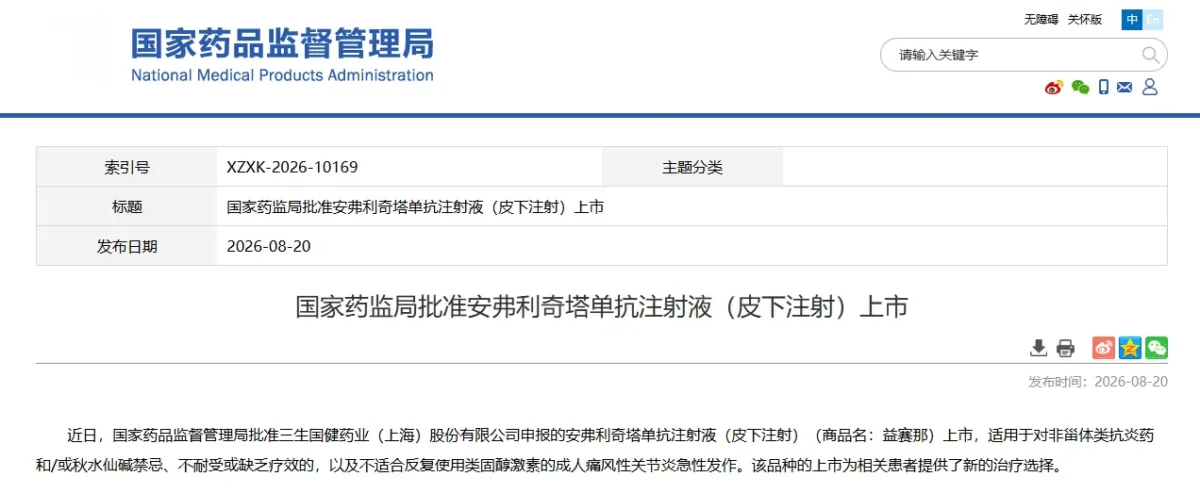
Acute gouty arthritis is the most common initial manifestation of gout.
For patients with limited treatment options due to contraindications, intolerance, or inadequate response to NSAIDs, colchicine, or corticosteroids, Anflekitug approved in China provides a new IL-1β-targeted treatment option.
China pharmaceutical wholesaler DengYueMed provides an overview of Anflekitug’s basic information, clinical research data, and clinical significance, helping pharmaceutical industry readers understand the latest developments in this innovative gout drug.
What Is Anflekitug and How Does It Work?
Anflekitug is a recombinant humanized monoclonal antibody targeting interleukin-1β (IL-1β). It specifically binds to IL-1β and blocks related inflammatory signaling.
During an acute gout attack, monosodium urate (MSU) crystal deposition can trigger an inflammatory response and promote the release of IL-1β and other inflammatory mediators, leading to symptoms such as joint redness, swelling, warmth, and pain.
Therefore, IL-1β is an important inflammatory target in acute gout.
Unlike small-molecule drugs primarily used to lower blood uric acid levels, Anflekitug mainly acts on the acute inflammatory pathway.
Basic Information on Anflekitug
| Item | Information |
|---|---|
| Generic name | Anflekitug |
| Brand name | 益赛那®/Yisaina® |
| Drug type | Recombinant anti-IL-1β humanized monoclonal antibody |
| Target | IL-1β |
| Route of administration | Subcutaneous injection |
| Approval date | August 20, 2026 |
| Regulatory agency | National Medical Products Administration (NMPA), China |
| Developer | Sunshine Guojian, a subsidiary of 3SBio |
| Indication | Acute attacks of gouty arthritis in adults who have contraindications to, are intolerant of, or have inadequate response to NSAIDs and/or colchicine, and who are not suitable for repeated corticosteroid use |
| Drug status | China’s second approved IL-1β monoclonal antibody after Firsekibart |
Why Is IL-1β an Important Therapeutic Target in Acute Gout?
Gout is driven by monosodium urate crystal deposition in joints and surrounding tissues, triggering inflammation in which IL-1β plays a key role in acute gouty arthritis.
Conventional treatments for acute gout mainly include NSAIDs, colchicine, and corticosteroids. However, conventional treatment may be limited for some patients because of various factors, including: 🔽
- Contraindications to certain medications
- Drug intolerance
- Insufficient treatment response
- Comorbidities
- Unsuitability for repeated corticosteroid use
Therefore, inhibition of the IL-1 pathway has become an important area of research in acute gout treatment.
The 2025 Guideline for Anti-inflammatory Treatment of Gout noted that clinical studies have shown IL-1 inhibitors may reduce the frequency and severity of gout flares, while their clinical use should also take factors such as treatment cost into consideration.
The main value of IL-1β targeted drugs for gout is therefore their ability to target an important inflammatory pathway in acute gout and provide an additional treatment option for patients whose conventional anti-inflammatory treatment is limited.
Clinical Research and Key Data for Anflekitug
Anflekitug approved in China was supported by a Phase III clinical study in acute gouty arthritis with a randomized, double-blind, double-dummy, active-controlled design.
According to information released by 3SBio Guojian, the study enrolled 505 Chinese patients and randomly assigned them in a 1:1 ratio to receive SSGJ-613 or compound betamethasone injection, primarily evaluating efficacy and safety.
The study provides important clinical evidence for SSGJ-613 in acute gout.
| Key indicator | Study data |
|---|---|
| Study phase | Phase III |
| Number of patients | 505 |
| Study duration | 48 weeks |
| Primary analysis time point | 24 weeks |
| Main efficacy results | Pain relief was comparable with the active control, while prevention of acute gout recurrence was superior to the active control |
| Safety | Overall favorable safety and tolerability; no new safety signals identified |
At the 24-week primary analysis, Anflekitug met both co-primary endpoints for acute gout pain relief and recurrence prevention. Its pain-relieving effect was comparable to compound betamethasone injection, while it showed a statistically significant benefit in preventing recurrent acute gout attacks.
From a clinical positioning perspective, these results support Anflekitug as an IL-1β targeted treatment for acute gout, providing a new treatment option for patients whose conventional anti-inflammatory treatment is limited.
How Is Anflekitug Different From Conventional Gout Treatments?
From a treatment-mechanism perspective, acute gout therapies can broadly be divided into anti-inflammatory treatments and urate-lowering therapies.
NSAIDs, colchicine, and corticosteroids are mainly used to control inflammation and pain during acute gout attacks, while urate-lowering therapies reduce blood uric acid levels over the long term by decreasing uric acid production or increasing uric acid excretion.
Anflekitug belongs to a more specifically targeted class of anti-inflammatory therapies, with IL-1β as its therapeutic target. With Anflekitug approved in China, this approach provides a new targeted treatment option for acute gout.
Unlike urate-lowering therapies, Anflekitug does not directly reduce blood uric acid levels. Instead, it targets an important inflammatory pathway involved in acute gout, making IL-1β-targeted therapy an increasingly important area of gout treatment research.
What Directions Are Emerging for Innovative Gout Drugs in China?
IL-1β monoclonal antibodies are only one of the approaches being explored in innovative gout drug development. As understanding of uric acid metabolism and inflammatory mechanisms continues to advance, companies in China and globally are exploring additional therapeutic targets and technologies.
1. IL-1β inhibitors:
These therapies mainly control acute gout inflammation by inhibiting IL-1β-related inflammatory pathways. With Anflekitug approved in China, the IL-1β-targeted treatment landscape in China has further expanded.
2. URAT1 inhibitors:
By inhibiting renal uric acid reabsorption and promoting uric acid excretion, URAT1 inhibitors reduce blood uric acid levels and are mainly used for long-term urate-lowering treatment.
3. Xanthine oxidase inhibitors (XOIs):
By inhibiting xanthine oxidase, XOIs reduce uric acid production and remain an important approach to long-term urate-lowering treatment.
4. Dual-target and RNA-based drugs:
Dual-target drugs and novel approaches such as small interfering RNA (siRNA) therapies are also advancing in development, potentially offering additional treatment options for gout.
Overall, China’s innovative gout drug pipeline is expanding from conventional small-molecule urate-lowering and anti-inflammatory therapies toward diverse approaches involving targeted inflammatory pathways, uric acid metabolism, and RNA-based therapies.
Conclusion
Anflekitug approved in China further expands IL-1β targeted treatment options for acute gouty arthritis and reflects the continued development of innovative therapies for inflammatory diseases by Chinese pharmaceutical companies.
As IL-1β inhibitors, URAT1 inhibitors, XOIs, and RNA-based therapies continue to advance, the China gout drug market is developing a more diverse treatment landscape.
For global pharmaceutical industry participants, China’s innovative drug development, regulatory approvals, and market trends remain important areas to follow.
As a Chinese pharmaceutical wholesaler, Hong Kong DengYue Medicine continues to focus on innovative drugs and specialty medicines from China, providing global pharmaceutical industry partners with information and insights related to the Chinese pharmaceutical market and pharmaceutical supply chain.
FAQ about Anflekitug Approved in China
What is Anflekitug?
Anflekitug is a recombinant humanized monoclonal antibody targeting IL-1β for the treatment of acute gouty arthritis.
What is Anflekitug approved for in China?
Anflekitug is approved in China for acute attacks of gouty arthritis in adults with limited treatment options involving NSAIDs, colchicine, or repeated corticosteroid use.
How does Anflekitug work for acute gout?
Anflekitug targets IL-1β and blocks related inflammatory signaling involved in acute gout attacks.
Is Anflekitug a urate-lowering drug?
No, Anflekitug primarily targets acute inflammation rather than directly lowering blood uric acid levels.
What is the significance of Anflekitug’s approval in China?
Anflekitug adds a new IL-1β-targeted treatment option and becomes the second IL-1β monoclonal antibody approved in China.