
Innovative PNH Drug Licancopan Approved in China: Oral CFB Inhibitor for Dual Hemolysis Control
On August 20, NMPA announced the approval of Licancopan Fumarate Capsules, a Class 1 innovative drug developed by Hengrui Pharma, for the treatment of adults with paroxysmal nocturnal hemoglobinuria (PNH) who have not previously received complement inhibitor therapy.
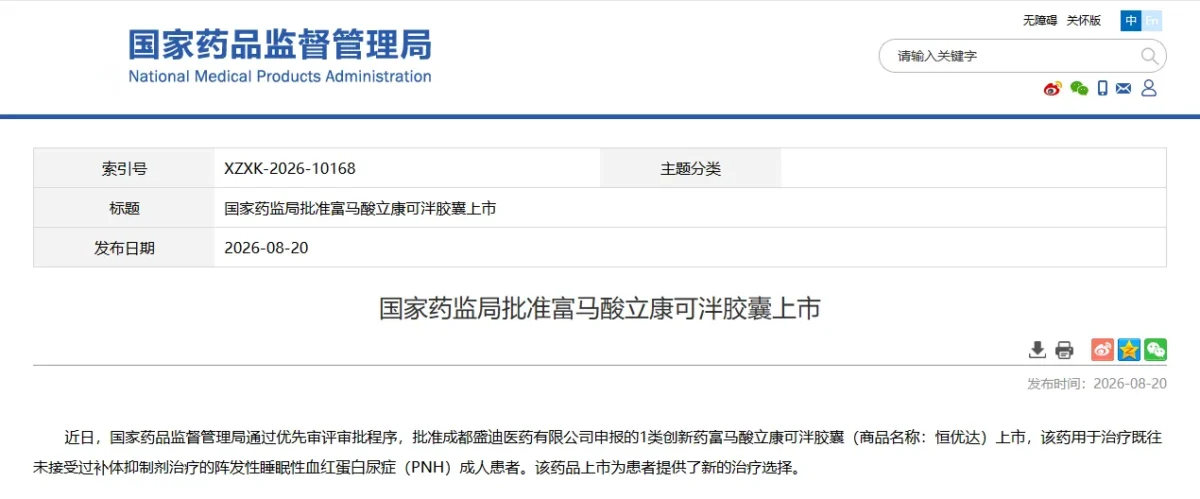
The innovative PNH drug Licancopan represents a new oral treatment option for PNH.
As an oral factor B (CFB) inhibitor, Licancopan targets the alternative complement pathway to inhibit complement activation and amplification. By acting at an upstream point in the complement cascade, it has the potential to control both intravascular and extravascular hemolysis.
DengYueMed will introduce Licancopan, covering the challenges of current PNH treatment, its mechanism of action, and key clinical findings to help patients and industry partners better understand this innovative PNH therapy and its development.
What Is Licancopan?
Licancopan is an oral small-molecule factor B (CFB) inhibitor developed by Jiangsu Hengrui Pharmaceuticals. By targeting CFB, a key component of the alternative complement pathway, it inhibits complement activation and amplification at an upstream point.
Compared with conventional injectable complement inhibitors, Licancopan is administered orally. Under its newly approved indication in China, it is used for adults with PNH who have not previously received complement inhibitor therapy.
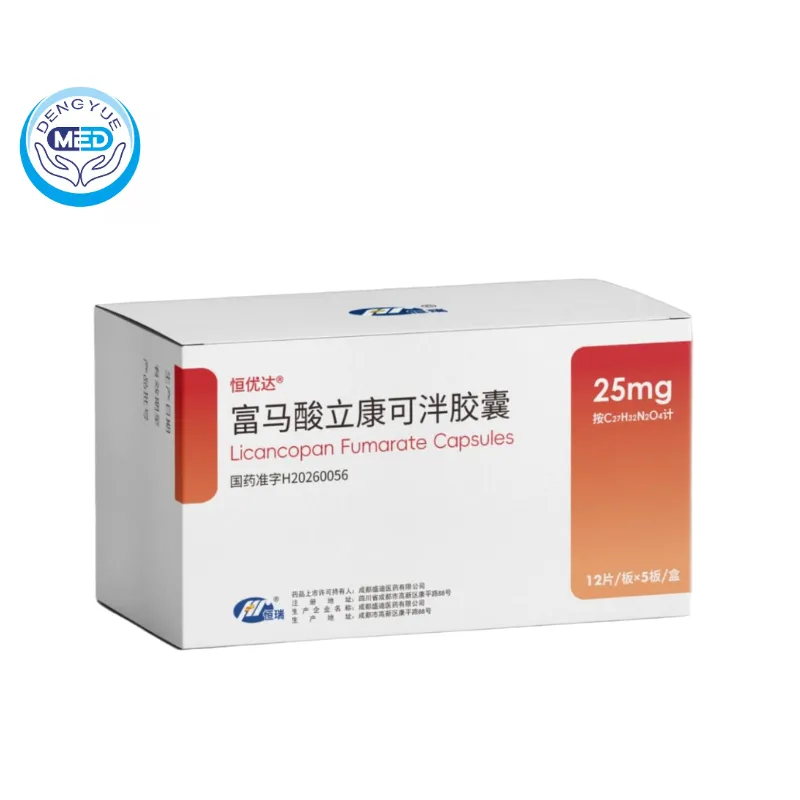
Basic Information on Licancopan
| Item | Information |
|---|---|
| Drug Name | Licancopan Fumarate Capsules |
| Development Code | HRS-5965 |
| Brand Name | 恒优达®/Hengyouda® |
| Developer | Jiangsu Hengrui Pharmaceuticals Co., Ltd. |
| Drug Type | Class 1 innovative drug |
| Drug Class | Small-molecule complement inhibitor |
| Primary Target | Complement factor B (CFB) |
| Route of Administration | Oral |
| China Approval Announcement Date | August 20, 2026 |
| Regulatory Authority | National Medical Products Administration (NMPA) |
| Approved Indication | Treatment of adults with PNH who have not previously received complement inhibitor therapy |
| Disease Area | Hematology / Rare Disease |
| Core Treatment Goals | Control complement-mediated hemolysis, improve anemia, and reduce the need for blood transfusions |
What Is PNH and What Challenges Remain in Current Treatment?
Paroxysmal nocturnal hemoglobinuria (PNH) is a rare acquired clonal hematopoietic stem cell disorder.
Because red blood cells lack normal protection from complement regulation, they can become vulnerable to complement attack and undergo hemolysis. Patients may experience anemia, fatigue, hemoglobinuria, and an increased risk of thrombosis.
PNH-related hemolysis mainly occurs in two forms: 🔽
- Intravascular hemolysis: associated with activation of the terminal complement pathway.
- Extravascular hemolysis: may occur when C3 fragments are deposited on the surface of red blood cells.
C5 inhibitors can effectively control intravascular hemolysis by blocking the terminal complement pathway. However, some patients may continue to experience extravascular hemolysis, persistent anemia, and fatigue despite treatment.
Therefore, the innovative PNH drug Licancopan reflects an important direction in PNH treatment research, targeting complement activation further upstream to achieve broader control of PNH-related hemolysis.
How Does Licancopan Work in PNH?
The complement system consists of several interconnected activation pathways. Among them, the alternative pathway plays an important role in complement amplification.
Complement factor B (CFB) is a key protein in the alternative pathway. It participates in the formation of the C3 convertase and promotes downstream complement activation and amplification.
The innovative PNH drug Licancopan is an oral small-molecule CFB inhibitor that targets the alternative complement pathway, helping reduce abnormal complement activation, amplification, and red blood cell destruction.
Its mechanism of action can be summarized as:
Licancopan → CFB inhibition → inhibition of alternative pathway activation and amplification → reduced complement-mediated red blood cell destruction → control of hemolysis
How Does Licancopan Differ From C5 Inhibitors?
| Feature | Licancopan | C5 Inhibitors |
|---|---|---|
| Primary Target | CFB | C5 |
| Complement Pathway | Alternative pathway | Terminal pathway |
| Site of Action | Upstream | Downstream |
| Potential Hemolysis Control | May affect both intravascular and extravascular hemolysis | Primarily controls intravascular hemolysis |
| Treatment Approach | Proximal complement inhibition | Terminal complement inhibition |
What Are the Potential Advantages of Licancopan for PNH?
1. Targets the Alternative Complement Pathway
Licancopan does not directly target C5. Instead, it targets CFB, a key component of the alternative complement pathway.
By inhibiting the complement amplification process, Licancopan may reduce abnormal complement activation at an upstream point and provide a new approach to proximal complement inhibition in PNH.
2. Mechanistically Addresses Both Intravascular and Extravascular Hemolysis
One of the challenges in PNH treatment is that some patients may continue to experience extravascular hemolysis even after intravascular hemolysis has been controlled.
Because CFB inhibition affects the alternative complement pathway and C3-related processes, Licancopan has the potential to reduce the burden associated with both intravascular and extravascular hemolysis.
3. Oral Administration
Licancopan is administered orally.
Compared with treatment options that require intravenous or subcutaneous administration, an oral dosage form can reduce some administration-related procedures and may provide greater convenience for long-term disease management.
Actual treatment regimens and administration should always follow the approved prescribing information and the judgment of a qualified healthcare professional.
Phase III Clinical Research Shows the Potential of Licancopan in PNH Treatment
Clinical development of the innovative PNH drug Licancopan was supported by the HRS-5965-301 Phase III trial, a multicenter, randomized, open-label study comparing Licancopan with eculizumab in adults with previously untreated PNH.
The 24-week trial enrolled 76 patients, with 40 receiving Licancopan and 36 receiving eculizumab.
Key Results From the HRS-5965-301 Study
| Key Measure | Licancopan Group | Eculizumab Group |
|---|---|---|
| Hb increase ≥2 g/dL from baseline | 95.0% | 55.6% |
| Hb ≥12 g/dL | 70.0% | 11.1% |
| No transfusion after Week 2 | 100% | 86.1% |
| Mean improvement in FACIT-Fatigue score | +8.6 points | +4.4 points |
| Major adverse vascular events (MAVEs) | None observed | None observed |
1. Hemoglobin Improvement
During Weeks 18–24, 95.0% of patients receiving Licancopan achieved a ≥2 g/dL increase in hemoglobin, compared with 55.6% with eculizumab. 70.0% reached Hb ≥12 g/dL versus 11.1%.
2. Transfusion Independence
After Week 2, 100% of patients in the Licancopan group had no transfusions, compared with 86.1% in the eculizumab group.
3. Fatigue Improvement
FACIT-Fatigue scores improved by 8.6 points with Licancopan versus 4.4 points with eculizumab.
4. Safety
No major adverse vascular events (MAVEs) were observed in either group, and Licancopan showed a manageable safety and tolerability profile.
Overall, the results support Licancopan’s clinical potential in hemoglobin improvement, transfusion independence, and fatigue management in complement inhibitor-naive adults with PNH.
Why Does the Innovative PNH Drug Licancopan Matter?
The approval of the innovative PNH drug Licancopan provides adults with PNH who have not previously received complement inhibitor therapy with a new oral treatment option in China.
From a drug development perspective, the approval reflects the continued expansion of China’s innovative pharmaceutical research into rare diseases and complement-targeted therapies.
As more complement-targeted medicines enter clinical practice, PNH treatment may move toward more individualized long-term disease management.
Licancopan is also being clinically developed for patients who continue to experience anemia after C5 inhibitor treatment. If approved for this use in the future, its potential eligible patient population could expand further.
Conclusion
The NMPA approval of the innovative PNH drug Licancopan gives adults with previously untreated PNH a new oral treatment option. As a CFB inhibitor, it targets the alternative complement pathway upstream, with clinical results showing improvements in hemoglobin, transfusion independence, and fatigue.
This approval expands complement-targeted treatment options, while further research will clarify Licancopan’s role in long-term PNH management.
As a China-based pharmaceutical wholesaler, DengYueMed follows Chinese innovative medicines and rare disease therapies while supporting industry partners with pharmaceutical sourcing and market insights.
FAQ about Innovative PNH Drug Licancopan
What is Licancopan?
Licancopan is an oral small-molecule CFB inhibitor developed by Jiangsu Hengrui Pharmaceuticals for PNH treatment.
How does Licancopan work in PNH?
Licancopan targets CFB in the alternative complement pathway to inhibit complement activation and amplification upstream.
What are the potential benefits of Licancopan for PNH?
Clinical results showed improvements in hemoglobin, transfusion independence, and fatigue-related measures in previously untreated adults with PNH.
How is Licancopan different from C5 inhibitors?
Licancopan targets CFB in the alternative pathway upstream, while C5 inhibitors act on the terminal complement pathway.
Who may receive Licancopan for PNH?
Licancopan is approved in China for adults with PNH who have not previously received complement inhibitor therapy.