
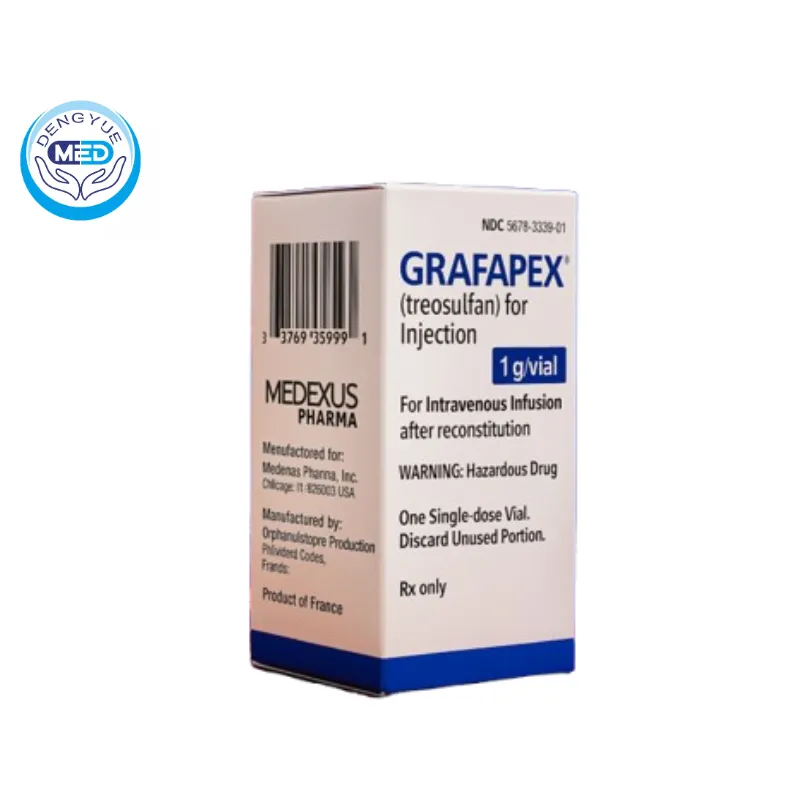
Treosulfan | AlloHSCT | HongKong DengYue Medicine
- Generic Name/Brand Name: Treosulfan / Grafapex
- Indications: AlloHSCT in combination with fludarabine for AML and MDS; advanced epithelial ovarian cancer
- Dosage Form: Lyophilized powder for intravenous infusion
- Specification: 1 g/vial and 5 g/vial
Treosulfan Application Scope

Primary Indication: Conditioning treatment prior to allogeneic hematopoietic stem cell transplantation (alloHSCT) in combination with fludarabine
FDA Approval: Adults and pediatric patients aged ≥1 year with acute myeloid leukemia (AML) or myelodysplastic syndromes (MDS)
EMA Approval: Adults with malignant and non-malignant diseases; children >1 month with malignant diseases Drugs.com
Other Uses (off-label or regional approvals):
Palliative treatment of advanced epithelial ovarian cancer
Investigational use in breast cancer and malignant melanoma
Treosulfan Characteristics
Ingredients: (active ingredient) Treosulfan; No excipients
Properties: White, crystalline powder; soluble in water
Packaging Specification:
1 g and 5 g vials of lyophilized powder for reconstitution
Packaged in colorless Type I glass vials with rubber stoppers and aluminum caps
Storage:
Unopened Vials: Store at 20°C to 25°C (68°F to 77°F); excursions permitted between 15°C and 30°C
Reconstituted Solution: Stable for up to 24 hours at room temperature (20°C to 25°C); do not refrigerate
Expiry Date:
Unopened Vials: Treosulfan has a shelf life of 5 years when stored under recommended conditions.
Reconstituted Solution: After reconstitution with 0.45% sodium chloride solution, the chemical and physical stability of Treosulfan has been demonstrated for 3 days at 25°C. It is important to note that the reconstituted solution should not be refrigerated (2°C–8°C) as this might cause precipitation.
Executive Standard: Approved by the U.S. Food and Drug Administration (FDA) under the brand name Grafapex.
Approval Number: Grafapex (USA): NDC 59137-0335
Date of Revision: January 2025 (Grafapex FDA approval)
Manufacturer: Grafapex: Medexus Pharma USA
Guidelines for the Use of Treosulfan
Dosage and Administration:
Conditioning Regimen:
10 g/m² body surface area (BSA) per day
Administered as a 2-hour intravenous infusion on three consecutive days (Day -4, -3, -2) prior to hematopoietic stem cell infusion (Day 0)
Used in combination with fludarabine RxList+1PMC+1
Ovarian Cancer (Palliative Treatment):
Monotherapy: 5–8 g/m² every 3–4 weeks
Combination with cisplatin: 5 g/m² every 3–4 weeks
Typically, 6 treatment courses are administered
Adverse Reactions:
Common Adverse Reactions:
Musculoskeletal pain, stomatitis, fever, nausea, edema, infections, vomiting
Severe Adverse Events:
Grade 3 or 4 laboratory abnormalities: elevated liver enzymes (ALT, AST), increased bilirubin, elevated creatinine
Myelosuppression leading to pancytopenia is expected and requires supportive care
Pediatric Considerations:
High incidence of treatment-emergent adverse events; common severe events include oral mucositis, infections, nausea, vomiting, and diarrhea
Contraindications:
Hypersensitivity to treosulfan
Severe and lasting bone marrow depression
Pregnancy and breastfeeding
Severe renal or hepatic impairment
Severe cardiac or pulmonary impairment
Active uncontrolled infections
DNA repair disorders (e.g., Fanconi anemia)
Precautions:
Monitor for signs of infection; provide appropriate antimicrobial therapy as needed
Regular blood count monitoring is essential due to myelosuppressive effects
Potential for seizures; monitor neurological status
Advise patients on fertility preservation options, as treosulfan may impair fertility in both men and women
Use effective contraception during treatment and for 6 months after the last dose
Avoid live attenuated vaccines during treatment
Treosulfan Interactions
- Drug Interactions:
Treosulfan may increase exposure to drugs metabolized by CYP2C19 and CYP3A4 enzymes
Medicinal products with a narrow therapeutic index (e.g., digoxin) that are substrates for CYP3A4 or CYP2C19 should not be administered during treosulfan treatment
To minimize interaction potential, concomitant medications should be administered at least 2 hours before or 8 hours after treosulfan infusion
Note:
- If there is a new packaging for the drug, the new packaging shall prevail. The above information is sourced from DengYue Medicine.
- It is only for internal discussion among medical staff and does not serve as a basis for medication. For specific medication guidelines, please consult the attending physician.
Related products

Eculizumab Injection | Paroxysmal Sleep Hemoglobinuria

Lunsumio(Mosunetuzumab)- NHL|HongKong DengYue Medicine
Simoctocog Alfa|Hemophilia A|HongKong DengYue Medicine
Meisoindigo Tablets | Chronic Myelogenous Leukemia
Prednisone Acetate Tablets|Immune Inflammatory Diseases
Pirtobrutinib|Chronic Lymphocytic Leukemia (CLL)
Methotrexate 2.5mg Tablets | Cancer Chemotherapy
Turoctocog Alfa|Hemophiliac|HongKong DengYue Medicine


Reviews
There are no reviews yet.