
Hansoh (Flumatinib Mesylate Tablets) – Ph+ CML | HongKong DengYue Medicine
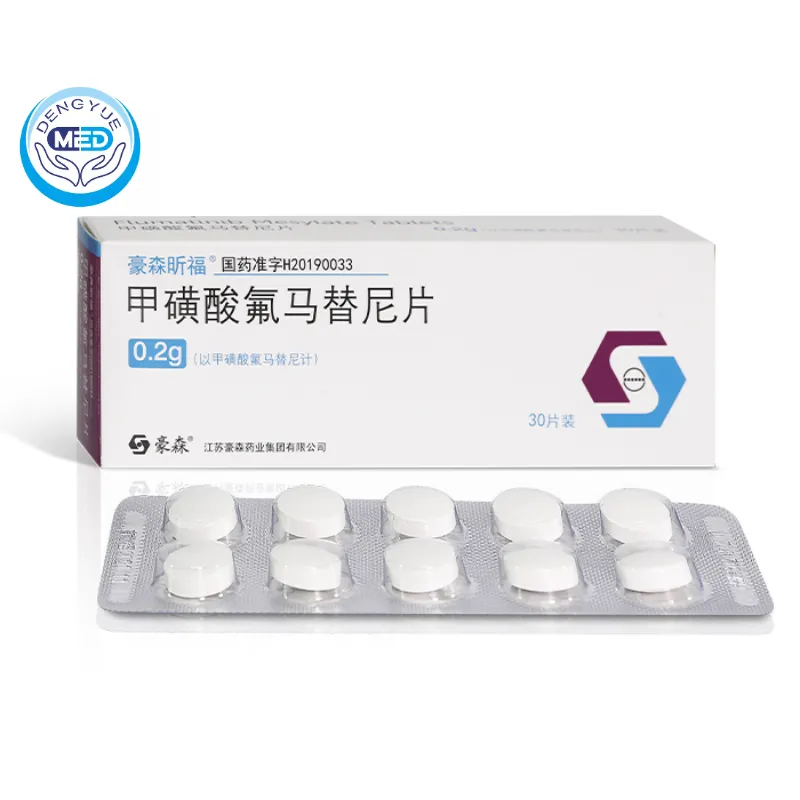
- Generic Name/Brand Name: Flumatinib Mesylate Tablets/Hansoh
- Indications: Ph+ CML
- Dosage Form: Tablets
- Specification: 200 mg × 30
Flumatinib Mesylate Tablets Application Scope
Flumatinib Mesylate Tablets are indicated for the first-line treatment of adult patients with newly diagnosed Philadelphia chromosome-positive chronic myeloid leukemia (Ph+ CML) in the chronic phase (CP). It is a small molecule tyrosine kinase inhibitor that targets Bcr-Abl kinase activity to inhibit tumor cell proliferation and induce apoptosis in Ph+ CML cells.
Flumatinib Mesylate Tablets Characteristics
-
Ingredients: The active ingredient is flumatinib mesylate. Chemical name: N-[6-methyl-5-[[4-(pyridin-3-yl)pyrimidin-2-yl]amino]pyridin-3-yl]-4-[(4-methylpiperazin-1-yl)methyl]-3-(trifluoromethyl)benzamide mesylate. Molecular formula: C₂₉H₂₉F₃N₈O·CH₄O₃S. Molecular weight: 658.69.
-
Properties: Flumatinib mesylate is a film-coated tablet, white to off-white in color. It is a selective second-generation tyrosine kinase inhibitor with improved potency against Bcr-Abl kinase compared to first-generation inhibitors like imatinib, while minimizing off-target effects.
-
Packaging Specification: 0.1 g per tablet or 0.2 g per tablet; 30 tablets per bottle or box.
-
Storage: Store in a sealed container at room temperature (below 25°C), protected from light and moisture. Keep out of reach of children.
-
Expiry Date: 36 months from the date of manufacture.
-
Executive Standard: Chinese Pharmacopoeia (ChP).
-
Approval Number: National Medical Products Administration (NMPA) Approval No.: 国药准字H20190033 (for 0.2 g specification).
-
Date of Revision: Latest revision: September 2023 (based on available updates; check packaging for the most current version).
-
Manufacturer: Jiangsu Hansoh Pharmaceutical Co., Ltd. (a subsidiary of Jiangsu Hansoh Pharmaceutical Group Co., Ltd.).
Guidelines for the Use of Flumatinib Mesylate Tablets
-
Dosage and Administration:
-
Recommended Dose: 600 mg orally once daily (qd). The dose may be adjusted based on tolerability or adverse reactions, down to 400 mg or 200 mg qd if needed.
-
Administration: Take on an empty stomach (at least 1 hour before or 2 hours after a meal), swallowed whole with water. Do not crush, chew, or dissolve the tablet.
-
Missed Dose: If a dose is missed, take it as soon as remembered unless it is close to the next scheduled dose. Do not double the dose to make up for the missed one. Consult a physician for guidance.
-
-
Adverse Reactions:
-
Common Adverse Reactions: Hematologic: Thrombocytopenia (21%), neutropenia (10%), anemia, leukopenia. Non-hematologic: Elevated liver enzymes (ALT/AST increase, 8-7%), elevated lipase (3%), edema, rash, diarrhea, fatigue, nausea. Most are mild to moderate and reversible.
-
Serious Adverse Reactions: Severe myelosuppression (≥3 grade: thrombocytopenia, neutropenia), hepatotoxicity, pleural effusion, QT prolongation, or severe skin reactions. Monitor closely and interrupt or reduce dose as needed. In clinical trials, 19% of patients required dose reduction, and 9% discontinued due to adverse events.
-
-
Contraindications: Hypersensitivity to flumatinib mesylate or any excipients in the formulation. Use is not recommended during pregnancy unless benefits outweigh risks.
-
Precautions:
-
Monitor complete blood counts (CBC) weekly for the first 2-3 months, then monthly; liver function tests (LFTs) periodically.
-
Use caution in patients with hepatic impairment (reduce dose in severe cases) or cardiac risks (monitor ECG for QT interval).
-
Women of childbearing potential should use effective contraception during treatment and for at least 3 months after discontinuation.
-
Avoid strong CYP3A4 inhibitors/inducers, as they may alter exposure.
-
Patients may experience dizziness or fatigue; caution when driving or operating machinery.
-
Flumatinib Mesylate Tablets Interactions
-
Flumatinib is metabolized primarily by CYP3A4.
-
CYP3A4 Inhibitors (e.g., ketoconazole, grapefruit juice): May increase flumatinib exposure; avoid strong inhibitors or monitor closely.
-
CYP3A4 Inducers (e.g., rifampin, St. John’s wort): May decrease efficacy; avoid if possible.
-
CYP3A4 Substrates (e.g., simvastatin): Flumatinib may increase their levels; adjust doses accordingly.
-
Proton Pump Inhibitors (e.g., omeprazole): May reduce absorption; consider alternatives like H2 blockers.
-
Warfarin: Monitor INR, as flumatinib may affect anticoagulation. No significant interactions with digoxin or midazolam in studies.
-
Note:
- If there is a new packaging for the drug, the new packaging shall prevail. The above information is sourced from DengYue Medicine.
- This content is for reference only. Prescription drugs must be used under a doctor’s guidance and purchased from authorized sources.
Related products
-

Nplate Romiplostim | Immune Thrombocytopenia | DengYueMedicine
-

Ayvakit (Avapritinib) – Systemic Mastocytosis | HongKong DengYue Medicine
-
Prednisone Acetate Tablets|Immune Inflammatory Diseases
-
Meisoindigo Tablets | Chronic Myelogenous Leukemia
-
Methotrexate 2.5mg Tablets | Cancer Chemotherapy
-
Cladribine Injection | Thrombocytopenia | HK DengYueMedicine
-

Ciltacabtagene Autoleucel|Multiple Myeloma
-
Hydroxycarbamide Tablets | Treatment of Leukemia

Reviews
There are no reviews yet.