

Padcev (Enfortumab Vedotin)|Urothelial Cancer
- Generic Name/Brand Name: Enfortumab Vedotin/Padcev
- Indications: Bladder cancer
- Dosage Form: solutions
- Specification: 20 mg vial
Enfortumab Vedotin Application Scope
Enfortumab Vedotin (EV) is a targeted therapy primarily used for the treatment of advanced or metastatic urothelial cancer (UC), particularly in patients who have previously received a PD-1 or PD-L1 inhibitor and/or platinum-based chemotherapy. It’s an antibody-drug conjugate (ADC) that links a monoclonal antibody specific to the Nectin-4 receptor, which is highly expressed in urothelial cancer cells, to a potent chemotherapy agent, monomethyl auristatin E (MMAE).
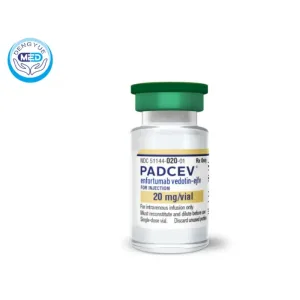
Enfortumab Vedotin Package Insert
- Ingredients: Enfortumab Vedotin consists of a monoclonal antibody (enfortumab) attached to the cytotoxic drug monomethyl auristatin E (MMAE).
- Properties: It targets and binds to Nectin-4, a protein overexpressed in several cancers, including urothelial carcinoma. Once bound, the MMAE component is internalized into the cancer cell, where it inhibits microtubule function, causing cell death.
- Specification: Generally available as a lyophilized powder for intravenous injection.
- Packaging Specification: 20 mg vial of Enfortumab Vedotin, reconstituted for IV administration.
- Storage: Store at 2-8°C (36-46°F). Do not freeze. Once reconstituted, it should be used immediately, or stored under specific conditions as outlined by the manufacturer.
- Expiry Date: Dependent on manufacturer’s specifications and lot number.
- Executive Standard: Follows approval standards set by health authorities such as the FDA.
- Approval Number: FDA approval number varies based on the approval date and region.
- Date of Revision: The latest revision of prescribing information will be available through the manufacturer and health authority updates.
- Manufacturer: Astellas Pharma, in collaboration with Seattle Genetics (now known as Seagen).
Guidelines for the Use of Enfortumab-Vedotin
- Indications: Primarily used for metastatic or locally advanced urothelial carcinoma (UC) that has progressed after previous chemotherapy or immunotherapy.
Dosage and Administration:
- Dosage: The typical dose is 1.25 mg/kg administered intravenously once a week for the first 4 weeks of a 6-week cycle, with adjustments based on tolerability and side effects.
- Administration: It is administered as an IV infusion over a period of 30 minutes. Careful monitoring during infusion is recommended for adverse reactions.
Adverse Reactions:
- Enfortumab Vedotin Side Effects: Fatigue, skin rash, peripheral neuropathy, diarrhea, and decreased appetite.
- Serious Adverse Effects: Including but not limited to ocular toxicity (e.g., vision impairment), skin reactions (such as Stevens-Johnson syndrome), and severe infections. Monitoring is important.
Contraindications:
- Known Hypersensitivity: Contraindicated in patients with hypersensitivity to enfortumab vedotin or any of its components.
- Active Ocular Toxicity: Patients with active or unresolved ocular toxicity should not be given this drug.
Precautions:
- Ocular Toxicity: Regular eye exams are recommended before, during, and after treatment to monitor for signs of eye issues such as vision impairment.
- Peripheral Neuropathy: Patients should be monitored for symptoms of neuropathy, and dosage adjustments may be required.
- Infections: Enfortumab vedotin can increase the risk of serious infections. Prophylactic antibiotics may be used in certain cases.
Enfortumab Vedotin Drug Interactions:
- Enfortumab Vedotin may interact with other drugs that affect the immune system or alter drug metabolism pathways, including cytochrome P450 enzymes. Careful consideration should be given when co-administering with chemotherapy or immune checkpoint inhibitors.
Note:
- If there is a new packaging for the drug, the new packaging shall prevail. The above information is sourced from HongKong DengYue Medicine. It is only for internal discussion among medical staff and does not serve as a basis for medication. For specific medication guidelines, please consult the attending physician.
Contact Us
Reviews
There are no reviews yet.