
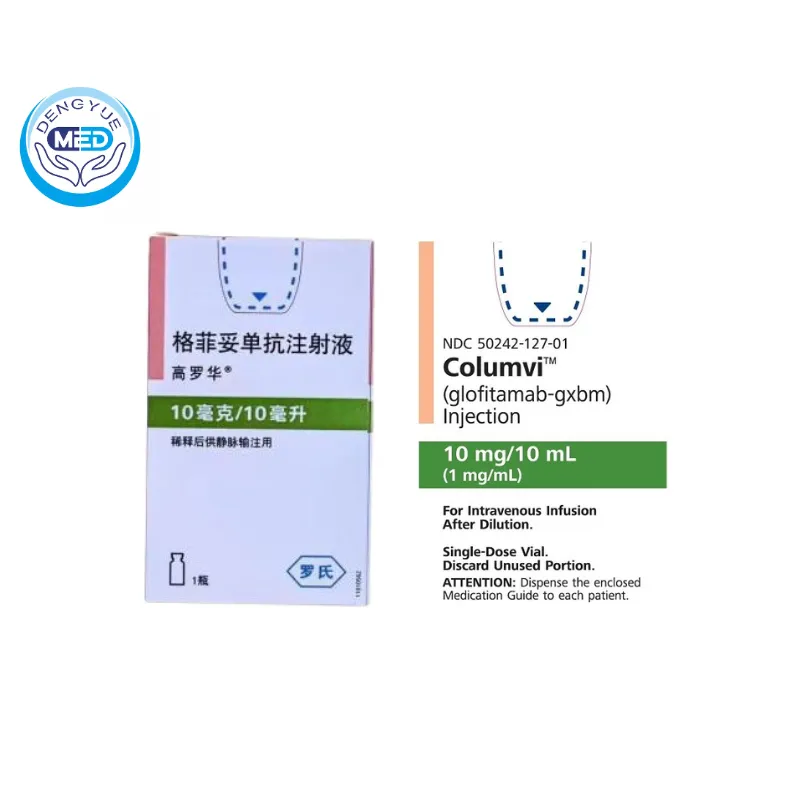
Columvi (Glofitamab) – DLBCL | HongKong DengYue Medicine
- Generic Name/Brand Name: Glofitamab/Columvi
- Indications: DLBCL
- Dosage Form: Injection
- Specification: 10mg (10ml) x 1 vial
Glofitamab Application Scope
Glofitamab (brand name: COLUMVI, glofitamab-gxbm) is indicated for the treatment of adult patients with relapsed or refractory diffuse large B-cell lymphoma (DLBCL, NOS) or large B-cell lymphoma (LBCL) arising from follicular lymphoma after two or more lines of systemic therapy.
In the EU the marketing authorisation has been expanded to include a Columvi + GemOx regimen for certain patients with R/R DLBCL (see local labels).
Glofitamab Characteristics
-
Ingredients:
-
Active: glofitamab-gxbm (glofitamab), a recombinant humanised bispecific monoclonal antibody (binds CD20 on B cells and CD3 on T cells).
-
Excipients (examples listed in EU label): L-histidine, L-histidine hydrochloride monohydrate, L-methionine, sucrose, polysorbate 20, water for injections.
-
-
Properties:
-
Mechanism: CD20 × CD3 bispecific IgG1 that redirects T-cells to kill CD20-expressing B cells.
-
Form: concentrate for solution for infusion (sterile, preservative-free, colourless clear solution).
-
-
Packaging Specification: Supplied as single-use vials (concentrate 1 mg/mL): 2.5 mg / 2.5 mL vial and 10 mg / 10 mL vial (1 mg/mL). Pack size typically 1 vial per carton (refer to local carton).
-
Storage:
-
Store refrigerated 2 °C to 8 °C (36–46 °F) in original carton to protect from light. Do not freeze. Do not shake.
-
After dilution: if not used immediately, diluted solution may be stored refrigerated (2–8 °C) up to the time window stated in the local label (e.g., up to 64 hours refrigerated or 4 hours at room temp per US label; other regions may specify similar limits).
-
-
Expiry Date: See the carton and vial label (the expiry (“EXP”) printed). Product shelf life stated in some local product monographs ≈ 30 months from manufacture (confirm on carton’s EXP).
-
Executive Standard: Conforms to the approved product information / prescribing information authorised by local regulatory agencies (e.g., US FDA Prescribing Information; EMA Product Information). Always follow the locally authorised label.
-
Approval Number: United States (BLA): BLA 761309 (Columvi). (Refer to the FDA approval documents). EU: conditional marketing authorisation (July 2023) converted to standard MA; see EMA EPAR for product number.
-
Date of Revision: Refer to the latest prescribing information / EPAR PDF date on the carton or regulators’ websites (e.g., FDA label June 15, 2023; EMA EPAR last updated June 4, 2025).
-
Manufacturer: Columvi
Guidelines for the Use of Glofitamab
-
Dosage and Administration: Glofitamab is given by intravenous infusion using a step-up dosing schedule to reduce risk of cytokine release syndrome (CRS). Treatment cycles are 21 days. Administer only in healthcare settings with immediate access to emergency care and trained staff.
-
Recommended Dose:
-
Pretreatment: single dose of Obinutuzumab 1,000 mg IV on Cycle 1 Day 1 (to deplete circulating/lymphoid B cells) — per label.
-
Step-up (Cycle 1): Day 8 — 2.5 mg (infuse ~4 hours); Day 15 — 10 mg (infuse ~4 hours).
-
Maintenance (Cycle 2–12): 30 mg IV on Day 1 of each 21-day cycle (infusion time may be reduced to ~2 hours if prior doses tolerated). Continue for up to 12 cycles total (including step-up) or until disease progression/unacceptable toxicity.
-
-
Administration: Administer via dedicated infusion line with a sterile 0.2-µm in-line filter; dilute as directed in the label; follow aseptic technique.
Premedicate before each dose (dexamethasone, acetaminophen, antihistamine per label) to reduce CRS/infusion reactions. Hospitalize patients during and for 24 hours after completion of the first step-up dose (2.5 mg); hospitalization for subsequent doses depends on CRS history per label. -
Missed Dose: If a dose is delayed, follow the label’s restart/repeat recommendations (e.g., repeat prior step doses or repeat obinutuzumab pretreatment if delay exceeds specified windows). See the label’s Table for exact timing and actions.
-
-
Adverse Reactions:
-
Common Adverse Reactions: Cytokine Release Syndrome (CRS) (very common), pyrexia, fatigue, neutropenia, anemia, thrombocytopenia, decreased fibrinogen, infusion-related reactions, nausea, constipation, headache, musculoskeletal pain, rash.
-
Serious Adverse Reactions: Severe or fatal CRS, neurologic toxicity / ICANS (encephalopathy, seizures, confusion), serious infections including opportunistic infections (some fatal), tumor-flare with local complications, tumor lysis syndrome. Monitor and manage per label recommendations.
-
-
Contraindications: Refer to the locally authorised product information for full contraindications. (No absolute contraindications listed in some labels beyond hypersensitivity to the active substance or excipients; however, use is contraindicated in the presence of severe uncontrolled infections or conditions making CRS/neurologic monitoring impossible). Always check the local label.
-
Precautions:
-
Risk of CRS — implement step-up dosing, premedication, monitoring, and have tocilizumab/other supportive measures available.
-
Neurologic toxicity (ICANS) — monitor neurologic status; withhold or permanently discontinue depending on severity.
-
Infections — screen for and manage infections; consider antiviral/PJP prophylaxis where appropriate.
-
Reproductive risk — potential embryo-foetal toxicity; advise effective contraception during treatment and for 1 month after last dose.
-
Use in special populations — follow label guidance for hepatic/renal impairment, pregnancy, lactation, and paediatric use (not established).
-
Glofitamab Interactions
- No formal drug interaction studies of glofitamab have established specific pharmacokinetic drug–drug interactions; however, concomitant immunosuppressive therapies, live vaccines, or therapies increasing infection risk require caution. Refer to local label for interaction and concomitant therapy guidance.
Note:
- If there is a new packaging for the drug, the new packaging shall prevail. The above information is sourced from DengYue Medicine.
- This content is for reference only. Prescription drugs must be used under a doctor’s guidance and purchased from authorized sources.
Related products
-

Zevorcabtagene Autoleucel Injection|Multiple Myeloma
-

Ubenimex Capsules|Enhancement of immune function
-
Imatinib Mesylate Tablets | Leukaemia
-
Ciltacabtagene Autoleucel|Multiple Myeloma
-
Ubenimex Capsules | Anti-Cancer Chemotherapy
-
Nimustine Hydrochloride for Injection | Brain Cancer
-
Simoctocog Alfa|Hemophilia A|HongKong DengYue Medicine
-
Piasky Crovalimab | Paroxysmal Nocturnal Hemoglobinuria

Reviews
There are no reviews yet.