

Innovative Lung Cancer Drug Asandeutertinib Approved: Deuterated Third-Generation EGFR-TKI for Brain Metastases
Treatment options for EGFR-mutated lung cancer continue to expand, but for patients with central nervous system (CNS) metastases, intracranial disease control remains an important clinical consideration.
On August 25, 2026, Asandeutertinib mesylate tablets were approved by China’s NMPA for first-line treatment of adult patients with locally advanced or metastatic non-small cell lung cancer (NSCLC) harboring specific EGFR mutations and CNS metastases.
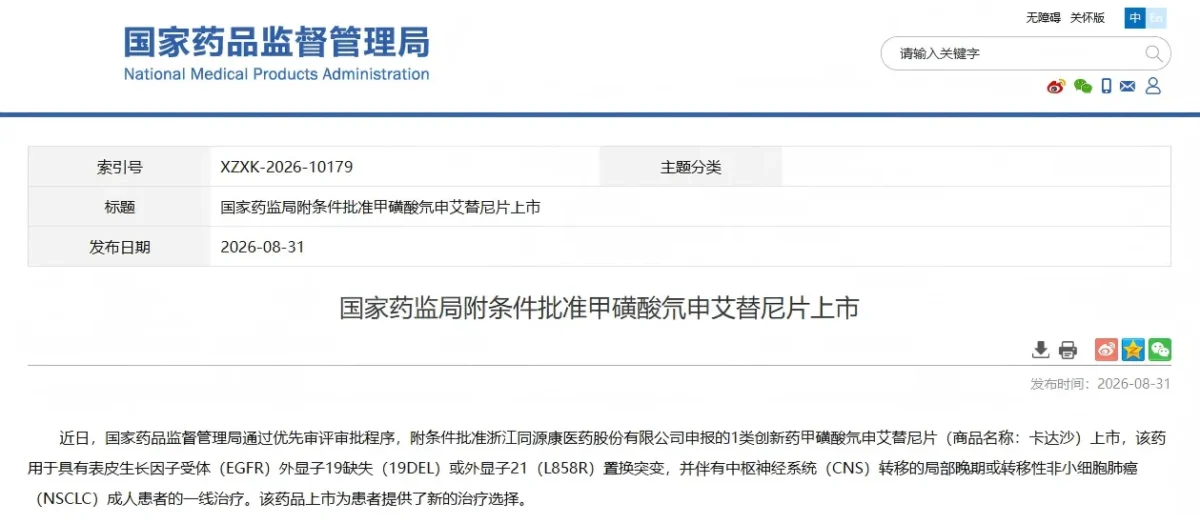
The approval of innovative lung cancer drug asandeutertinib provides a new treatment option for patients with lung cancer brain metastases and further expands the clinical application of deuterated EGFR-TKIs.
In this article, DengYueMed explores asandeutertinib, including its basic characteristics, mechanism of action, and clinical development in EGFR-mutated NSCLC with CNS metastases.
What Is Asandeutertinib Mesylate? How Does It Work?
Asandeutertinib mesylate is a new-generation, highly selective, irreversible oral EGFR-TKI independently developed by TYK Medicines. As a differentiated deuterated innovative derivative of osimertinib, the drug is being developed for EGFR-mutated NSCLC.
As an innovative lung cancer drug asandeutertinib, its development focuses in part on the clinical setting of EGFR-mutated NSCLC with CNS metastases, exploring a targeted treatment approach with potential for intracranial activity.

Basic Information About Asandeutertinib Mesylate
| Item | Basic Information |
|---|---|
| Generic name | Asandeutertinib Mesylate |
| Brand name | Kardorisso®/卡达沙® |
| Development code | TY-9591 |
| Drug class | Third-generation EGFR-TKI |
| Molecular characteristic | Deuterated EGFR-TKI |
| Dosage form | Tablet |
| China approval date | August 25, 2026 |
| Regulatory authority | National Medical Products Administration (NMPA) |
| Marketing authorization holder | Zhejiang Tongyuankang Pharmaceutical Co., Ltd. (TYK Medicines, Inc.) |
| Approved indication | First-line treatment of adult patients with locally advanced or metastatic NSCLC harboring EGFR exon 19 deletion (19DEL) or exon 21 L858R substitution mutations and CNS metastases |
| Key clinical study | ESAONA |
Mechanism of Action of Asandeutertinib Mesylate
EGFR is an important driver gene in NSCLC. Certain EGFR mutations can lead to persistent activation of EGFR signaling pathways, promoting tumor cell growth, proliferation, and survival.
Innovative lung cancer drug asandeutertinib is a third-generation EGFR-TKI that primarily binds to mutant EGFR and inhibits its tyrosine kinase activity, thereby blocking abnormal EGFR signaling and suppressing the proliferation of tumor cells driven by EGFR mutations.
As a deuterated EGFR-TKI, asandeutertinib incorporates deuterium in place of hydrogen at specific positions within its molecular structure.
Deuteration is primarily used to explore changes in drug metabolism and pharmacokinetic characteristics, providing an additional approach to molecular optimization in drug development.
Why Do Brain Metastases Remain a Clinical Challenge in EGFR-Mutated Lung Cancer?
EGFR mutations are important driver alterations in NSCLC, with exon 19 deletion (19DEL) and L858R being common sensitizing mutations relevant to EGFR-TKI treatment.
With the development of third-generation EGFR-TKIs, patients with EGFR-mutated NSCLC now have multiple targeted treatment options. However, CNS metastases remain an important challenge in disease management.
The main challenges include two aspects:
- Brain metastases increase disease burden: When lung cancer cells spread to the brain and form metastatic lesions, they may affect neurological function and quality of life.
- Intracranial treatment presents challenges: The blood-brain barrier may limit the penetration of some drugs into the central nervous system. Therefore, systemic efficacy does not always fully reflect the control of intracranial lesions.
For patients with CNS metastases, treatment evaluation therefore needs to consider not only systemic efficacy measures such as ORR and PFS, but also intracranial efficacy endpoints such as iORR and iPFS.

What Is the Significance of Asandeutertinib for Lung Cancer Brain Metastases?
The approval specifically covers adults with locally advanced or metastatic NSCLC harboring EGFR 19DEL or L858R mutations and CNS metastases in the first-line setting.
The clinical significance can mainly be considered from three aspects:
1. A Specific Indication for CNS Metastases
The approved population directly includes patients with EGFR 19DEL or L858R mutations and CNS metastases, focusing on the specific clinical setting of lung cancer brain metastases.
2. Focus on Intracranial Efficacy
Asandeutertinib follows a deuterated third-generation EGFR-TKI development strategy, with clinical studies evaluating endpoints such as iORR and iPFS to assess treatment outcomes from the perspective of intracranial disease control.
3. A New Targeted Treatment Option
For eligible patients with EGFR-mutated NSCLC and CNS metastases, the approval adds another third-generation EGFR-TKI treatment option and provides additional clinical data for the application of deuterated EGFR-TKIs in the setting of CNS metastases.
✨ Overall, the approval of innovative lung cancer drug Asandeutertinib highlights its specific clinical positioning in EGFR-mutated NSCLC with CNS metastases, with a particular focus on intracranial efficacy.

Asandeutertinib Clinical Data: What Did the ESAONA Trial Show?
An important clinical basis for the approval of Asandeutertinib was the pivotal Phase II ESAONA study (NCT05948813).
The ESAONA trial was a multicenter, randomized, open-label, positive-controlled study that enrolled 224 patients with EGFR-mutated NSCLC and CNS metastases. Patients were randomized 1:1 to receive Asandeutertinib 160 mg once daily or Osimertinib 80 mg once daily.
| Key Endpoint | Asandeutertinib | Osimertinib |
|---|---|---|
| iORR | 95.5% | 79.6% |
| Median iPFS | Not reached | 17.51 months |
| iPFS HR | 0.46 | — |
| ORR | 89.2% | 77.9% |
| Median PFS | Not reached | 17.22 months |
| PFS HR | 0.64 | — |
According to blinded independent central review (BICR), the iORR was 95.5% with Asandeutertinib compared with 79.6% with osimertinib (P=0.0004). Median iPFS was not reached in the Asandeutertinib group and was 17.51 months in the osimertinib group (HR=0.46, P=0.0020).
For overall efficacy, the ORR was 89.2% and 77.9% in the two groups, respectively, while median PFS was not reached with Asandeutertinib and was 17.22 months with osimertinib.
From the ESAONA study, three aspects can be highlighted:
- Study design: The ESAONA trial used a randomized, positive-controlled design with osimertinib as the comparator, providing direct comparative data for asandeutertinib.
- Intracranial efficacy: The iORR was 95.5% with Asandeutertinib, while median iPFS was not reached. Both endpoints showed statistically significant differences between the treatment groups.
- Overall efficacy: The ORR was 89.2% with Asandeutertinib, while median PFS was not reached. These systemic efficacy findings, together with the intracranial efficacy results, formed an important part of the clinical evaluation.
The available asandeutertinib clinical data therefore include both intracranial and systemic efficacy outcomes from a randomized comparison with osimertinib. The findings provide clinical evidence for its development as a treatment option for EGFR-mutated NSCLC with brain metastases.
Conclusion
he approval of innovative lung cancer drug asandeutertinib provides an additional treatment option for adults with EGFR 19DEL or L858R-mutated NSCLC and CNS metastases.
As a deuterated third-generation EGFR-TKI, asandeutertinib has shown intracranial efficacy in the ESAONA study compared with osimertinib. Its long-term efficacy, safety, and broader clinical application require further evaluation.
As a China pharmaceutical exporter, DengYueMed continues to follow Chinese pharmaceutical innovation and global market developments, leveraging its China online pharmacy resources to support connections between pharmaceutical resources in China and international markets.
FAQ about Innovative Lung Cancer Drug Asandeutertinib
What is Asandeutertinib?
Asandeutertinib is a deuterated third-generation EGFR-TKI developed for EGFR-mutated non-small cell lung cancer (NSCLC).
What is Asandeutertinib approved for?
Asandeutertinib is approved in China for first-line treatment of adults with locally advanced or metastatic NSCLC with EGFR 19DEL or L858R mutations and CNS metastases.
How does Asandeutertinib work?
Asandeutertinib works by inhibiting mutant EGFR tyrosine kinase activity and blocking abnormal EGFR signaling.
What clinical data support Asandeutertinib?
The Phase II ESAONA trial reported an iORR of 95.5% and a median iPFS that had not been reached with Asandeutertinib.
Is Asandeutertinib being studied for lung cancer brain metastases?
Yes, its clinical development specifically includes EGFR-mutated NSCLC with CNS metastases, including lung cancer brain metastases.