

What is The Mechanism of Action of Dalpiciclib (Airuikang)? Targeting the CDK4/6 Pathway in HR-Positive Breast Cancer
For patients diagnosed with HR-positive, HER2-negative breast cancer, treatment is often not a single drug but a carefully designed strategy.
Among the most important advances in recent years is the introduction of CDK4/6 inhibitors, and Dalpiciclib Isethionate (Airuikang) is one of them.
In the sections that follow, let’s explore what is the mechanism of action of dalpiciclib together, guided by Dengyue Medicine’s perspective, to better understand how and why this therapy works.
What is Dalpiciclib (Airuikang)? —The Precise “Cell Cycle Brake”
In modern oncology, precision targeted therapy has fundamentally reshaped the cancer treatment landscape.
Among these advances, the emergence of CDK4/6 inhibitors has brought new hope to patients with hormone receptor (HR)-positive breast cancer.
Dalpiciclib isethionate (Airuikang) is the first domestically developed CDK4/6 inhibitor in China. It represents not only a major scientific breakthrough in targeting this critical pathway but also a meaningful new therapeutic option for countless patients—driven by a clearly defined and highly targeted mechanism of action.
.webp "What is The Mechanism of Action of Dalpiciclib (Airuikang)? Targeting the CDK4/6 Pathway in HR-Positive Breast Cancer 1")
What Is a CDK4/6 Inhibitor?
To understand the mechanism of action of dalpiciclib, it is essential to first understand the role of CDK4 and CDK6.
✨ These proteins—cyclin-dependent kinases 4 and 6—are key regulators of the cell cycle, the tightly controlled process that governs cell growth and division.
The cell cycle can be compared to a highly regulated production line. CDK4/6 function as the speed regulators of this line, determining whether a cell is allowed to proceed to the next stage of division.
Under normal conditions, cells progress through four stages:
- G1 phase (cell growth)
- S phase (DNA synthesis)
- G2 phase (preparation for division)
- M phase (cell division)
CDK4/6 control the critical checkpoint between the G1 and S phases.
When this checkpoint functions properly, cells divide only when needed. When it becomes dysregulated, cells continue dividing without restraint—one of the fundamental biological hallmarks of cancer.
Why Target CDK4/6 in HR-Positive Breast Cancer?
In HR-positive breast cancer, this regulatory mechanism is particularly disrupted.
Tumor growth in this subtype is highly dependent on estrogen signaling, and CDK4/6 plays a central intermediary role in transmitting these growth signals.
Specifically, in HR-positive breast cancer cells:
- Persistent pathway activation: Growth signaling remains abnormally active, even under normal estrogen levels.
- CDK4/6 overactivation: These kinases remain continuously “switched on,” similar to a car with the accelerator pressed down at all times.
- Uncontrolled cell proliferation: Constant CDK4/6 activation drives cells repeatedly through the cell cycle checkpoint, leading to rapid tumor growth.
This biological understanding led to the development of CDK4/6 inhibitors, which differ fundamentally from traditional chemotherapy.
👉 Rather than indiscriminately killing rapidly dividing cells, they selectively inhibit overactive CDK4/6, stopping cancer cell proliferation at its source.
Dalpiciclib Isethionate: How Does It Apply the “Brake”?
As a highly selective CDK4/6 inhibitor, dalpiciclib acts with precision and efficiency. Its mechanism can be clearly described as a three-step targeted process: recognition, binding, and blockade.
- Step 1: High-Precision Target Recognition
The dalpiciclib structure is carefully designed to function like a highly specialized molecular key. It selectively binds to the active sites of CDK4 and CDK6 with high affinity, while exerting minimal effects on other CDK family members.

This selectivity helps preserve normal cellular function and reduces off-target toxicity.
- Step 2: Deep Inhibition of Kinase Activity
Once bound, dalpiciclib alters the three-dimensional conformation of CDK4/6, preventing them from forming an active complex with cyclin D. As a result, CDK4/6 can no longer phosphorylate the downstream retinoblastoma (Rb) protein.
Rb functions as the master “gatekeeper” of cell division. CDK4/6 normally open this gate; dalpiciclib keeps it firmly closed.
- Step 3: G1 Phase–Specific Cell Cycle Arrest
Without Rb phosphorylation, cancer cells are arrested in the G1 phase, unable to enter the S phase and replicate their DNA. Importantly, this arrest is reversible—once treatment is paused, normal cells can resume their regulated cell cycle.
👉 This explains why the safety profile of dalpiciclib is generally manageable.
From Molecular Mechanism to Clinical Strategy: Synergistic Treatment Design
The dalpiciclib mechanism of action makes it ideally suited for combination with endocrine therapy—a strategy that reflects the modern principle of therapeutic synergy.
- Endocrine therapy (aromatase inhibitors or fulvestrant) cuts off the tumor’s “fuel supply” by reducing estrogen signaling.
- Dalpiciclib disables the tumor’s “engine” by blocking cell cycle progression, preventing cancer cells from dividing even if residual growth signals remain.
This dual approach targets the two core vulnerabilities of HR-positive breast cancer: hormone dependence and cell cycle dysregulation.
In summary, the value of dalpiciclib isethionate (Airuikang) lies in its clear and highly targeted mechanism of action. By selectively inhibiting CDK4 and CDK6, dalpiciclib directly interferes with the core process that drives tumor cell proliferation—cell cycle progression.
Rather than attacking cancer cells indiscriminately, dalpiciclib acts as a precise “cell cycle brake,” keeping cancer cells arrested in the G1 phase and preventing uncontrolled division. When combined with endocrine therapy, it simultaneously blocks both hormone-driven growth signals and cell cycle activation, resulting in a rational, synergistic treatment strategy.
Who Is Dalpiciclib For? Understanding Why This Treatment Is Chosen
After understanding how dalpiciclib works, the next natural question for many readers is simple: Who is this treatment actually for?
❗ The answer starts with an important fact that is often overlooked: not all breast cancers are the same.
Not All Breast Cancers Behave the Same Way
Although they share the same name, breast cancers can behave very differently inside the body.
👉 Some breast cancers grow mainly because they respond strongly to female hormones such as estrogen. These are known as hormone receptor–positive (HR-positive) cancers. Others are driven by different biological signals and require very different treatments.
In HR-positive breast cancer, hormones act like a growth signal, telling cancer cells when to divide. That is why hormone (endocrine) therapy is often the foundation of treatment.
However, hormone signals are only part of the story.
Why Dalpiciclib Fits HR-Positive Breast Cancer
As explained in the first section, dalpiciclib works by directly interfering with the cell division process that drives tumor growth.
In HR-positive, HER2-negative breast cancer, tumor cells rely on two closely connected biological pathways to proliferate.
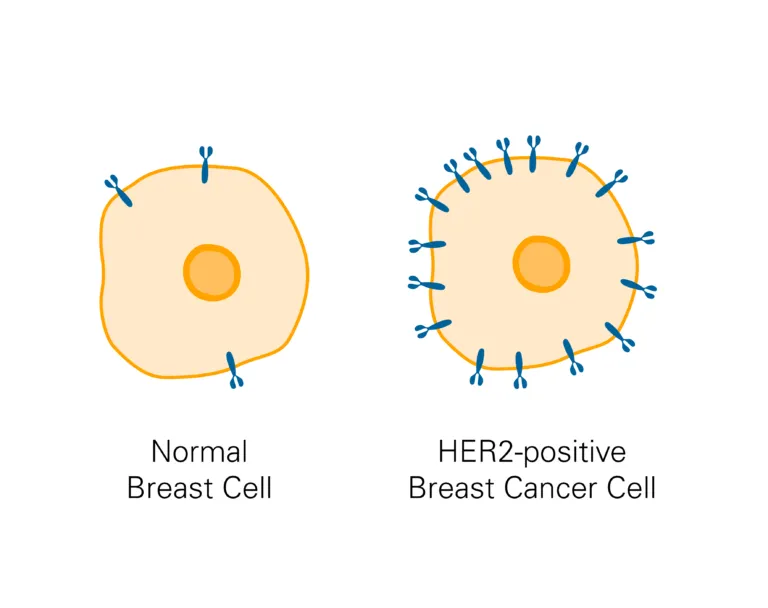
- The first is hormone signaling, which stimulates cancer cell growth.
- The second is cell cycle activation, which allows those growth signals to translate into actual cell division.
CDK4 and CDK6 play a central role in this second pathway by regulating the transition of cells from the G1 phase to the DNA replication phase.
While endocrine therapy reduces or blocks hormone signaling, it does not always fully shut down cell cycle activity. In some cases, cancer cells are still able to activate CDK4/6 and continue dividing despite reduced hormone stimulation.
Dalpiciclib addresses this gap by selectively inhibiting CDK4 and CDK6, preventing cancer cells from progressing through the cell cycle. By blocking this critical downstream pathway, dalpiciclib limits tumor cell proliferation even when residual growth signals remain.
This is why dalpiciclib is particularly effective in HR-positive, HER2-negative breast cancer: it targets a key biological dependency that these cancer cells rely on for continued growth.
When Might a Doctor Recommend Dalpiciclib?
For patients and families, treatment decisions can feel overwhelming. Doctors usually consider dalpiciclib in situations where the goal is long-term control rather than short-term intensity.
Common situations include:
- A patient newly diagnosed with advanced or metastatic HR-positive breast cancer
- A patient whose cancer has started to progress on hormone therapy alone
- A patient who wishes to delay or avoid chemotherapy if possible
- A patient who values maintaining daily life and independence during treatment
In these cases, dalpiciclib is often combined with hormone therapy to strengthen its effect and help keep the disease under control for a longer time.
In summary, dalpiciclib works by targeting the cell cycle pathway that allows cancer cells to continue dividing. By inhibiting CDK4 and CDK6, it blocks a critical step in tumor cell proliferation that may remain active even when hormone signaling is reduced.
✨ This complementary mechanism explains why dalpiciclib strengthens the effect of endocrine therapy and plays an important role in controlling HR-positive, HER2-negative breast cancer.
Key Advantages: Why Is Dalpiciclib Gaining Attention?
As more CDK4/6 inhibitors become available, dalpiciclib stands out not simply because it is a new option, but because it delivers balanced performance across innovation, efficacy, safety, and long-term treatment feasibility—factors that matter greatly to patients facing a chronic disease like breast cancer.
✨ Its strengths are often summarized in one phrase: domestically developed, effective, and well controlled. Behind these words are several concrete advantages that directly influence treatment decisions and patient confidence.
1️⃣ A First-in-China Innovation Designed for Chinese Patients
Dalpiciclib is the first domestically developed CDK4/6 inhibitor in China, representing a major breakthrough at a critical therapeutic target in breast cancer. This milestone marked China’s transition from relying solely on imported therapies to contributing original innovation in this important field.
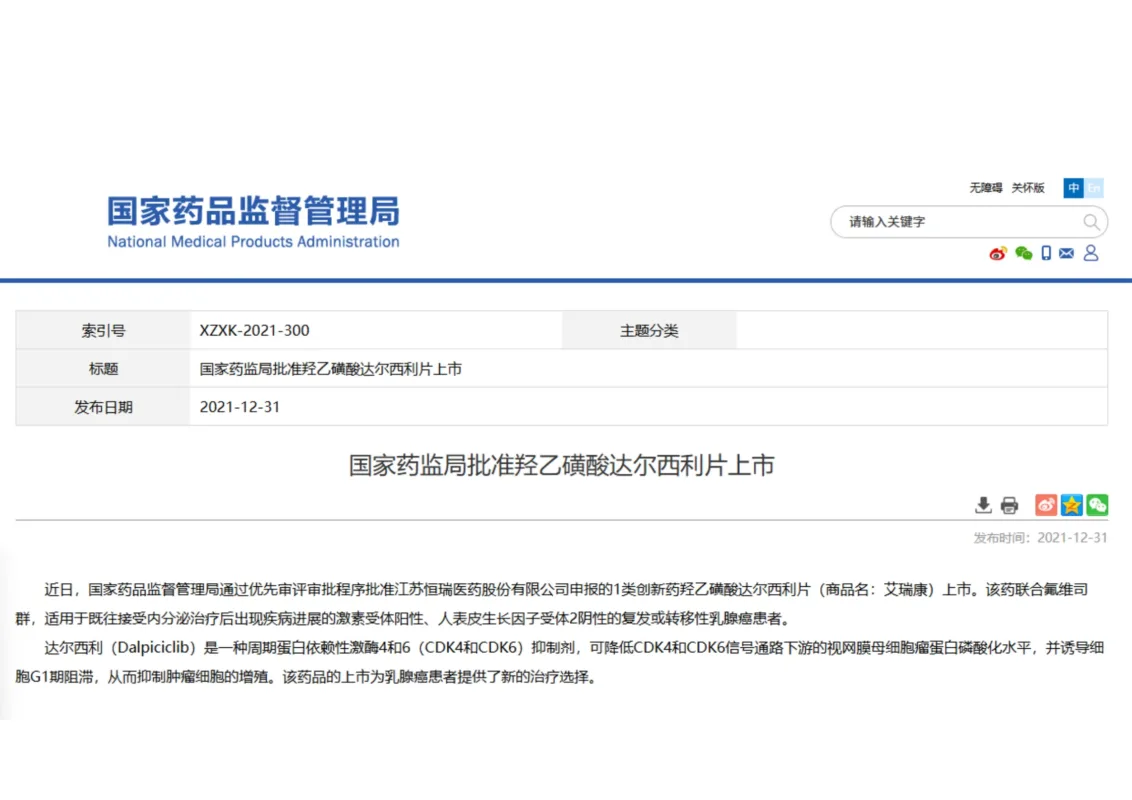
Equally important, dalpiciclib was not developed in isolation from local clinical realities. Its pivotal clinical studies were conducted primarily in Chinese patients with HR-positive, HER2-negative breast cancer, ensuring that both efficacy and safety data closely reflect real-world use in this population.
✅ What does this mean for patients? It means access to a high-quality treatment option that has been rigorously tested in people with similar genetic backgrounds, treatment patterns, and clinical characteristics.
2️⃣ Proven Efficacy Supported by Solid Clinical Evidence
Effectiveness is ultimately measured by clinical outcomes, and dalpiciclib’s performance is supported by robust data.
In international, multicenter Phase III trials (the DAWNA study program), dalpiciclib in combination with endocrine therapy demonstrated a significant improvement in progression-free survival (PFS) compared with endocrine therapy alone. This indicates that tumor growth can be controlled for a longer period, delaying disease progression.
From a broader perspective, the overall efficacy of dalpiciclib-based combination therapy has been shown to be comparable to that of other globally used CDK4/6 inhibitors, providing clinicians and patients with confidence in its antitumor activity.
3️⃣ A Key Strength: Favorable and Manageable Safety Profile
For treatments intended to be used over months or even years, safety and tolerability are just as important as efficacy. This is one area where dalpiciclib has gained strong recognition among clinicians.
Like all CDK4/6 inhibitors, dalpiciclib can cause neutropenia, a decrease in white blood cells related to bone marrow suppression. However, clinical data show several reassuring features:
- A very low incidence of febrile neutropenia (<1%), indicating a minimal risk of serious infection
- Short duration and good reversibility of bone marrow suppression, allowing recovery with appropriate monitoring and dose adjustments
- Relatively low overall risk of liver toxicity, supporting long-term treatment use
✨ For patients, this translates into greater treatment continuity and peace of mind, with fewer interruptions caused by severe adverse events.
4️⃣ Flexible Dosing Supports Long-Term, Individualized Treatment
Every patient responds differently to therapy. Dalpiciclib offers clear and flexible dose-adjustment pathw (for example, 150 mg → 125 mg → 100 mg), enabling physicians to tailor treatment based on individual tolerance.
Rather than discontinuing therapy at the first sign of side effects, clinicians can adjust the dose while maintaining therapeutic benefit. This flexibility is especially valuable in long-term disease management, where sustainability of treatment is critical.
Overall, dalpiciclib’s value lies not only in its mechanism of action but also in its balanced clinical profile—delivering reliable efficacy while maintaining manageable safety and flexibility for long-term use.
✨ These qualities make it a meaningful treatment option for patients with HR-positive, HER2-negative breast cancer and an important contribution from China to global breast cancer care.
How Is Dalpiciclib Taken?
Understanding how to take dalpiciclib correctly is just as important as understanding how it works. Proper dosing, timing, and monitoring all play a critical role in ensuring both effectiveness and safety during treatment.
- Standard Dosage
The recommended starting dose of dalpiciclib is 150 mg taken once daily.
This dose has been established through clinical trials to provide effective CDK4/6 inhibition while maintaining an acceptable safety profile for most patients.
However, it is important to remember that dosing may be adjusted by your doctor based on individual tolerance and laboratory results.
- The Classic Treatment Cycle: “3 Weeks On, 1 Week Off”
Dalpiciclib is taken following a 28-day treatment cycle, commonly described as:
- 21 consecutive days of daily dosing
- Followed by 7 days without the drug
This “3 weeks on, 1 week off” schedule allows the medication to continuously suppress cancer cell division while giving the body—especially the bone marrow—time to recover during the break.
To ensure stable absorption and reduce stomach discomfort, dalpiciclib should be taken with food or immediately after a meal. Taking it at roughly the same time each day can also help maintain consistent drug levels in the body.
- Monitoring Is Essential for Safe Use
Regular monitoring is a cornerstone of safe dalpiciclib treatment.
During therapy, doctors will routinely check:
- Complete blood counts, to monitor white blood cells and detect neutropenia early
- Liver function tests, to ensure the liver is tolerating the medication well
These tests are not optional—they allow potential side effects to be identified early and managed proactively, often before symptoms are felt.
4️⃣ Managing Common Side Effects
In addition to bone marrow suppression, some patients may experience side effects such as:
- Fatigue
- Nausea
- Diarrhea or mild gastrointestinal discomfort
For most patients, these reactions are mild to moderate and manageable.
Importantly, patients should not stop or adjust the medication on their own. Prompt communication with the treating physician allows for timely guidance, supportive care, or dose adjustments when needed.
Airuikang is taken once daily in a structured 28-day cycle designed to balance effectiveness with safety.
✅ When used as directed, with regular monitoring and open communication with healthcare providers, most patients are able to continue treatment smoothly and benefit from its mechanism of action over the long term.
Conclusion
This article provides a clear, patient-focused overview of what is the mechanism of action of dalpiciclib and why it matters in the treatment of HR-positive, HER2-negative breast cancer, aims to help readers better understand the rationale behind this treatment choice and support informed discussions with healthcare professionals.
✨ The success of dalpiciclib isethionate reflects China’s pharmaceutical innovation journey—from following global advances, to moving in parallel, and even leading in certain areas.
As a global medicine distributor, we believe that understanding treatment mechanisms empowers patients to engage more confidently in care decisions, communicate more effectively with their healthcare providers, and approach long-term therapy with greater clarity and reassurance.
FAQ about What is The Mechanism of Action of Dalpiciclib?
How does the CDK4/6 inhibitor work?
By reducing the activity of CDKs 4 and 6, these inhibitor drugs restore the growth-suppressive properties of the retinoblastoma (Rb) protein, which is a control point for cell division.
What is the mechanism of action of integrase inhibitors?
INSTIs work by blocking retroviral integration, an essential step in the viral lifecycle that is catalyzed by the virally encoded IN protein within a nucleoprotein assembly called an intasome.
Why do integrase inhibitors cause weight gain?
Potential Mechanisms of Weight Gain and Fat Changes with Integrase Inhibitors. The cause of the differential weight gain with INSTIs is unknown.
What class of drug is integrase?
Integrase inhibitors (INIs) are a class of antiretroviral drugs designed to block the action of integrase, a viral enzyme that inserts the viral genome into the DNA of the host cell.