
5 Stages of Bladder Cancer: What You Need to Know to Protect Your Health
Bladder cancer is one of the most common malignant tumors of the urinary system, with its incidence rate increasing year by year. Many people feel a sense of dread when they hear the word “cancer,” instinctively assuming it is an extremely serious condition.
So, how serious is bladder cancer exactly?The answer lies in understanding the 5 stages of bladder cancer: Its severity varies from person to person and depends primarily on the stage at which it is detected.
Bladder cancer symptoms detected early may not be very serious and can often be treated effectively, posing a relatively minor threat to the patient’s life. However, advanced bladder cancer, especially when the tumor has invaded the muscle layer or metastasized, is indeed a serious condition.
At Hong Kong DengYue Medicine, we emphasize the importance of understanding these warning signs to help healthcare professionals and patients detect cervical cancer early and select the most effective treatments.
Understanding TNM Staging: The Doctor’s Language for Bladder Cancer
The TNM system is the most common method doctors use to stage bladder cancer. This system provides a detailed understanding of how far the cancer has progressed.
TNM stands for Tumor, Node, and Metastasis—three key aspects that determine the cancer’s stage and severity:
- T (Tumor): Describes how deeply the cancer has grown into the bladder wall and nearby tissues
- N (Node): Indicates whether cancer has spread to nearby lymph nodes
- M (Metastasis): Shows whether cancer has spread to distant parts of the body
Detailed TNM Staging: What Each Stage Means
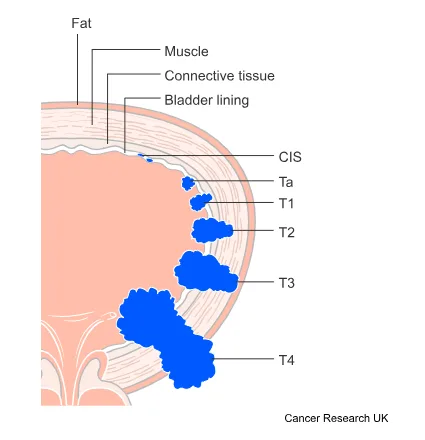
Tumor (T) Stages
The T category is divided into several stages that describe the cancer’s invasion depth:
Non-Muscle-Invasive Bladder Cancer:
- Tis (Carcinoma in situ): Very early, high-grade cancer cells are only in the innermost layer of the bladder lining
- Ta: The cancer is confined to the innermost layer of the bladder lining
- T1: The cancer has started to grow into the connective tissue beneath the bladder lining
Muscle-Invasive Bladder Cancer:
- T2: The cancer has grown through the connective tissue into the muscle
- T2a: Invasion into the superficial muscle
- T2b: Invasion into the deeper muscle
- T3: The cancer has grown through the muscle into the fat layer
- T3a: Microscopic invasion into the fat layer
- T3b: Macroscopic invasion visible on tests or examination
- T4: The cancer has spread outside the bladder
- T4a: Spread to the prostate, womb (uterus) or vagina
- T4b: Spread to the wall of the pelvis or abdomen
Node (N) Stages
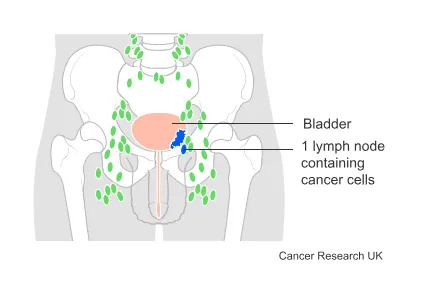
The N category describes lymph node involvement:
- N0: No cancer cells in any lymph nodes
- N1: Cancer in one lymph node in the pelvis
- N2: Cancer in multiple lymph nodes in the pelvis
- N3: Cancer in lymph nodes outside the pelvis
Metastasis (M) Stages
The M category indicates distant spread:
- M0: No spread to other parts of the body
- M1: Cancer has spread to other areas
- M1a: Spread to lymph nodes outside the pelvis
- M1b: Spread to other organs like bones, lungs or liver
Number Staging System: Simplified Classification
There is another staging system for bladder cancer which provides a simplified framework for understanding disease progression. This system categorizes the disease into 5 stages of bladder cancer, numbered from stage 0 to stage 4, with stage 0 being the earliest and stage 4 representing the most advanced form.
Stage 0
The cancer is confined to the inner layer of the bladder lining. This includes stage 0a (non-invasive papillary carcinoma) and stage 0is (carcinoma in situ), where high-grade cancer cells are present only superficially.
Stage 1
The cancer has penetrated through the inner lining and started growing into the connective tissue beneath the bladder lining but has not reached the muscle layer.
Stage 2
The cancer has invaded deeper through the connective tissue layer into the muscle of the bladder wall, indicating a more aggressive progression.
Stage 3
At this stage, the cancer has grown through the muscle into the fat layer surrounding the bladder and may have spread to adjacent organs such as the prostate, womb, or vagina. It might also involve nearby lymph nodes.
Stage 4
This is the most advanced of the 5 Stages of Bladder Cancer, where the cancer has metastasized extensively. It may have spread to the abdominal or pelvic wall, distant lymph nodes, or other organs like the bones, lungs, or liver.
Generally, the earlier the stage, the better the treatment outcome.
For non-muscle-invasive bladder cancer (Stages 0-1), minimally invasive surgeries such as transurethral resection of bladder tumor (TURBT) are typically used.
For muscle-invasive bladder cancer (Stages 2-4), more extensive surgeries, such as partial or radical cystectomy, may be necessary, often combined with chemotherapy, radiation, and other comprehensive treatments.
Understanding these 5 stages of bladder cancer is crucial for patients and caregivers to grasp the severity and treatment options associated with each phase of the disease.
Prevention and Early Detection Strategies
Bladder cancer treatment is always better than cure. Taking proactive measures can significantly reduce the risk of developing bladder cancer.
For non-muscle-invasive bladder cancer (Stages 0-1), treatment primarily involves transurethral resection of the bladder tumor or laser surgery, often followed by intravesical therapy (chemotherapy or immunotherapy) to reduce the risk of recurrence.
For muscle-invasive bladder cancer (Stages 2-3), the standard treatment is radical cystectomy with urinary diversion. This is a major surgery but is currently the most effective way to eradicate the tumor. Chemotherapy is often used before or after surgery.
For advanced or metastatic bladder cancer (Stage 4), treatment focuses on controlling cancer growth and managing symptoms. This includes:
- Chemotherapy (e.g., cisplatin, gemcitabine)
- Immunotherapy (e.g., checkpoint inhibitors like pembrolizumab)
- Targeted Therapy: For patients with specific genetic alterations, drugs like BALVERSA (erdafitinib) may be used. BALVERSA targets FGFR genetic mutations, offering a personalized treatment approach.

BALVERSA (Erdafitinib) – Urothelial Cancer | HongKong DengYue Medicine
- Generic Name/Brand Name: Erdafitinib / BALVERSA®
- Indications: Urothelial cance
- Dosage Form: Oral tablet
- Specification: 3 mg, 4mg × 56 tablets/box
Antibody-Drug Conjugates (ADCs): These are a newer class of drugs that deliver chemotherapy directly to cancer cells. Padcev (enfortumab vedotin) is an ADC used for patients with locally advanced or metastatic disease, often showing effectiveness even after other treatments have failed.

Padcev (Enfortumab Vedotin)|Urothelial Cancer
- Generic Name/Brand Name: Enfortumab Vedotin/Padcev
- Indications: Bladder cancer
- Dosage Form: solutions
- Specification: 20 mg vial
FAQ about What Are the 5 Stages of Bladder Cancer And How to Protect Your Health
How fast does bladder cancer spread?
If the cancer invades the bladder, it can spread to the lymph nodes within months,” Dr. Linehan said. However, if the cancer is in situ (on the surface of the bladder), it can take years to spread
Is bladder cancer stage 4?
Stage 4 is advanced bladder cancer. Stage 4 includes cancer that has spread outside your bladder into the wall of your abdomen or pelvis.
What is the lifespan of a person with bladder cancer?
Around 75 out of every 100 (around 75%) survive their cancer for 1 year or more after diagnosis. More than 50 out of every 100 (more than 50%) survive their cancer for 5 years or more after they are diagnosed.
Which stage of bladder cancer is curable?
Early-stage bladder cancer (stages 0 to 1) is almost always curable. Later-stage cancer (stages 2 to 3) can still be cured, but the treatment is usually more radical. Metastatic (stage 4) cancer is unlikely curable. Bladder cancer can come back.