
What Are Hengmu Tenofovir Tablets Used For? Indications, Mechanism, and Safety Advantages in Chronic Hepatitis B
In China, chronic hepatitis B remains a major public health challenge, affecting tens of millions of people.
😖 For patients who require long-term antiviral therapy, treatment often presents a difficult dilemma:
- On the one hand, medications must strongly suppress viral replication to prevent disease progression to cirrhosis or hepatocellular carcinoma
- On the other hand, they must minimize the cumulative risks of long-term use, particularly potential impacts on renal function and bone health.
This ongoing treatment journey is much like a carefully balanced war of endurance.

For many years, existing antiviral therapies have proven effective, yet both clinicians and patients have never stopped seeking better long-term safety.
✨ Today, a new and important counterweight has entered this equation—Tenofovir Amibufenamide Tablets (brand name: Hengmu®). As China’s first domestically developed, oral, Class 1 innovative anti-hepatitis B drug, its arrival represents more than just another therapeutic option. It signals an evolution in treatment philosophy: while maintaining potent antiviral efficacy, long-term safety is placed at the very center of care.
In this article, DengYue Medicine takes you inside What Are Hengmu Tenofovir Tablets Used For, exploring how innovation is reshaping the future of chronic hepatitis B management.
Core Indication: What Is Tenofovir Amibufenamide (Hengmu) Used for?
After clearly establishing its core identity as the first China-developed, oral Class 1 innovative anti-hepatitis B drug, we now turn our focus to its most fundamental clinical mission: what are Hengmu Tenofovir tablets used For?
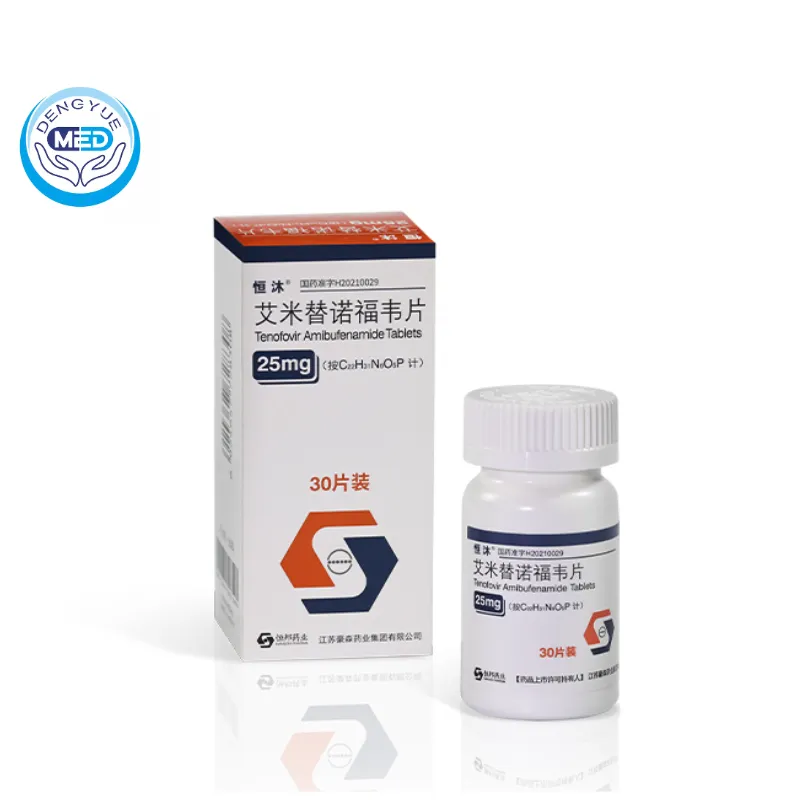
The answer is clear and straightforward: Tenofovir Amibufenamide Tablets (Hengmu®) are used to treat adult patients with chronic hepatitis B (CHB).
Behind this seemingly simple definition lies important medical meaning:
- 🦠 It is designed exclusively for hepatitis B virus (HBV).
Its mechanism precisely targets the replication process of HBV and is purpose-built for this virus. It is not effective against other forms of viral hepatitis, such as hepatitis A or hepatitis C.
- ⌛ It is intended for “chronic” infection.
The drug is indicated for adult patients whose HBV infection has persisted for more than six months, marking the transition to chronic disease.
- 😷 Its goal is “treatment,” not “cure” or “prevention.”
Like all currently available oral antiviral therapies, the core mission of tenofovir amibufenamide is long-term, maximal suppression of HBV replication rather than viral eradication.
By achieving sustained viral suppression, the therapy can:
- Reduce hepatic inflammation and promote recovery of liver function
- Delay or prevent progression to liver fibrosis and cirrhosis
- Significantly lower the risk of hepatocellular carcinoma
- Ultimately manage the disease, improving long-term quality of life and survival
Which Patients Should Initiate Treatment?
Not all HBV carriers require immediate antiviral therapy.
👉 According to the Chinese Guidelines for the Prevention and Treatment of Chronic Hepatitis B, physicians typically consider initiating antiviral treatment—including tenofovir amibufenamide—when patients meet the following key criteria:
- Active viral replication: Persistently elevated serum HBV DNA levels reaching a defined threshold (commonly > 2,000 IU/mL)
- Evidence of significant liver injury, including:
- Persistently abnormal liver function tests (e.g., elevated ALT), indicating ongoing inflammation.
- Findings from liver pathology (such as biopsy) or non-invasive assessments (e.g., transient elastography) showing moderate or greater hepatic inflammation or fibrosis.
❗ For patients who have already progressed to cirrhosis, antiviral therapy is strongly recommended whenever HBV is detectable, regardless of ALT levels, to prevent further disease deterioration.
Therefore, Tenofovir Amibufenamide (Hengmu) assumes a strategic role in long-term health management.
For the broad population of adult patients with chronic hepatitis B who meet treatment indications, it offers a potent yet more reassuring domestically developed core therapeutic option, precisely addressing the dual clinical expectations of robust antiviral efficacy and long-term safety.
Mechanism of Action: The Microscopic Design and Macroscopic Advantages of a “Liver-Targeted Missile”
To understand the unique advantages of Tenofovir Amibufenamide (Hengmu®), a vivid analogy is helpful.
💪 If the liver infected with hepatitis B virus is likened to an “enemy camp” requiring precise clearance, then traditional therapies resemble wide-area artillery fire, whereas Hengmu functions more like a “liver-targeted missile” equipped with an advanced guidance system.
This precision-strike capability originates from its sophisticated molecular design.
Limitations of Traditional Therapies: Systemic Exposure and “Collateral Damage”
Take first-generation tenofovir disoproxil fumarate (TDF, 300 mg/day) as an example.
TDF is a prodrug that, after entering the body, must circulate widely through the systemic bloodstream. Ultimately, only a small fraction reaches the liver, where it is converted within hepatocytes into the active antiviral form.
⚠️ To ensure sufficient drug concentration in the liver to suppress viral replication, relatively high doses are required.
This leads to high systemic exposure—meaning that large amounts of the active compound (tenofovir) remain in the bloodstream and are distributed to non-target tissues such as the kidneys and bones.
- Kidneys: Tenofovir is primarily excreted unchanged via the kidneys. High concentrations may place a burden on renal tubular cells, potentially affecting renal function with long-term use.
- Bones: Tenofovir may interfere with the balance between osteoblasts and osteoclasts, posing a potential risk to bone mineral density over prolonged treatment.
This approach is akin to “flood irrigation”—while adequately watering the target field (the liver), surrounding areas are also submerged, increasing the risk of unnecessary “collateral damage.”
Hengmu’s Upgraded “Black Technology”: Precision Delivery Through Molecular Redesign
Scientists achieved a revolutionary modification of the tenofovir molecular structure, giving rise to tenofovir amibufenamide.
The essence of this innovation lies in the addition of a specialized “navigation module.”

- 1️⃣ Precision Targeting: Efficient Uptake by Hepatocytes
👉 Tenofovir amibufenamide has enhanced lipophilicity and a higher affinity for hepatic transport proteins.
In simple terms, it more easily dissolves into and penetrates hepatocyte membranes and can be actively recognized and transported into liver cells by specific “carriers” (transporters) on the hepatocyte surface.
This is comparable to fitting a missile with a guidance system capable of recognizing the unique features of the “enemy camp,” dramatically increasing both the efficiency and concentration of drug delivery to the liver compared with traditional agents.
- 2️⃣ Efficient Conversion and Intracellular Enrichment: Releasing Potency at the Target Site
Once inside hepatocytes, tenofovir amibufenamide is efficiently and almost completely converted by intracellular enzymes into the active antiviral metabolite, tenofovir diphosphate.
Because cellular uptake is highly efficient, the intracellular concentration of this active compound is very high, enabling powerful inhibition of viral replication. At the same time, this conversion occurs predominantly within hepatocytes, reducing the likelihood of activation in the bloodstream or other tissues.
- 3️⃣ “Low-Dose Precision Strike”: Extremely Low Systemic Exposure
Thanks to this highly efficient “targeting–enrichment” mechanism, tenofovir amibufenamide requires only a very low daily dose (25 mg/day) to achieve intracellular hepatic concentrations comparable to—or even higher than—those achieved with 300 mg of TDF.
This translates into a fundamental advantage: the total amount of parent drug and active metabolites entering systemic circulation—systemic exposure—is dramatically reduced.
This sequence—efficient liver targeting → high intracellular concentration → low dose → low systemic exposure → enhanced safety—forms a complete and coherent logical loop.
It is more than a metaphor; it is a scientifically grounded reality supported by molecular pharmacology and clinical pharmacokinetic data.
Core Identity: Not an Ordinary “Generic,” but a Milestone Innovation
First, it is essential to clearly define the position of Tenofovir Amibufenamide (Hengmu®).
From a pharmacological standpoint, it is classified as a nucleos(t)ide reverse transcriptase inhibitor (NRTI).
Simply put, Tenofovir Amibufenamide works by mimicking the building blocks required for viral replication. When the hepatitis B virus attempts to replicate, these “false materials” are incorporated into the viral DNA chain, causing premature termination of DNA synthesis.
✅ The mechanism is akin to feeding faulty components into a viral assembly line, preventing the production of complete new viruses and thereby effectively controlling disease progression.
However, the true weight of this drug goes far beyond its mechanism of action. To understand what makes it exceptional, two key terms must be considered:
- “Class 1 innovative drug”
- “The first China-developed original oral anti-HBV therapy.”
A Class 1 innovative drug represents the highest level of innovation in China’s drug evaluation system. 🔻
Behind this designation lie years of laboratory screening, sophisticated molecular design, and validation through large-scale clinical trials—reflecting a complete innovation chain, from scientific discovery to clinical application.
The designation “the first China-developed original” carries even greater historical significance. 🔻
Prior to the emergence of Hengmu®, all oral anti-hepatitis B therapies available in China—whether early agents such as lamivudine or later first-line treatments including entecavir, tenofovir disoproxil fumarate (TDF)—were based on core patents and original discoveries originating overseas.
🤔 For decades, Chinese patients relied on imported originator drugs or generics launched after patent expiration.
The approval of Hengmu® therefore marks a defining shift of an era. It breaks through a more than 20-year foreign patent monopoly in this field and achieves a historic transition from imitation to original innovation in oral anti-HBV therapy.
-1132x800.webp "What Are Hengmu Tenofovir Tablets Used For? Indications, Mechanism, and Safety Advantages in Chronic Hepatitis B 4")
Clinical Value: How Effective and How Safe Is It?
Even the most elegant theory must ultimately be validated by clinical trials. Multiple large-scale studies have provided robust and reassuring answers.
Efficacy: Potent Viral Suppression, on Par with First-Line Therapy
In pivotal Phase III clinical trials, tenofovir amibufenamide demonstrated antiviral efficacy comparable to that of established international first-line therapy, namely tenofovir disoproxil fumarate (TDF).
There were no statistically significant differences between the two treatments in terms of:
- The speed of HBV DNA suppression.
- The proportion of patients achieving virological response.
These findings confirm that, with respect to the core therapeutic goals—disease control and delay of disease progression—tenofovir amibufenamide is a reliable and well-validated treatment option.
Safety: Clear Advantages with Long-Term Health in Mind
This is where Hengmu stands out most prominently. Clinical data clearly show:
- Superior renal safety: Data extending to 144 weeks of treatment indicate that changes in key renal function markers, such as estimated glomerular filtration rate (eGFR), were significantly more favorable in patients receiving Hengmu® compared with those on TDF.
✅ For patients who require lifelong therapy—particularly those with existing or potential renal impairment—this represents a meaningful clinical advantage.
- Reduced impact on bone health: Dual-energy X-ray absorptiometry (DXA) assessments revealed that bone mineral density (BMD) decline was significantly smaller in the Hengmu® group than in the TDF group.
✅ This translates into a lower long-term risk of osteoporosis, allowing patients to maintain strength and confidence over time.
- Overall good tolerability: Common adverse events, such as headache or nausea, occurred at low frequencies and were generally mild in severity.
How long should I take Tenofovir Amibufenamide Tablets?
A simple dosing regimen—one tablet once daily, taken with food—helps patients establish consistent medication habits and improves adherence, which is essential for successful long-term antiviral therapy.
Conclusion and Outlook: An Important New Option, Moving Toward a More Precise Future
💊 In summary, the launch of Tenofovir Amibufenamide (Hengmu®) represents a strategic advancement in chronic hepatitis B treatment in China, combining precise liver targeting with potent antiviral efficacy to support long-term quality of life and more personalized, patient-centered care.
As a pharmaceutical distributor in China committed to improving access to innovative therapies, Dengyue plays a role in helping ensure that such high-quality treatment options can reach the patients who need them. By supporting the availability and responsible use of Hengmu, our companiny contributes to translating pharmaceutical innovation into real-world clinical benefit.
Of course, progress in medicine is never final.
😊 The success of Hengmu marks a solid step forward in China’s pharmaceutical innovation journey, inspiring confidence that more advanced and effective therapies will emerge in the future—bringing us ever closer to the ultimate goal of overcoming chronic hepatitis B.
FAQ about What Are Hengmu Tenofovir Tablets Used For?
What is the purpose of taking tenofovir amibufenamidefor hepatitis B?
Tenofovir alafenamide (AF) is used to treat chronic (long term) hepatitis B virus (HBV) infection.
Tenofovir is in a class of medications called nucleoside reverse transcriptase inhibitors (NRTIs).
It works by decreasing the amount of HBV in the blood.
Is there a 100% cure for hepatitis B?
There’s no cure for hepatitis B.
How long will it take to fully recover from hepatitis B?
Acute HBV infection lasts less than six months. Your immune system likely can clear the hepatitis B virus from your body. You should recover fully within a few months.
Can I take tenofovir on an empty stomach?
You may take this medication with or without food. If it upsets your stomach, take it with food.