Is This Spot Dangerous? 5 Critical Melanoma Signs You Must Not Ignore
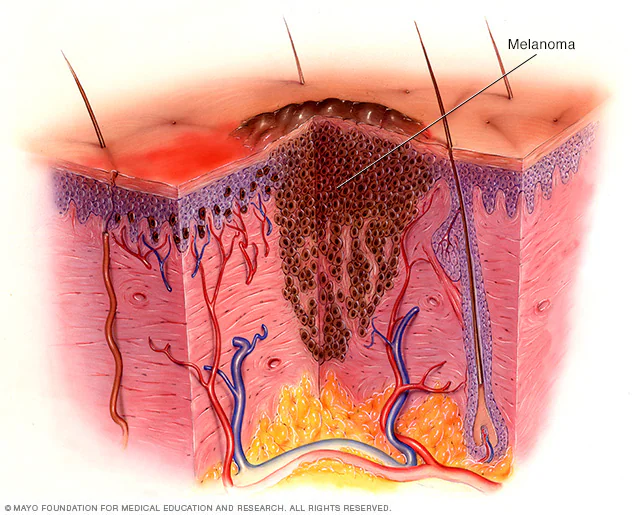
What are 5 Critical Melanoma Signs? When we talk about skin cancer, melanoma is the most serious form. It develops in the melanocytes—the cells that produce the pigment melanin, which gives your skin its color.
While it accounts for only about 1% of skin cancers, melanoma is responsible for the vast majority of skin cancer deaths. Its danger lies in its ability to spread (metastasize) rapidly to other parts of the body if not caught early.
But here is the most crucial message of hope:When detected early, the 5-year survival rate for melanoma is over 99%. The power of early detection lies in your hands. Knowing what warning signs to look for and performing regular self-examinations are your most powerful first line of defense.
Why Is Melanoma So Dangerous?
Understanding the “why” helps us respect the “what.” Unlike some other skin cancers that primarily remain localized, melanoma originates in melanocytes.

These pigment-producing cells are inherently more active and aggressive. If left undetected, melanoma cells can grow downward through the skin layers, eventually penetrating the lymphatic system and bloodstream.
This allows them to travel to and form new tumors in vital organs like the lungs, liver, brain, and bones, making treatment much more challenging.
Key risk factors include:
- A personal or family history of melanoma
- Fair skin that freckles or burns easily
- Having a large number of moles (especially atypical moles)
- A history of severe, blistering sunburns
- Excessive exposure to ultraviolet (UV) radiation from the sun or tanning beds
- A weakened immune system
However, it is vital to understand that anyone can get melanoma, regardless of skin tone, age, or gender.
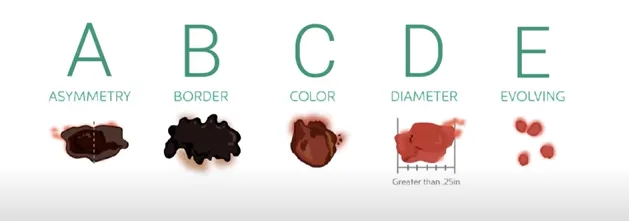
5 Critical Melanoma Signs: The ABCDEs of Melanoma
Think of yourself as a detective. Your job is not to diagnose but to identify “suspects” and bring them to the attention of the expert—your dermatologist. Memorize these five critical criteria.
1. A is for Asymmetry
- What to look for: One half of the mole does not match the other half.
- In-depth explanation: Common, benign moles are typically symmetrical. If you were to draw a line through the center, both sides would be mirror images. Melanomas often begin growing asymmetrically. Visualize a mole where one side is flat and the other is raised, or one side is dark brown while the other is light tan. This lack of balance is a red flag.
- Example: A mole that looks like it has two completely different halves.
2. B is for Border
- What to look for: The edges are irregular, ragged, notched, or blurred.
- In-depth explanation: Benign moles usually have smooth, even borders that are well-defined. Melanomas often exhibit borders that are uneven, scalloped, or poorly demarcated. It may look as if the pigment is “leaking” or “bleeding” into the surrounding skin. This irregularity reflects the uncontrolled, invasive growth pattern of the cancerous cells.
- Example: A mole with edges that are jagged, fuzzy, or have distinct indentations.
3. C is for Color
- What to look for: The color is not uniform throughout. Shades of brown, black, tan, red, white, or blue may be present.
- In-depth explanation:This is one of the most telling signs. A harmless mole is usually a single, solid shade of brown. Melanomas often display a variety of colors or an uneven distribution of color within the same lesion. You might see different shades of brown and black, and sometimes patches of pink, red, white, or blue. This variegation occurs because the tumor cells are producing pigment erratically.
- Example: A mole with a dark black center, a lighter brown periphery, and a random white patch.
4. D is for Diameter
- What to look for: The spot is larger than 6 millimeters across (about the size of a pencil eraser).
- In-depth explanation: While size is a helpful guideline, the context is key: look for change and relative size. Many benign moles can be large from birth (congenital nevi). The critical question is, is it growing? Any mole that is increasing in diameter, even if it’s currently smaller than 6 mm, warrants attention. It’s also important to note that some rare nodular melanomas can be small yet very aggressive, so size should never be the only factor considered.
- Example: A mole you’ve had for years that suddenly starts to enlarge, or a new mole that grows rapidly to become the largest one on your body.
5. E is for Evolving
- What to look for: The mole is changing in size, shape, color, or feel. This is the single most important sign.
- In-depth explanation:Your skin is dynamic, but a common benign mole remains stable over time in adulthood. Any evolution over weeks or months is a major warning sign. This includes:
- Change in size: Noticeable growth.
- Change in shape: Becoming more asymmetrical or irregular.
- Change in color: Darkening, lightening, or appearing multi-colored.
- Change in symptoms: Beginning to itch, crust, flake, bleed, or ooze.
- Change in sensation: Becoming tender, painful, or raised.
- Example: A mole you’ve had for years that suddenly starts to itch persistently or that you accidentally notice is bleeding.
Beyond ABCDE: The “Ugly Duckling” Sign
Another highly effective method for spotting melanoma is the “Ugly Duckling” sign.
Most of your normal moles look similar to each other—they are part of the same “family.” A melanoma often stands out as different; it is the “ugly duckling” that doesn’t belong.
It might be the only mole that is significantly darker, larger, or has a different texture compared to all the others on your body. During your self-exam, take a step back and look for the outlier.
What To Do If You Find A Suspicious Mole
- Don’t Panic: Meeting one or more of the ABCDE criteria does not mean you have cancer. Many benign skin conditions can mimic these signs. However, it is a clear signal to take action.
- Schedule an Appointment Immediately: Do not adopt a “wait and see” approach. Book an appointment with a board-certified dermatologist as soon as possible. Tell them exactly what changes you’ve observed.
- Get a Professional Skin Exam: The dermatologist will examine the spot, often using a device called a dermatoscope. This tool magnifies and illuminates the skin, allowing the doctor to see structures beneath the surface that are invisible to the naked eye, greatly improving diagnostic accuracy.
- Biopsy if Recommended: If the dermatologist is suspicious, they will perform a biopsy. This minor procedure involves numbing the area and removing all or part of the lesion for laboratory analysis. A biopsy is the only definitive way to diagnose melanoma.
Prevention And Early Detection: Your Best Defense
- Perform Monthly Self-Exams: Get familiar with your skin. In a well-lit room, use a full-length mirror and a hand-held mirror to check your entire body systematically. Don’t forget your scalp, between your toes, the soles of your feet, your nails, and your back. Ask a partner or family member for help with hard-to-see areas.
- Get Annual Professional Skin Checks: Even if you find nothing concerning, an annual check-up with a dermatologist is a wise investment in your health. If you are high-risk, your doctor may recommend more frequent visits.
- Practice Sun Safety: This is the most effective way to prevent all skin cancers.
- Use a broad-spectrum sunscreen with an SPF of 30 or higher every single day, even when cloudy. Reapply every two hours, or after swimming or sweating.
- Wear sun-protective clothing, a wide-brimmed hat, and UV-blocking sunglasses.
- Seek shade, especially during peak sun intensity hours (10 a.m. to 4 p.m.).
- Never use tanning beds. They emit harmful UV radiation and are a known carcinogen.
If Diagnosed With Melanoma: Understanding Your Treatment Options
If a biopsy confirms melanoma, do not lose hope. Advances in modern medicine, particularly in targeted therapy and immunotherapy, have revolutionized the melanoma treatment landscape for advanced melanoma.
This is where drugs like Tafinlar (Dabrafenib Mesylate) and Mekinist (Trametinib) come into play.
Approximately half of all melanoma patients have a tumor with a specific genetic mutation known as the BRAF V600 mutation. This mutation acts like a stuck accelerator, driving cancer cells to grow and divide uncontrollably.
Tafinlar (Dabrafenib) is a BRAF inhibitor. It works by targeting and blocking the action of the defective protein created by the mutated BRAF gene.

Tafinlar (Dabrafenib Mesylate) – Melanoma & Lung Cancer | DengYue Medicine
- Generic Name/Brand Name: Dabrafenib Mesylate/Tafinlar
- Indications: NSCLC, Metastatic Melanoma, Solid Tumors, Alone or with Trametinib.
- Dosage Form: Oral Capsules
- Specification: 75 mg x 120 capsules
Mekinist (Trametinib) is a MEK inhibitor. It works by blocking the MEK protein, another related protein in the same cellular growth pathway, downstream from BRAF.

Mekinist (Trametinib) – Melanoma | DengYue Medicine
- Generic Name/Brand Name: Trametinib/Mekinist
- Indications: Melanoma
- Dosage Form: Oral
- Specification: 2 mg (30 tablets)
When used in combination, the Tafinlar + Mekinist (dabrafenib + trametinib) regimen provides a powerful one-two punch, effectively creating a “dual blockade” of the signals that drive cancer growth.
This combination therapy has been proven to significantly shrink tumors, prolong patient survival, and improve quality of life for patients with BRAF V600 mutant stage III (as adjuvant therapy after surgery) and stage IV (metastatic) melanoma.
At Hong Kong DengYue Medicine, we emphasize that your skin is your body’s largest organ and often the first place to signal a problem. Taking a few minutes to learn these signs and perform regular checks could save your life.
FAQ about 5 Critical Melanoma Signs
How does your body feel if you have melanoma?
Hard or swollen lymph nodes. a hard lump on your skin. unexplained pain. feeling very tired or unwell.
Where is the most common spot for melanoma to start?
Melanoma can occur anywhere on the skin, but it is more common on the trunk (chest and back), head or neck in men, and the arms and legs in women. The face is another common site. This section focuses on melanoma that starts in the skin.
Does the sun cause melanoma?
Yes. Ultraviolet (UV) light is the most common cause of melanoma.
Can melanoma be cured?
Most skin cancers can be cured if they’re treated before they have a chance to spread.
However, more advanced cases of melanoma can be fatal. The earlier skin cancer is found and removed, the better your chances for a full recovery.