
Bayer’s Asundexian Approved in China: A Novel FXIa Inhibitor for Stroke Prevention
On October 26, 2026, China’s NMPA approved Bayer’s novel coagulation factor XIa (FXIa) inhibitor, asundexian, to reduce stroke risk in adults following a non-cardioembolic ischemic stroke or high-risk transient ischemic attack (TIA). It is not indicated for cardioembolic stroke.
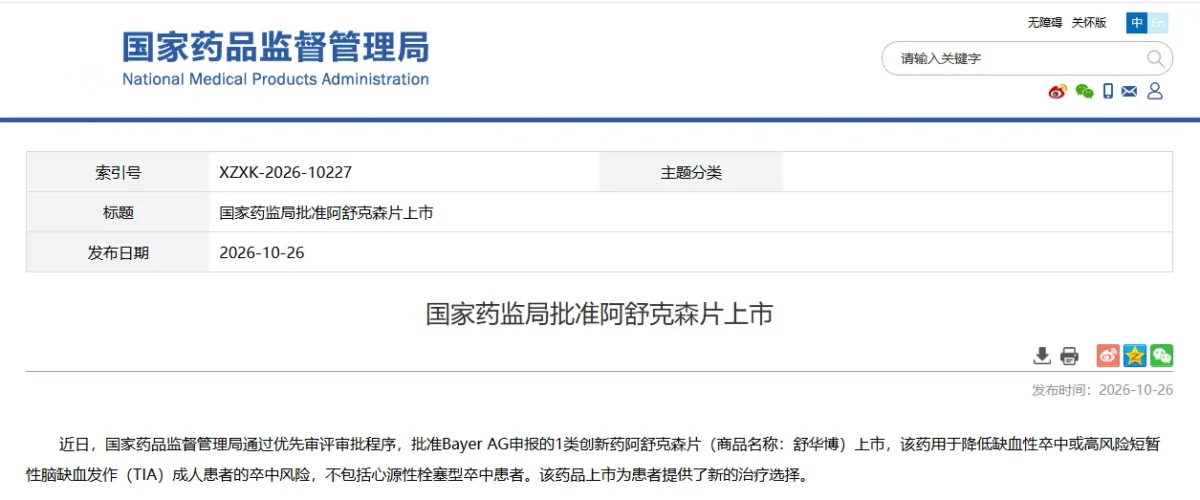
Notably, asundexian entered regulatory review in China, the United States, and Japan in 2026. Asundexian approved in China ahead of these markets gives Chinese patients earlier access to this emerging treatment.
In this article, DengYueMed explores asundexian’s mechanism of action, clinical evidence, and the significance of its approval in China, helping global pharmaceutical partners understand developments in China’s innovative drug landscape and pharmaceutical supply chain.
What Is Asundexian? How Does This Novel FXIa Inhibitor Work?
Asundexian is an oral, small-molecule FXIa inhibitor developed by Bayer.
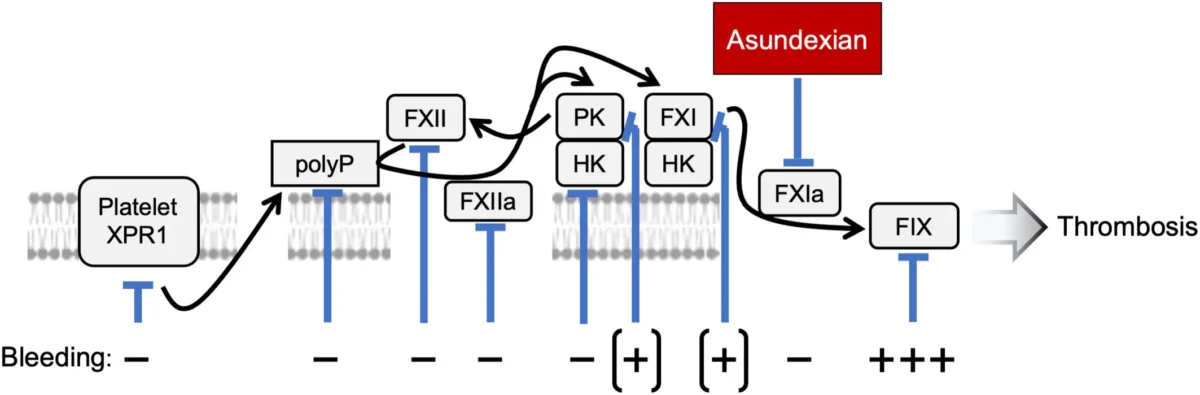
Unlike antiplatelet drugs, which primarily target platelet function, asundexian acts on the coagulation cascade by inhibiting FXIa activity and interfering with the process of pathological thrombus formation.[1,2]
Asundexian: Key Drug Information
| Item | Details |
|---|---|
| Generic name | Asundexian |
| Brand name | Sunharbo® /舒华博® |
| Developer | Bayer |
| Drug type | Oral, small-molecule, selective FXIa inhibitor |
| Target | Coagulation factor XIa (FXIa) |
| Dosage and administration | 50 mg orally once daily |
| China approval date | October 26, 2026 |
| Approved indication | Reduction of stroke risk in adults following a non-cardioembolic ischemic stroke or high-risk transient ischemic attack (TIA) |
| Key clinical trial | Phase III OCEANIC-STROKE |
How Does Asundexian Differ from Traditional Antithrombotic Treatments?
The human coagulation system is involved in both physiological hemostasis following blood vessel injury and pathological thrombus formation.
FXIa is a key factor in the intrinsic coagulation pathway. It contributes to thrombin generation and plays a role in the formation and propagation of blood clots.
Unlike traditional direct oral anticoagulants (DOACs), which primarily target factor Xa (FXa) or thrombin, asundexian selectively inhibits FXIa. This approach aims to reduce pathological clot formation while potentially preserving physiological hemostasis to a greater extent.[1]
| Comparison | Antiplatelet drugs | Traditional direct oral anticoagulants | Asundexian |
|---|---|---|---|
| Primary target | Platelet activation and aggregation pathways | FXa, thrombin, or other coagulation targets | FXIa |
| Main mechanism | Inhibits platelet-mediated thrombus formation | Inhibits the coagulation cascade | Inhibits FXIa-mediated thrombus propagation |
| Treatment role | An important component of secondary prevention for non-cardioembolic stroke | Selected according to stroke etiology and approved indications | May be used alongside antiplatelet therapy in eligible patients |
✨ The potential advantage of FXIa inhibition lies in exploring a better balance between antithrombotic efficacy and physiological hemostasis.
OCEANIC-STROKE Trial: A 26% Relative Reduction in Ischemic Stroke Risk
The asundexian approved in China decision was supported by findings from the global Phase III OCEANIC-STROKE trial.
This international, multicenter, randomized, double-blind, placebo-controlled study enrolled 12,327 patients with non-cardioembolic ischemic stroke or high-risk TIA. The results were published in the New England Journal of Medicine (NEJM).[2]
1. Primary Efficacy Endpoint: Significant Reduction in Ischemic Stroke Risk
Patients received asundexian 50 mg once daily or placebo on top of antiplatelet therapy. The median follow-up period was approximately 19 months.
| Key endpoint | Asundexian group | Placebo group |
|---|---|---|
| Number of patients | 6,162 | 6,165 |
| Incidence of ischemic stroke | 6.2% | 8.4% |
| Hazard ratio (HR) | 0.74 | Reference |
| 95% confidence interval | 0.65–0.84 | — |
| Relative risk reduction | 26% | — |
The incidence of ischemic stroke was significantly lower in the asundexian group than in the placebo group (P<0.001), corresponding to a 26% relative risk reduction. These findings provide important clinical evidence supporting the use of FXIa inhibition for secondary stroke prevention.
2. Severity of Recurrent Stroke
Further analyses examined stroke severity among patients who experienced a recurrent stroke.
The proportion of patients whose highest in-hospital National Institutes of Health Stroke Scale (NIHSS) score was ≥8 was 22.9% in the asundexian group, compared with 30.3% in the placebo group. The proportions with a highest NIHSS score of ≤3 were 44.3% and 40.9%, respectively.
In addition, the incidence of disabling or fatal stroke was 2.1% in the asundexian group and 3.0% in the placebo group (HR 0.69; 95% CI 0.55–0.87).
3. Safety Results: No Statistically Significant Difference in Major Bleeding
| Key endpoint | Asundexian group | Placebo group |
|---|---|---|
| Incidence of ISTH major bleeding | 1.9% | 1.7% |
| Hazard ratio (HR) | 1.10 | Reference |
| 95% confidence interval | 0.85–1.44 | — |
| P value | 0.46 | — |
There was no statistically significant difference in the incidence of major bleeding between the two groups.
✨ Overall, the trial showed that adding asundexian to antiplatelet therapy reduced the risk of ischemic stroke, while the primary major bleeding endpoint did not show a statistically significant difference between the treatment groups.
Asundexian Approved in China: What Does It Mean for Secondary Stroke Prevention?
Even with standard secondary prevention treatment, patients with non-cardioembolic ischemic stroke may remain at risk of recurrence. Reducing the risk of ischemic events while maintaining an acceptable bleeding safety profile remains an important clinical challenge.
Asundexian approved in China provides a new treatment option for secondary stroke prevention.

The significance of this approval can be considered from three perspectives.
First, it expands the range of antithrombotic mechanisms. Asundexian targets FXIa, a mechanism distinct from that of antiplatelet drugs. The OCEANIC-STROKE trial provides clinical evidence for adding an FXIa inhibitor to antiplatelet therapy in the studied patient population.
Second, global and Chinese subgroup findings provide complementary evidence. Ischemic stroke risk fell by 26% globally and 32% in the Chinese subgroup. These findings demonstrate consistent reductions in ischemic stroke risk across the global study population and the Chinese subgroup.
Third, it introduces a new treatment option for clinical practice in China. Asundexian received approval through China’s priority review pathway, highlighting the regulatory system’s support for innovative treatments addressing clinical needs.
Conclusion
With asundexian approved in China, a new antithrombotic treatment option is available for secondary stroke prevention.
As China’s innovative drug development and regulatory approval landscape continues to evolve, global pharmaceutical companies, drug distributors, and healthcare institutions are paying increasing attention to China’s pharmaceutical resources and supply chains.
Hong Kong-based DengYueMed specializes in pharmaceutical wholesale, import, export, and supply chain services. Through our China pharmacy platform, DengYueRX, we help international partners explore China’s pharmaceutical resources and supply opportunities.

Explore Our Global Pharmaceutical Solutions
FAQ about Asundexian Approved in China
What is asundexian, and how does it work?
Asundexian is an oral, selective factor XIa (FXIa) inhibitor developed by Bayer that targets the coagulation cascade to reduce pathological clot formation.
What is asundexian approved for in China?
Asundexian is approved in China to reduce stroke risk in adults following a non-cardioembolic ischemic stroke or high-risk transient ischemic attack (TIA).
What were the key results of the OCEANIC-STROKE trial?
The Phase III OCEANIC-STROKE trial found that asundexian reduced the relative risk of ischemic stroke by 26% compared with placebo when added to antiplatelet therapy.
Does asundexian increase the risk of major bleeding?
The OCEANIC-STROKE trial found no statistically significant difference in major bleeding between the asundexian and placebo groups, although bleeding risk remains an important safety consideration.
What is the recommended dosage of asundexian?
In the OCEANIC-STROKE trial, asundexian was administered orally at 50 mg once daily alongside antiplatelet therapy.
References
[1] Bayer. Asundexian first Factor XIa inhibitor approved in China for stroke risk reduction after priority review. October 26, 2026.
https://www.bayer.com/media/en-us/asundexian-first-factor-xia-inhibitor-approved-in-china-for-stroke-risk-reduction-after-priority-review/
[2] Sharma M, et al., for the OCEANIC-STROKE Investigators. Asundexian for Secondary Stroke Prevention. New England Journal of Medicine. 2026;394:1467–1479.
https://www.nejm.org/doi/full/10.1056/NEJMoa2513880