

China Pharmaceutical Imports: Market Reshapes with Structural Adjustments Deepening
Imports fell by 3.9%; high-end medical equipment imports contracted across the board, while API imports bucked the trend with a 15.3% surge—these figures from the first half of 2025 paint a picture of profound industrial restructuring in China pharmaceutical imports market.
In the first half of 2025, China’s pharmaceutical product imports totaled $43.41 billion, a year-on-year decrease of 3.9%.
Against this backdrop, imports of prepared Western medicines saw a marginal increase of 1.2%, while active pharmaceutical ingredient (API) imports rose significantly by 15.3%.
This contrast between decline and growth underscores a delicate balance in the Chinese pharmaceutical market, caught between accelerating domestic substitution and persistent reliance on high-end manufacturing.
For pharmaceutical distributors, this presents both an unprecedented challenge and a transformative opportunity.
Market Overview: Volume Contraction and Structural Divergence
In the first half of 2025, China’s total pharmaceutical import and export value reached $97.95 billion. Of this, imports accounted for $43.41 billion, down 3.9% year-on-year, continuing the contraction trend from Q1 2025.
Medical device imports fell across the board, dropping 3.9% to $16.99 billion.
The decline was particularly sharp for high-end medical equipment: MRI scanner imports fell 38.1%, renal dialysis equipment dropped 36.6%, and artificial joint imports decreased by 22.8%.
Western medicine products, a major component of pharmaceutical imports, saw imports of $24.99 billion in H1, down 3.9% year-on-year.
Imports of prepared Western medicines reached $11.17 billion, a slight increase of 1.2%, characterized by “volume growth and price decline”—import volume grew 8.2%, while average import price fell 7%.
Biochemical drug imports were $7.86 billion, down 19.7% year-on-year, with both import volume and average price falling by 6.1% and 14.5%, respectively.
Notably, human vaccine imports plummeted by 82.4%, with import volume and average price crashing 71.1% and 39.2%, respectively.
Structural Shifts: Overall Contraction with Selective Growth
Against the backdrop of overall import contraction, different product categories showed varied performance, reflecting structural market changes.
The comprehensive decline in medical device imports was most noticeable in high-end equipment.
- 🩺 Hospital diagnosis and treatment equipment imports fell 7.01%. Beyond the previously mentioned categories, imports of in vitro diagnostic reagents dropped 19.4%, and X-ray application equipment decreased by 30.6%.
Western API imports defied the trend, becoming a market highlight.
- 💊 In the first half of the year, API import value increased 15.3% year-on-year. Among these, peptide hormones and their derivatives reached $1.41 billion in import value, growing 14.9%.
The pharmaceutical import market diverged, with prepared Western medicines and biochemical drugs moving in opposite directions.
- 🧬Prepared Western medicine imports reached $11.17 billion, up 1.2% year-on-year, mainly driven by import volume growth. Meanwhile, biochemical drug imports were $7.86 billion, down 19.7% year-on-year, with both volume and price declining.

Driving Forces: Domestic Substitution and Evolving Demand
The changes in China pharmaceutical import market result from multiple interacting factors.
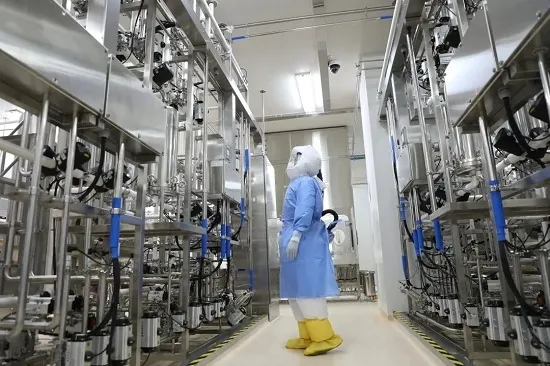
Domestic industry upgrades have improved Chinese-made high-end medical equipment and technology, gradually replacing imported products.
The across-the-board decline in medical device imports reflects Chinese companies’ continuous breakthroughs in high-end equipment manufacturing.
- The normalization of volume-based procurement policies has significantly impacted market structure.
Since the national centralized procurement policy began in 2018, 435 drugs have been included in the procurement program, compressing drug prices through a “volume-for-price” mechanism.
- Changing demand structures are guiding import adjustments.
The 14.9% growth in peptide hormone API imports reflects increasing market demand for new therapeutic drugs like GLP-1 receptor agonists.
Meanwhile, the sharp 82.4% drop in human vaccine imports is partly due to inventory adjustments for imported HPV vaccines and intensified competition from domestic vaccine alternatives.
- Changing external conditions have also affected the import landscape.
Affected by US tariff policies, imports of preparations from the US fell 54.3% and 59.6% in April and May respectively, prompting companies to increase procurement from alternative markets like Germany and Japan.
Regional Patterns: Diversified Import Markets Emerging
From a regional perspective, China pharmaceutical import markets shows a trend toward diversification.
- The EU and UK remain China’s largest source of pharmaceutical imports. 👉 In the first half of 2025, imports from the EU and UK reached $21.86 billion, though this represented a decrease of 8.3% year-on-year.
- The United States, as an important source of pharmaceutical products, saw imports from the US reach $7.17 billion in the first half, down 3.2% year-on-year. 👉Notably, the US became the top market for biochemical drug imports, with import value increasing 2.8% year-on-year.
- ASEAN markets showed impressive import performance, with H1 imports from ASEAN reaching $2.57 billion, up 12.4% year-on-year. 👉Imports from Belt and Road countries grew significantly, reaching $7.88 billion in the first half, a 9.7% increase year-on-year.
Future Outlook: Structural Adjustment Continues, Distributors’ Role Evolves
Looking ahead, the structural adjustment of China pharmaceutical imports market will continue irreversibly.
In this context, the value of pharmaceutical distributors is being redefined.
They are no longer simple logistics “carriers” but are evolving into “integrated supply chain service providers.”
Addressing Changes: Leading Distributors’ Three Breakthrough Strategies
- High-end Product Specialized Operation Capability
- Deeply Penetrated Omni-channel Network
- Data-Driven Supply Chain Coordination Capability
👉 For more information about the Chinese pharmaceutical market, please following this article. 🔻
About DengYue Medicine
Authoritative Compliance and Trust
As an enterprise fully licensed by the Hong Kong Department of Health for import, export, and wholesale, Dengyue operates with complete legality and transparency.
This foundational commitment to compliance builds a solid bedrock of trust for all international partnerships.

Comprehensive End-to-End Service
Dengyue is a true full-service partner.
Their capabilities encompass global sourcing, import/export customs clearance, warehousing, and market distribution.
Clients can simplify their operations by dealing with a single, accountable partner for all their cross-border pharmaceutical needs.
Stable and Reliable Supply Network
The company has forged strong, direct partnerships with numerous renowned pharmaceutical manufacturers globally.
This ensures that all products are sourced from legitimate and reliable origins, eliminating quality risks and guaranteeing clients a consistent supply of high-quality medications.

Industry Prospects: Import Market Transformation and Distribution Value Chain Restructuring
The transformation of China pharmaceutical imports market validates the transition logic from “capital-driven” to “value creation.”
As domestic demand continues to be released, the policy system improves, and R&D capabilities advance, this sector is moving from “single-point breakthroughs” to “systematic leadership.”
The future will see China’s pharmaceutical import market continue its structural adjustment trajectory.
Import substitution for medical devices will deepen, but dependence on imported biologics, anti-cancer drugs, and other high-end products will persist.
For pharmaceutical distribution companies, only by transforming from traditional “distributors” to “marketers,” shifting from simple logistics channel delivery to service procurement and control of healthcare endpoints, can they win new development opportunities during this historic transition period.
FAQ about China Pharmaceutical Imports
Who is China’s No. 1 importer?
The top China importing countries are Taiwan, United States, South Korea, Japan, and Australia.
Which country is No. 1 in import?
The United States.
What are cheap imports?
A high amount of cheap imports is a situation where consumers start buying foreign-made products instead of domestic products in large numbers.
This caused the nation’s GDP to fall by up to 12% and upset the country’s trade unionists.
Does China have ARVs?
Whereas only domestically produced ARV drugs were initially available in China, after the relatively recent addition of imported 3TC, the recommended D4T + 3TC + NVP combination has become the most common regimen, received by 56% of the cohort.