
On November 12, 2026, NMPA approved the marketing of imipenem-cilastatin-funobactam for injection, an innovative antibiotic independently developed by Evopoint Biosciences. The drug is indicated for the treatment of hospital-acquired bacterial pneumonia (HABP) and ventilator-associated bacterial pneumonia (VABP).[1]
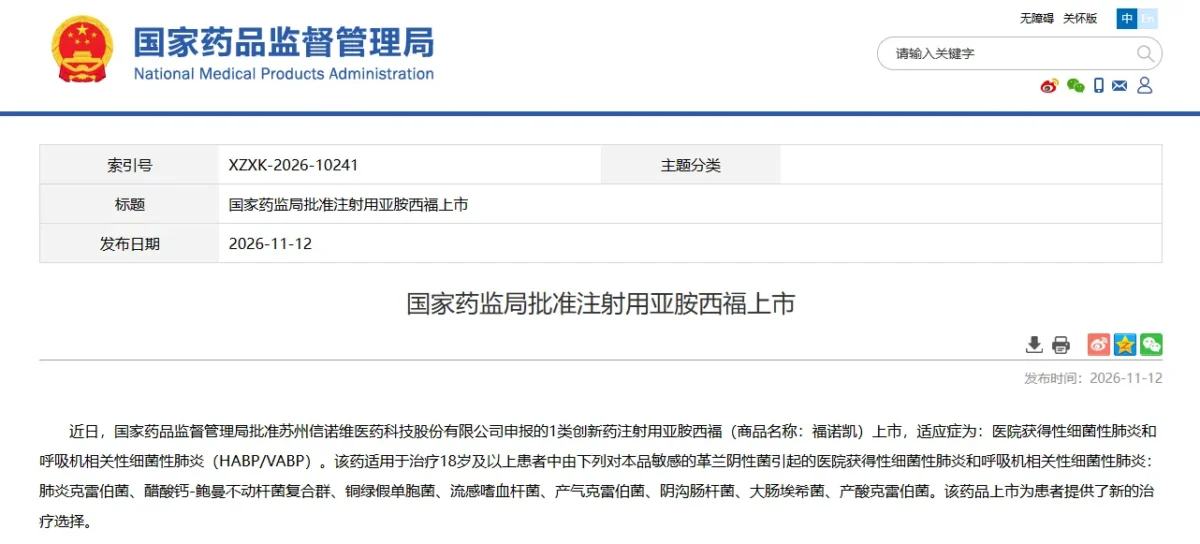
Imipenem-cilastatin-funobactam is described as the world’s first Class 1 innovative drug in the β-lactam/β-lactamase inhibitor (BL/BLI) combination category with broad-spectrum antibacterial activity against three major groups of carbapenem-resistant Gram-negative bacilli (CRO).
In this article, DengYueMed explores the background behind China approves imipenem-cilastatin-funobactam, including the drug’s development features, approved indications, clinical study results, and significance in addressing drug-resistant bacterial infections.
Basic Information and Approved Indications of Imipenem-Cilastatin-Funobactam
Imipenem-cilastatin-funobactam is the first innovative drug approved for marketing by Evopoint Biosciences. Its approval also introduces a new antibacterial treatment option for patients with hospital-acquired pneumonia in China.

| Category | Information |
|---|---|
| Generic Name | Imipenem-Cilastatin-Funobactam |
| Brand Name | 福诺凯®/Funuokai® |
| Developer | Suzhou Evopoint Biosciences Co., Ltd. |
| Drug Class | β-lactam/β-lactamase inhibitor (BL/BLI) combination |
| Drug Type | Class 1 innovative chemical drug |
| Approval Date | November 12, 2026 |
| Regulatory Authority | China National Medical Products Administration (NMPA) |
| Approved Indications | HABP/VABP |
| Eligible Population | Adults aged 18 years and older |
According to the indications published by the NMPA, imipenem-cilastatin-funobactam is indicated for HABP and VABP caused by the following Gram-negative bacteria that are susceptible to the drug: 🔽
- Klebsiella pneumoniae
- Acinetobacter calcoaceticus–baumannii complex
- Pseudomonas aeruginosa
- Haemophilus influenzae
- Klebsiella aerogenes
- Enterobacter cloacae
- Escherichia coli
- Klebsiella oxytoca
China approves imipenem-cilastatin-funobactam, specifically for HABP and VABP caused by susceptible bacterial pathogens, reflecting its development focus on serious bacterial infections in hospital settings.
HABP and VABP: Treatment Challenges Posed by Carbapenem-Resistant Bacteria

Hospital-acquired bacterial pneumonia (HABP) generally refers to pneumonia that develops 48 hours or more after hospital admission. Ventilator-associated bacterial pneumonia (VABP) is a pulmonary infection that occurs in patients receiving mechanical ventilation.
Acinetobacter baumannii, Pseudomonas aeruginosa, and Klebsiella pneumoniae are among the important pathogens associated with these infections.
Relevant epidemiological data from Chinese hospitals show that A. baumannii accounts for approximately 16.2%–35.8% of HABP cases, P. aeruginosa for 16.9%–22%, and K. pneumoniae for 8.3%–15.3%. In VABP, the proportion of A. baumannii can reach 35.7%–50%.
Meanwhile, carbapenem resistance further complicates treatment:
| Resistant Bacteria | Carbapenem Resistance Rate |
|---|---|
| CRAB | Approximately 60%–70% |
| CRPA | Approximately 20%–40% |
| CRKP | Approximately 22%–25% |
Infections caused by resistant Gram-negative bacteria can limit conventional antibiotic treatment options. Therefore, developing new drugs with targeted antibacterial activity is important for expanding treatment options for hospital-acquired infections.
Novel Development Features: Targeting Three Major Carbapenem-Resistant Bacterial Groups
Imipenem-cilastatin-funobactam adopts a β-lactam/β-lactamase inhibitor (BL/BLI) combination design. By combining an antibacterial agent with a β-lactamase inhibitor, the formulation is designed to address treatment challenges associated with bacterial resistance mechanisms.
The three major groups of resistant bacteria targeted in its development include:
1. Carbapenem-Resistant Acinetobacter baumannii (CRAB)
CRAB is one of the multidrug-resistant Gram-negative bacteria of major concern in hospital-acquired infections. It is commonly encountered in intensive care units and can cause serious infections, including pneumonia and bloodstream infections.
Its complex resistance mechanisms make treatment particularly challenging.
2. Carbapenem-Resistant Enterobacterales (CRE)
CRE refers to a group of Enterobacterales that are resistant to carbapenem antibiotics, including certain strains of Klebsiella pneumoniae and Escherichia coli. These bacteria can cause pneumonia, urinary tract infections, and bloodstream infections.
Their spread and clinical management remain important issues in global antimicrobial resistance control.
3. Carbapenem-Resistant Pseudomonas aeruginosa (CRPA)
Pseudomonas aeruginosa is an important pathogen in hospital-acquired infections, particularly among patients receiving mechanical ventilation, those with impaired immune function, and those requiring prolonged hospitalization. Carbapenem resistance further increases the complexity of treating related infections.
The World Health Organization (WHO) has included these three groups of resistant pathogens among its priority concerns.[2]
By focusing on these important resistant bacteria, imipenem-cilastatin-funobactam reflects the development direction of novel BL/BLI combinations for addressing complex Gram-negative bacterial infections.
Phase III Clinical Study: REITAB-2 Demonstrates Clinical Performance
The clinical evidence supporting China approves imipenem-cilastatin-funobactam comes from the XNW4107-302 international multicenter Phase III clinical study, also known as REITAB-2.[3,4]
The study primarily evaluated the efficacy and safety of imipenem-cilastatin-funobactam in patients with hospital-acquired bacterial pneumonia and ventilator-associated bacterial pneumonia, using imipenem-cilastatin-relebactam as the comparator.
The results showed that the day-14 all-cause mortality rate was 3.0% in the imipenem-cilastatin-funobactam group and 2.7% in the imipenem-cilastatin-relebactam group. Imipenem-cilastatin-funobactam met the study’s prespecified non-inferiority endpoint.
In terms of safety, imipenem-cilastatin-funobactam was generally well tolerated, with a safety profile consistent with expectations.
The REITAB-2 results provide clinical evidence supporting the use of imipenem-cilastatin-funobactam in patients with HABP and VABP and formed an important part of the clinical evidence supporting its approval by China’s NMPA.
Significance of the Approval: A New Development in China’s Innovative Antibiotic Research
China approves imipenem-cilastatin-funobactam, marking progress in several important areas of antibiotic development and the treatment of drug-resistant bacterial infections.
1. Expanding treatment options for HABP and VABP
Hospital-acquired bacterial pneumonia and ventilator-associated bacterial pneumonia involve various Gram-negative pathogens, and some patients may face infections caused by carbapenem-resistant bacteria.
The approval provides a new antibacterial treatment option for adult patients who meet the approved indications and susceptibility criteria.
2. Advancing innovative antibiotic development in China
As Evopoint Biosciences’ first innovative drug to receive marketing approval, imipenem-cilastatin-funobactam focuses on three major groups of carbapenem-resistant Gram-negative bacteria.
Its development reflects ongoing efforts by Chinese pharmaceutical companies to address complex bacterial resistance challenges.
3. Providing a new reference for global research into resistant bacterial infections
As global attention to antimicrobial resistance continues to grow, innovative antibiotics and combination formulations with targeted antibacterial activity remain an important area of research.
The approval of imipenem-cilastatin-funobactam in China also provides another example for the international pharmaceutical industry to follow developments in China’s antibiotic research sector.
Conclusion
China approves imipenem-cilastatin-funobactam, marking new progress in China’s anti-infective drug research through its focus on three major groups of carbapenem-resistant Gram-negative bacteria and supportive Phase III clinical results.
As China’s innovative pharmaceutical sector and international pharmaceutical supply chains continue to develop, global pharmaceutical companies, drug distributors, and healthcare institutions are paying increasing attention to China’s pharmaceutical market and supply resources.
Hong Kong DengYueMed provides pharmaceutical procurement, import-export, and supply chain support for pharmaceutical companies, distributors, and healthcare institutions worldwide, while following developments in China’s innovative and specialty medicines.

Explore China’s Pharmaceutical Supply Chain
FAQ about China Approves Imipenem-Cilastatin-Funobactam
What is imipenem-cilastatin-funobactam?
Imipenem-cilastatin-funobactam is a novel β-lactam/β-lactamase inhibitor (BL/BLI) combination antibiotic developed by Evopoint Biosciences. It is designed to provide broad-spectrum activity against major carbapenem-resistant Gram-negative pathogens.
What infections is imipenem-cilastatin-funobactam approved to treat in China?
China’s NMPA approved imipenem-cilastatin-funobactam for adults with hospital-acquired bacterial pneumonia (HABP) and ventilator-associated bacterial pneumonia (VABP) caused by susceptible bacteria.
Which drug-resistant bacteria does imipenem-cilastatin-funobactam target?
The drug was developed to address three major groups of carbapenem-resistant Gram-negative pathogens: carbapenem-resistant Acinetobacter baumannii (CRAB), carbapenem-resistant Enterobacterales (CRE), and carbapenem-resistant Pseudomonas aeruginosa (CRPA).
What clinical evidence supports the approval of imipenem-cilastatin-funobactam in China?
Its approval was supported by the Phase III REITAB-2 study (XNW4107-302), which evaluated the drug in patients with HABP or VABP. The study met its prespecified non-inferiority endpoint for day-14 all-cause mortality.
Why is the approval of imipenem-cilastatin-funobactam significant?
The approval represents progress in China’s development of innovative antibiotics targeting serious drug-resistant bacterial infections, particularly those caused by carbapenem-resistant Gram-negative pathogens.
References
- National Medical Products Administration (NMPA), China. NMPA Approves Imipenem-Cilastatin-Funobactam for Marketing. November 12, 2026. https://www.nmpa.gov.cn/zhuanti/cxylqx/cxypxx/20261112142043188.html
- World Health Organization. WHO Bacterial Priority Pathogens List, 2024. May 17, 2024. https://www.who.int/publications/i/item/9789240093461
- The Lancet Infectious Diseases. Imipenem–cilastatin–funobactam versus imipenem–cilastatin–relebactam in patients with hospital-acquired bacterial pneumonia or ventilator-associated bacterial pneumonia: a phase 3, double-blind, non-inferiority randomised trial. November 4, 2026. https://doi.org/10.1016/S1473-3099(26)00520-7
- ClinicalTrials.gov. REITAB-2: NCT05204563. https://clinicaltrials.gov/study/NCT05204563