

New Breakthrough in Breast Cancer Treatment: CDK4/6 Inhibitor Pipeline Expands in China
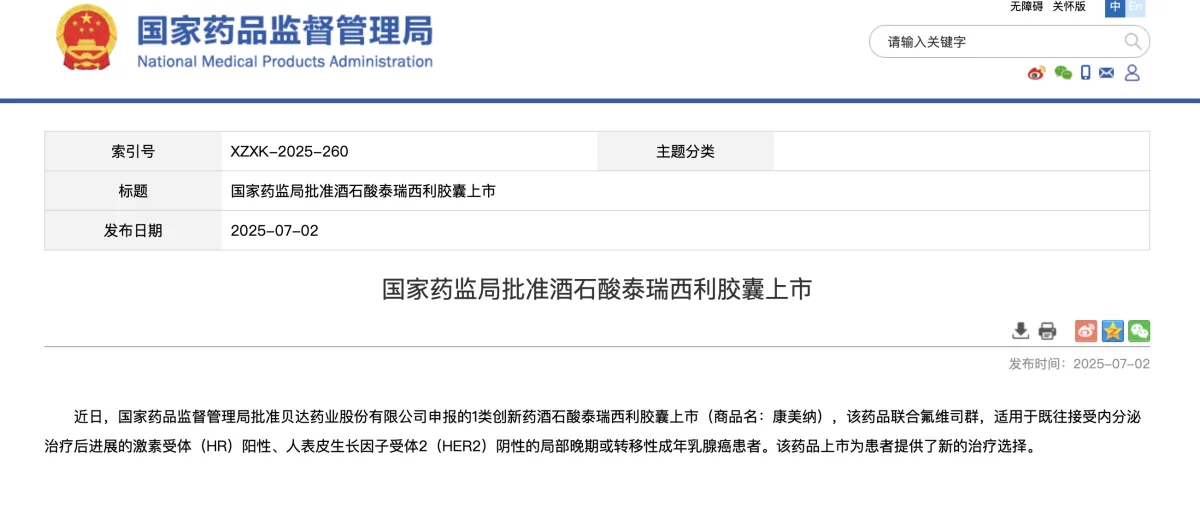
On July 2, Betta Pharmaceuticals announced that its Class 1 innovative drug Terixilib Tartrate Capsules (brand name: Comenat®) has been officially approved by the National Medical Products Administration (NMPA).
In combination with fulvestrant, the drug is indicated for the treatment of hormone receptor-positive, HER2-negative (HR+/HER2-) locally advanced or metastatic breast cancer in adult patients.
Clinical Evidence
The approval was supported by data from a multicenter, randomized, double-blind Phase III clinical trial (BTP-66732), which enrolled 274 patients. Results showed that terixilib plus fulvestrant significantly improved progression-free survival (PFS) compared with placebo.
In addition, Phase I data confirmed both the safety and anti-tumor activity of the regimen, with an objective response rate (ORR) of 53.8%, a disease control rate (DCR) of 87.2%, and a median PFS of 17 months.
Expanding CDK4/6 Inhibitor Options in China
With the approval of terixilib, there are now eight CDK4/6 inhibitors available in China for HR+/HER2- breast cancer treatment, covering a broad range of treatment scenarios from first-line endocrine therapy to later-line interventions.
- Reimbursed drugs: palbociclib, abemaciclib, dalpiciclib, ribociclib
- Newly approved agents: lerociclib, fuvociclib, pyrotociclib, terixilib
Among them, abemaciclib and ribociclib are already approved for early-stage breast cancer treatment, while dalpiciclib is expected to join based on promising data from the DAWNA-A study.
Safety Profile
Common adverse events of CDK4/6 inhibitors include:
- Neutropenia
- Diarrhea (particularly with abemaciclib)
- Liver enzyme elevations
- QT prolongation (more frequent with ribociclib)
- Venous thromboembolism
- Skin-related effects such as rash, alopecia, and pruritus
Most side effects are manageable with appropriate monitoring and timely interventions.
Breast Cancer Treatment Outlook
Beyond CDK4/6 inhibitors, innovation in endocrine therapy continues. The first-in-class PROTAC drug, Vepdegestrant, has recently been submitted to the U.S. FDA for approval, and is anticipated to provide a novel therapeutic option for HR+ breast cancer patients.
💡 DengYueMed Insight:
The landscape of breast cancer therapy is rapidly evolving. The continuous approval of innovative drugs not only enriches treatment options but also brings renewed hope for improved survival and potential cure for patients worldwide.